Monday, 12 April 2021

Gender Inclusivity Workshop

The Department of Sociology and Social Work Association of CHRIST (Deemed to be University) on 13th April 2021 from 4:00 pm to 6.00 pm, initiated and organized the first workshop of the Equality, Diversity & Inclusivity Unit, under the Gender and Sexuality Cell on the Topic “Gender Inclusivity”.

The workshop was conducted by Dr Ivan John who is a professor at Sophia College (Autonomous), Mumbai. He is an active part of the LGBT+ movement in Mumbai, and he was awarded a PhD in Sociology from Mumbai University on the topic “Gay Movement with reference to Mumbai’. Currently, he is working towards a doctorate in Education ~ with a focus on Gender Inclusivity in Education. He identifies as queer and is an activist, especially in academic spaces.

Dr Ivan John had an extremely interactive session with students who are a part of the Gender and Sexuality Cell, his insights were extremely enriching and informative and it provided a clear picture of what the concept of Gender Inclusivity, sexuality and diversity means. The session was moderated by Ahana Mukherjee 2MSoc.

After the introduction, Dr Ivan chose to begin with a question & answer session, which was followed by a clear discussion of what exactly the concepts of inclusivity, sexuality and diversity entail. The session began with an introduction to the concepts of gender and sex which was clearly elaborated by him, followed by getting a deeper understanding of the spectrum of LGBT+ people. He spoke about binaries, and how the myth of gender binaries needs to be resolved as people need to learn how to embrace diversity and fluidity. He explained the concept of "coming out". He addressed these concepts in a compassionate and inclusive manner so that everyone could understand these complex concepts. The workshop included an interactive session. Students asked several questions based on gender inclusivity which gave better clarity and understanding of these concepts. Hence, this session was extremely helpful and informative in nature and was appreciated by everyone who participated.


Thursday, 8 April 2021

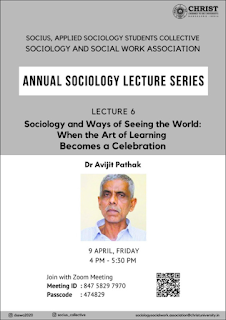
Annual Sociology Lecture Series - Lecture 6: Sociology and Ways of Seeing the World: When the Art of Learning becomes a Celebration

Socius (Applied Sociology Students Collective) and the Department of Sociology and Social Work Association of CHRIST (Deemed to be University) organized an Online Annual Lectures series starting from the 18th of March to 9th April. Some of the top sociologists, academicians, and researchers in the country joined the event. Dr Avijith Pathak addressed the topic ‘Sociology and the Ways of Seeing the World: When the Art of Learning Becomes a Celebration’ on the 9th of April from 4 P.M to 5:30 P.M.

Mr Pathak began the session with how students should understand the word “celebration” in relation to academics. Sometimes it doesn’t excite the students as education is viewed as an ultimate compulsion and learning is more celebrated. According to Mr Pathak, through our own educational experiences, we can see how the entire education system has faults. Later he addressed questions on how there arises an understanding education system such as what it means to pursue humanities or sociology in a world of commerce, economics and other superior subjects. Unlike techno-science, subjects like the social sciences, humanities and related subjects produce emancipation over domination. Mr Pathak spoke extensively on how sociology is seen as a subject of science but by not being technical, we are able to understand subjectivity which brings empathy, unlike techno-science subjects.

Mr Pathak concluded the session by talking about how we can keep the windows of consciousness open. The session was ended with interactive questions and answers.


Roundtable 5 - Resistance Against Substance Abuse: The Need for Youth Action

 The Roundtable Series held by the Department of Sociology and Social Work Association conducted its fifth session on the 8th of April 2021, Thursday,  from 4:00 to 5:30 pm. The event began with an introductory note by Keshavi, following which a new Initiative by the Sociology and Social Work Association- CASA (Christites against Substance Abuse) was announced. This initiative is undertaken with the vision to contribute towards creating and maintaining a campus environment that is free from substance abuse. CASA is committed to its mission of building an active community of volunteers, peer educators, faculties experts, and counsellors dedicated to raising awareness about issues involving substance. Keshavi further invited faculty members Amaresha C Sir and Reenamerin Cherian Ma'am to share their views on Substance Abuse.

Pooja, the event moderator, took over the event and introduced the panellists for the day. They were Laksheta from MSW HR, Gokul Nair from 2PSEco, Harangal from 4PSEco, and Bhanu Bhasin from MA Sociology. Laksheta brought up multiple arguments and questions regarding awareness and the amount of awareness. She further says that information should strictly be controlled according to ethical considerations.

Afterwards, Gokul Nair from 2PSEco was invited to talk about his views on substance abuse. He started with the technical uses of drugs that comply with recreational uses and meditational uses and how it has specific dosages in which it is helpful to us. His main argument revolved around how peer pressure turns someone into a hole of substance. He looked at both sides of peer pressure and how it can be good and bad.

The next panellist was Harshal from 4PSEco, who talked about the psychological aspect of substance abuse. In his pitch, he says that you feel a certain way, which you would not have felt otherwise when you ingest some drug into your body. He further categorizes drugs into four different categories and expands the conversation into what those drugs do. At last, Bhanu from MA Sociology shared his thoughts on the policy aspects of substance abuse. He stated that India needs strict imposition of the existing laws which are kept there to avoid giving young people access to substances like tobacco. In the end, panellists were invited to give their concluding remarks on the topic. Dr Victor Paul was called upon the screen to give his remarks on the whole event. The event went into a question and answer session where the audience (students) asked respective questions to the panellists. The guidance and support of the faculties worked along with the foundation to make the event a success.

Monday, 5 April 2021

Annual Sociology Lecture Series - Lecture 5: Adi Sankara's Soundariya Lahiri and Solomon's Song of Songs : The Questions of History, Myth, and Legend

 The fifth lecture of the Annual Sociology Lecture series was organized on 6th April 2021 by Socius and DSSWA. The lecture was delivered by Dr Susan Visvanathan on the topic ‘Adi Sankara’s Soundariya Lahiri and Solomon’s Song of Songs: The Questions of History, Myth and Legend’.

Pooja welcomed the gathering and introduced our esteemed speaker.

Dr Susan gave a functional analysis of the stories of Sankaracharya and Solomon’s Song of Songs. She discussed the methodological challenges in studying myth and mythology, the relevance of myths and legends in understanding Indian history and society, and the rising popularity of mythology-inspired works in the past decade. The discussion on patriarchy and the representation of women in mythology was another interesting aspect of the lecture.

The lecture was followed by a Q&A session where Dr Susan also elaborated on the methodological challenges in studying myth and mythology. She gave examples of scholars like Mircea Eliade, who has made immense contributions to the field of religious studies.

The session concluded with a vote of thanks by Archana.


Friday, 2 April 2021

SDG Quiz

 The Sustainable Development Goals are a collection of 17 interlinked global goals. It serves as a "blueprint to achieve a better and more sustainable future for all”. Sustainable Development Goals or the SDGs as they are referred to is something everyone would have read or would have known. Based on this idea, the Sociology and Social Work Association conducted SDG Quiz Competition as an inaugural intra-department competition on the 3rd of April at 1:00 p.m. This quiz aims to provide a platform where you can test and challenge your level of awareness. Formulated as a 2 rounds quiz with finals, the quiz had interesting participation among the students. It was an individual quiz and students were asked to compete solo. The event had to be conducted via virtual meeting through the WebEx platform.

The event was hosted by Neha Shetty and co-hosted by Gurneesh and Salma. The first Prelims round commenced at 1:01 p.m and was concluded at 1:11 p.m as the round involved filling the google forms with the questions. Totally the google sheet had 13 questions and had to be completed with the given time of 10 minutes. After the first round, the scores were noted. The second round was the Eliminator round, where the participants were sent a link to a special platform called ‘Quizizz’ and the participants had to compete through the website link by answering the given questions where they would be provided with the code to access the quiz through the link. The website at the end of the quiz revealed the participant with the highest score. At 1:21 p.m the round two came to an end. The final round was a PPT presentation where the questions were displayed to the participants and they had to privately send the answers to the host. There were two sub-rounds presented in the last round. The last round also had the rule of ‘Pounce and Bounce’ with add on of +10 and -10. The final round was completed at 2:00 p.m. The tallying of scores commenced at 2:02 p.m with the marks from all the 3 rounds being taken into account. The winner of the competition was N Sindhu from 4 PSEco who scored 98 marks and the first and second runners-up were Pooja A and Vikram Bhansali, both from 4PSEco with a score of 95 and 72 respectively. The event was concluded by Neha, Gurneesh and Salma at 2:05 p.m.

Thursday, 1 April 2021

Annual Sociology Lecture Series - Lecture 4: Revisiting the Woman Question from a Gender Economics Perspective

 The Sociology and Social Work Association and Socius, Applied Sociology Students Collective organised the Annual Sociology Lecture Series. The fourth lecture of this series was on the topic ‘Revisiting the Woman Question from a Gender Economics Perspective’ and was delivered by Dr Vibhuti Patel, a renowned academician, researcher and social thinker who has extensively contributed to the field of gender economics.

The introductory note was delivered by Neha Ashar of I MA Applied Sociology.

Dr Vibhuti Patel’s lecture gave a comprehensive overview of gender economics in the Indian context. The main focus of the lecture was on the impact and issues faced by women in the economy.

Dr Patel discussed the gender perspective and its three approaches - Women in Development, Women and Development, Gender and Development, and how they have panned out in India. She also briefly discussed the importance of having an intersectional approach in dealing with the ‘woman’ question in gender economics. She also offered a critique of the conventional development indicators, which she stated has “bypassed women and enhanced the gender gap”.

She discussed the socioeconomic and political bases of the disadvantageous position of women in the current economic systems. Insightful examples like - how the nutrition of women is affected by the practice of women eating after the rest of the household made the situation more apparent to the audience. She also discussed the importance of political participation of women and how there are economic bases to customary and family laws. Thus the position of women in the economy is affected by factors that are not apparent as completely economic.

The woman question was also discussed with regard to economic theory. Dr Patel discussed gender bias in theories of value, distribution, and population. An example is the Nobel Laureate Gary Backer’s model of ‘competing interests’ which has been criticised by women’s studies scholars as sexist and as merely promoting the status quo.

The next topic discussed was measures that have made women more visible in statistics and data systems. Dr Patel briefly discussed the Gender Development Index and the Gender Empowerment Measure.

Dr Patel also presented HDI-related figures related to women.

The final part of her lecture was dedicated to discussing current issues and experiences of women during the COVID-19 pandemic, ways to achieve gender mainstreaming and the role it can play in attaining SDG goals.

The lecture was followed by a question and answer session. The vote of thanks was proposed by Tina Dsouza from I MA Applied Sociology.

Monday, 29 March 2021

Annual Sociology Lecture Series - Lecture 3: Tales of the Field: Doing Ethnography Today

 The Annual Sociology Lecture Series held by the Department of Sociology and Social Work Association conducted its third lecture on the 30th of March, Tuesday from 4:30 to 6 pm. Dr Nilika Mehrotra conducted the lecture series on the topic, “Tales of the field: Doing ethnography today”. It was a highly enlightening session that was attended by many students from the Sociology and Social works department.

Dr Nilika Mehrotra started the session by briefly explaining what ethnography means. It is a process of fieldwork and monograph writing. She highlighted that ethnography is a research design. Dr Mehrotra further answered a common question of whether ethnography and qualitative methods are the same by pointing that the former is not the same as a survey but can be considered as a component. She went on to detail the two types of ethnography, little and big ethnography. In classical anthropology, ethnography is an understanding of both the people and communities, for instance, religions, urban space, hospital and so on. Therefore for ethnography careful selection of fields in a natural setting in a social space is key.

Dr Mehrotra then moved on to tracing the history of Ethnography in Sociology and Anthropology.

Dr Mehrotra also drew attention to the many kinds of literature available on even the local communities, which the ethnographers can use as a reference to prepare research questions. However, Ethnography is a research methodology that is very flexible and therefore the questions can be modified according to the social setting. In such a case, Dr Mehrotra emphasizes how ethnographers need to have different strategies for different social settings and different types of data. From her personal experience, she pointed out that researchers who are older, experienced and are socially skilled make better ethnographers. Nowadays Visual anthropology and visual photography are useful tools to collect data. To ensure the validity of data cross-checking, triangulation and interpretation, self-introspection and self-criticism are very important. She went on to talk about the ways technology is being used today in this field, for jotting down notes.

Dr Mehrotra pointed out various challenges that lie in the way of carrying out ethnographic studies. These include over-participation, difficulty in taking sides, the lack of access to specialised knowledge, and more.

With this, Dr Mehrotra wrapped up the session, saying that ethnography is imbibing more and more usage of digital sources and only time will tell how the future of this field is going to look. Following this, Neha Ashar thanked Ma’am for the insightful lecture and opened the floor for questions from the audience. The audience actively engaged and an informative discussion ensued. Questions regarding perspectives (etic and emic), disabilities,over-participation and more were asked. Dr Mehrotra answered the questions in detail and supplemented them with examples from personal experiences and anecdotes. Post the question-answer session, a vote of thanks was delivered by Neha and the session came to a close.

Wednesday, 24 March 2021

Annual Sociology Lecture Series - Lecture 2: Vernacular Feminism

On the 23rd of March, 2021, the Sociology and Social Work Association organized the fourth lecture of the Annual Sociology Lecture Series, on ‘Vernacular Feminism’. The lecture was delivered by Dr J. Devika. Ananya Sunil Nair introduced and greeted the participants into the meeting. She then introduced Dr J. Devika, a Feminist researcher and Professor at the Centre of Developmental Studies in Kerala. She is also a translator of literature and social science writing in both Malayalam and English and has started a website displaying a few of the earliest writings on feminism in Kerala.

Dr Devika began the session by explaining in detail what ‘Vernacular’ really means. Vernacular is a word used in a pejorative sense, according to her it was in some way the colonial thinking which divided language into English and vernacular. The main topic of discussion during the session was the meaning of ‘Vernacular feminism’. Dr Devika successfully explained this concept, providing solid instances and highlighting the subtleties of the concept. Vernacular feminism often emphasizes the importance of everyday forms of language idiom and this has been particularly strong in media studies and cultural studies. To explain this point, Dr Devika elaborated on some of the advertisements presented in the Indian media, especially in Kerala, which tries to include feminism but fails with the consumer interpretation. Dr Devika argued that it is important to follow vernacular feminism even if you do not agree with a lot of what happens in those debates or arguments. People often think language has one primary layer whereas it is not, in every language, there are certain layers and it has the ability to translate feminism into other layers of language.

Dr Devika argued that there are two modes of translating particular political ideas including feminism, and one of them is a faithful mode where you aim for a one-to-one correspondent and the second mode is called grounded translation. Grounded translation involves picking an idea derived from a modern critical possibility is chosen and then they are explained in a local area in which it helps serve the local. She further talked about how the feminist theory was being absorbed into everyday articulations in very intriguing ways. Towards the end of the session, Dr Devika encouraged the participants to ask questions and answered them very briefly with valid points. While answering the questions she highlighted the importance of feminists to consciously make an effort to change the local words to bring in a new lens of understanding in the society. As the session came to an end, the students expressed their immense gratitude for having Dr Devika conduct the session and for introducing a topic that is very essential in today’s society.

Sunday, 21 March 2021

Roundtable 4: Sustainable Living: Towards a Better World Everyday

 The Department of Sociology and Social Work conducted its fourth student roundtable of the academic year 2020-21 on Monday, 22nd March 2021. The panellists were Niyanta Desai (6EPS), Manisha D (2MSW-HR), Rahil Parekh (2PSEco), Ahana Mukherjee (2MSoc) and Nishaanthini M. (2MSW-CCP). The moderator was Suryaveer Singh Deora from 6PSEco

The session started with an introduction to the topic by Teethi Nag, who gave the audience a background on the topic and introduced the key speakers for the day. The first speaker was Ahana, who spoke about what exactly is sustainable living and why it is important for our future. She also outlined the importance that the youth play in perpetuating this issue.

PANELISTS’ INSIGHTS

Sustainable Lifestyle at Home

Manisha spoke about how consumers can collectively influence companies, by choosing to say no to polluting products. Next, Nishaanthini gave deep insights into the topic of sustainable practices at home. She spanned over electricity consumption at home, plastic usage, water purifier systems, and much more. She also highlighted how meat consumption is detrimental to society. She gave tips to the audience, like switching to bamboo toothbrushes over plastic ones, installing rainwater harvesting systems and solar panels, and concluded her inputs by urging everyone to adopt such practices.

Sustainability Goals and their Importance

Rahil took up this topic, emphasizing building a future that is efficient and in harmony with the environment. Sustainable goals go hand in hand with social goals like gender equality. Moreover, minimalism also is connected to sustainable living, as it has to do with doing the most with the least resources.

Food Industry and Sustainable Practices

Ahana talked about the food industry. She started off by explaining organic food, and although it is completely environment-friendly, it is not affordable. The water resources are also heavily stressed, and expected to last only for the next 30 years or so. Plus, the world is facing water scarcity for around 4.7 million all over the world. Virtual water is the water required for the process of producing food, and a lot of this water is wasted. Hence, the food industry also stresses already depleting natural resources. She further iterated how groundwater and freshwater resources are being overexploited by governments. Moving on, she spoke about the various methods that can be used to replenish these water resources. Sustainable packaging is also an emerging concern for many companies today. Rahil continued this topic by speaking about organizations that are propagating sustainable practices. Many start-ups are working toward sustainable agriculture and renewable energy.

Fashion Industry’s Impact

Manisha addressed how society induces us to consume more fashion products than we actually need. Also, the fashion industry is one of the leading waste producers in the world, with the third-largest carbon emissions and being the second largest water consumer worldwide. A single pair of jeans and a cotton t-shirt can take up to 30,000 litres. Moreover, many garments are made of plastic-based materials and particles from this enter the water bodies when we watch them. Several corporations make claims that they are green, but this is not always true. Manisha further suggested tips each person can follow to reduce fashion consumption and brought up an idea for a club where students can swap clothes to be ‘green’ in fashion.

Sustainability in Developed and Underdeveloped Countries

Niyanta gave the audience an overview of the scenario and spoke at length about the state of developing countries. They are more vulnerable and have a lack of financial resources to cope with natural calamities. Climate change and its various calamities are one of the major causes of many deaths, globally and annually. The gender issue is also rampant in climate change issues, as women and girls are more vulnerable to the ill effects of climate change. She posed the question ‘should countries with historical responsibility for emission be obliged to compensate?’

She further iterated that the need of the hour is that developed nations must spearhead the attempts toward fighting climate change and pave the way for developing countries to do the same.

Post this, Suryaveer opened the floor for questions from the audience. Finally, Manisha spoke about consumer behaviour and how we need to change. She also said that collectively, consumers can coerce organizations to take actions that are environment-friendly. Ahana added to this and talked about biodiversity issues and other various issues that are present today.

The session was wrapped up by Suryaveer with a concluding note and a vote of thanks. It was a fruitful session and provided great insight on the topic of discussion.

Thursday, 18 March 2021

Annual Sociology Lecture Series - Lecture 1: The Necessity of Theory by Prof Dilip Menon

 The Department of Sociology and Social Work Association and Socius, Applied Sociology Students Collective organised the first lecture of the Annual Sociology Lecture Series on 18th March 2021. The lecture was on the topic ‘The Necessity of Theory’ and was delivered by Prof Dilip M Menon.

Archana Jayaprakash from 4 MSOC welcomed the gathering and introduced the speaker. This was followed by Prof Victor Paul delivering the introductory note.

Prof Dilip Menon began by talking about the uniqueness of the theoretical imagination of sociology and the diverse ways in which it has been used to explain the social world. He focused on the unique conditions of theorising in India, a diverse, colonial space. He elaborated on how the colonial influence has shaped the way Indian sociological thought has been shaped; it has been a mixture of elements like the colonisation of thought, and questioning of the knowledge received from colonial forces, like the colonial archives. He highlighted the role of oral histories in constructing theories on Indian societies.

Prof Dilip also discussed the Europhone Theory and the influence European and other Western histories have had on the narration of India’s history. There has been a change in how we understand communities, societies, and individuals. Our focus now is more on the atomisation of human beings.

He discussed all these aspects with several examples and then went on to remind everyone of the continued relevance of sociology in a rapidly changing India, where there are many societies changing in a multitude of ways.

Prof Dilip’s talk thus touched on many areas of theorisation and the unique conditions and challenges faced in theorising India. His thought-provoking talk was followed by a fruitful Q&A session. Nithya from 4 MSOC proposed the vote of thanks.