Thursday, 8 October 2020

Catharsis Through Art

Artistic expressions provide a sense of solace during adversities. The current pandemic has significantly affected the mental health of most people. Art's cathartic nature helps individuals to express their emotions, feelings and apprehensions freely. “Catharsis Through Art” was a small exercise conducted amongst the students of MA Applied Sociology. Students were invited to send entries of their original artwork and also pen down their feelings about the pandemic. Art is a medium through which most of us express ourselves and our apprehensions. The idea was to compile different forms of artistic expressions to provide a sense of solidarity and solace during the pressing times of the pandemic. Students submitted their artworks ranging from painting, photography to cooking and farming. Since September is Suicide Prevention Awareness month, this activity is also highly relevant in spreading awareness about mental health. 

The entire exercise was a success as many students sent in their artwork. These entries were then compiled in a form of zine and circulated amongst the students and the faculty members. Going through the artworks of fellow classmates and also seeing one's own work in the zine was indeed a cathartic experience for the students.

To view the zine, you can click the following link: 

https://drive.google.com/file/d/19BWRxcIbmF8DexRtyN6q-vlpwdtro8Sc/view?usp=sharing


Saturday, 3 October 2020

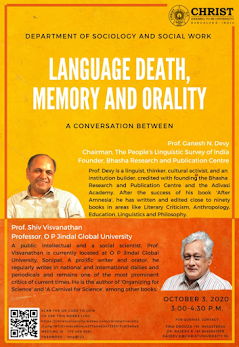
Language Death, Memory and Orality

 The Department of Sociology and Social Work organised a webinar titled ‘Language Death, Memory and Orality’ on 3rd October 2020. The speakers for this event were Prof. Ganesh N. Devy, Chairman, The People’s Linguistic Survey of India and Founder of the Bhasha Research and Publication Centre, and Prof. Shiv Visvanathan, Professor, O.P Jindal Global University. The webinar was aptly subtitled as ‘a conversation between’ the two speakers. An introductory note was given by the organisers and opening remarks by Dr Rajeev. The conversation explored the vast array of linguistic diversities present in India and the world.

Linguistic imperialism and the resultant processes with respect to dominant languages and dominated languages, the clerical approach towards languages which creates an “othered” category of non-citizens by denying means of expression and the dangers of this in an oral society like India, was discussed by Prof Devy. He also shed light on the drawbacks of the technology - how artificial memory, as opposed to human memory, is linear and therefore lacks a myth-making ability and the ability to look into the future.

Prof. Visvanathan addressed issues around cognitive violence and knowledge systems - certain pedagogies and knowledge cannot be accessed without language since they are all intimately tied together. He also spoke about how the diversity of language is beyond the efficiency of technology, and if languages die, democracy dies, and thus, the need for new languages arises. Prof. Visvanathan talked about having the space for diversity in the future, and Prof. Devy about being able to carry forward our knowledge of diversity that we so far have had. Nearing the end of the session, the speakers invited queries from the audience. The rich discussion that ensued proved that the session had indeed been a fruitful and thought-provoking one for all present!


Saturday, 26 September 2020

Inauguration of the Department of Sociology and Social Work Association 2020-2021

On September 26th, 2020, the Sociology and Social Work Association of the Department of Sociology and Social Work, CHRIST (Deemed to be University), Bengaluru, organised the inauguration and investiture ceremony of its newly elected office bearers for the academic year of 2020-202. The inaugural ceremony was attended by Dr Tony Sam George, Dean of the School of Social Sciences, Dr Victor Paul, Head of the Department, Department Cluster Coordinators, Faculty members, office bearers of the academic year 2019 - 2020, and the undergraduate and postgraduate students of the Department of Sociology and Social Work.

The President and the Secretary for the academic year 2019-2020 addressed the audience sharing their experiences and the importance of the association for the department and the student community.

The event was graced by Dr Tony Sam George, Dean of the School of Social Sciences. Dr Tony Sam Geroge delivered the keynote address discussing the importance of leadership in these difficult times. He emphasized the importance of understanding leadership as a spiritual exercise encouraging a holistic approach towards leadership and the activities of the association.

The keynote address was followed by the investiture ceremony of the newly elected office-bearers. The oath was administered by Dr Victor Paul, Head of the Department. Mr Aashik Mathews B Paliyath, Ms Archana Jayaprakash, Ms Gurneesh Arora, and Ms Asmita Bhattacharya were elected as the President, Vice President, Secretary, and Joint Secretary for the academic year 2020 - 2021. Ms Ahana Mukherjee, Mr Pradhyumna Poojari, and Ms Salma Ilyas were elected as the Treasurer, the Sports Secretary, and the Cultural Secretary respectively

The felicitation address was delivered by Dr Victor Paul, Head of the Department, Dr Hemalatha K MSW HR Cluster Coordinator, Dr.Suparna Majumdar Kar, Sociology Cluster Coordinator, and Dr Amaresha C, MSW CCP Cluster Coordinator. This was followed by the presidential address by Mr Aashik Mathew B Paliyath, the newly elected President of the association. He presented the proposed activities for this academic year. The association had decided to dedicate the activities of the academic year to discuss and act on the Sustainable Development Goals - Agenda 2030. The vote of thanks was delivered by Ms

Archana Jayaprakash.

Friday, 25 September 2020

Book Talk: Caste Matters, A Conversation with Dr Suraj Yengde

On the 24th of September, Socius, Applied Sociology Students Collective of the Department of

Sociology and Social Work organized a discussion on the book ‘Caste Matters’ with the

author, Dr Suraj Yengde. Dr Yengde, a Havard postdoctoral fellow, is one of India's leading

public intellectuals and a noted scholar of caste. He is the author of the bestseller ‘Caste

Matters,’ which was recently featured in the prestigious ‘Best Nonfiction Books of the

Decade’ list by The Hindu. The talk offered an insight into the book and some of the crucial

issues discussed by the author. The session was moderated by Nithya and Archana of II MA

Applied Sociology. The esteemed author discussed a common man’s everyday experiences

with caste with emphasis on symbolic elements in houses and surroundings. The talk covered

a broad array of topics, ranging from the process of writing a book on one of the most

complex and controversial issues to the assertion of Dalit identity in the 21st century.


Wednesday, 2 September 2020

Environmental Impact Assessment (EIA) Draft 2020

On September 1, Socius, Applied Sociology Students Collective of the department of Sociology and Social Work organized a talk on the Environmental Impact Assessment Draft 2020. The talk was delivered by Nitin Sethi, a journalist and a member of The Reporters' Collective. 


He has investigated, written, and reported for two decades on the intersections of India's political economy, natural resources, environment, climate change, economy, public finance, and development. Nitin Sethi discussed the importance of public participation in environmental lawmaking. The draft EIA 2020 is subverting the Constitution by limiting the inclusion of local decision-making bodies and public participation in the region. In the light of several protests and agitations against the draft, the talk offered a deep insight into the future of environmental policy discourse in India.


Friday, 28 August 2020

Talking Public Health; Circa COVID-19 Lecture Series

 India faces both unique challenges and unprecedented opportunities in the sphere of public health. The COVID-19 pandemic has revealed the fragility of the public health care systems, urging governments around the world to revisit their public health policies. In August 2020, Socius, Applied Sociology Students Collective of the Department of Sociology and Social Work, organised a lecture series on the Theme ‘Talking Public Health, circa COVID-19.’ The lecture series offered a platform to initiate discussion on a wide array of topics that play a decisive role in shaping the course of public health policies in India.

The first lecture of the series, ‘COVID-19 and Lessons for Public Health Systems’ was organised on the 8th of August. The lecture was delivered by Dr T Sundararaman, Global Coordinator, People’s Health Movement. He discussed the necessity of a paradigm shift in the public health discourse in India. From the origin of the modern public health discourse to the public-private nexus in health service delivery, Dr Sundararaman offered an illuminating lecture, laying a strong foundation for further discussions and debates on public health discourse in India.

The second lecture of the series ‘Decentralization and Community Participation in COVID Control - IKerala Experience’ was conducted on the 17th of August and was delivered by Dr Jayasree A K, Head of the Department of Community Medicine at the Academy of Medical Sciences, Pariyaram, Kerala.

Dr Jayasree extensively discussed decentralised governance and community participation in public health and in the fight against COVID19, with regard to the measures taken by the Government of Kerala to control the spread of the virus. The speaker suggested that decades of investment in public health and a long history of social reform movements rooted in the egalitarian principles of development, social justice, and equality, have paved the way for the successful containment of COVID-19 in Kerala. Dr Jayasree stressed the importance of community participation under the leadership of empowered local governments as one of the most effective strategies in COVID-19 control.


On August 22, the third lecture of the public health lecture series was organised on the topic ‘Reimagining the Urban in the Post COVID India.’ The speaker Dr. Piush Antony is a Social Policy Specialist at UNICEF India. The enlightening lecture offered a new perspective into understanding public health in the post-COVID world. The lecture covered a wide array of topics ranging from the dynamics of "the new normal" to the politics of social distancing.

The final lecture of the series ‘Social Determinants of Health: Towards a Humanitarian Approach to Public Health,’ was delivered on 27th August 2020 by Dr Asima Jena, Assistant Professor, Department of Sociology, University of Hyderabad. Dr Jena discussed the importance of developing a humanitarian approach towards public health policies in the post-COVID 19 era which requires a broad array of disciplines to inform and influence the totality of their precept and practice to advance global health.

The lecture series brought together public health experts from various fields and has established a platform that encourages more discussions on the importance of a fresh perspective into public health in the post-COVID 19 world.

Tuesday, 18 August 2020

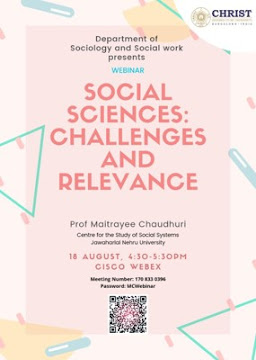
Social Sciences: Challenges and Relevance

On the 18th of August, the Department of Sociology and Social work, CHRIST (Deemed to be University), Bengaluru, organised a webinar on Social Sciences: Challenges and Relevance by Prof. Maitrayee Chaudhari, Centre for the Study of Social Systems, Jawaharlal Nehru University, New Delhi. She discussed the relevance of the Classical Sociologist perspective in understanding social science’s relevance in a modern democratic society. She brings in the philosophy of classical sociologists such as C. Wright Mills’ Sociological Imagination and Peter Berger’s Invitation to Sociology. In doing so, she tried to elucidate the different ways of understanding society.


She begins her talk by questioning one’s choice of selecting subjects at the school and college levels. She quotes C. Wright Mills and says that one’s will is not so personal, instead is governed by society. Society has considered some subjects as sacrosanct over others; she cites her example of how her family, relatives, and neighbourhood negatively reacted to her choice of choosing the field of humanities over science and commerce.

By shedding light on the relevance of social science, Prof. Chaudhuri says that it helps us understand our aspirations and limitations better. It further elucidates how society and history structure one’s identity. She goes on to give relevant examples, for one to understand the connection between social structure and the self. Knowledge of and from the social sciences can help one gain an insight into their social position and the way their identities work with each other.

Prof. Chaudhuri uses the Sociology of Peter Berger, to understand the ongoing COVID-19 pandemic, where the society has normalised the migrant labour unrest as ‘typical’ human behaviour. But sociology will tell us that gender, class, and caste are differently impacted even in this “normal” scenario.

In conclusion, she states that sociology and social work produce an understanding of society, and quality data and information help understand it. She shows hope when she mentions the New Education Policy (2020), and how it might give equal status to social science along with other streams.

The talk was followed by a Q&A session, where the participants engaged with the presenter and crucial questions regarding the education policy were discussed and were answered with a constructive conclusion.

Monday, 9 March 2020

Interactive Session with Indi-Village

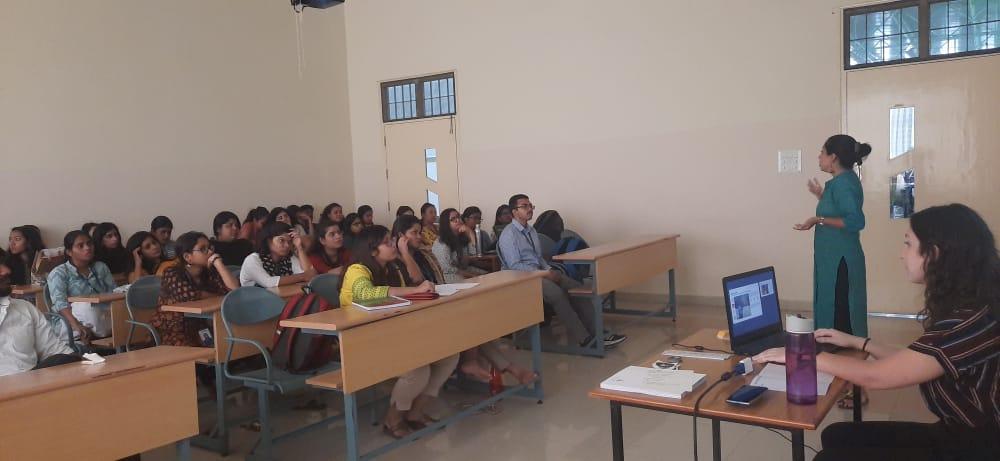
The first and second-year MA students of Applied Sociology interacted with a few representatives from Indivillage on the 25th of February, 2019. The session was organized by the Department of Sociology and Social Work. 
As global crises and assertions are being made for a collective need, to work on the Sustainable Development Goals (SDGs), this organization has been working towards attaining some of the SDGs in rural Indian landscapes. Some of the goals that IndiVillage has been working towards include Quality Education, Gender Equality, Decent Work and Economic Growth. The organization primarily works with impact outsourcing to bring about better opportunities and for growth in rural India, through Information Technology (IT) and Information Technology Enabled Services (ITES).

The session was fruitful for students interested in the development sector, and the first-year students to the network who would soon be interning. Furthermore, through interactions, the discussants also provided insights into the challenges and necessity for students of humanities and budding social scientists to work for the social impact sector. 

M N Srinivas Memorial Lecture

As the birth and death anniversary of M N Srinivas falls in the month of November, the Department
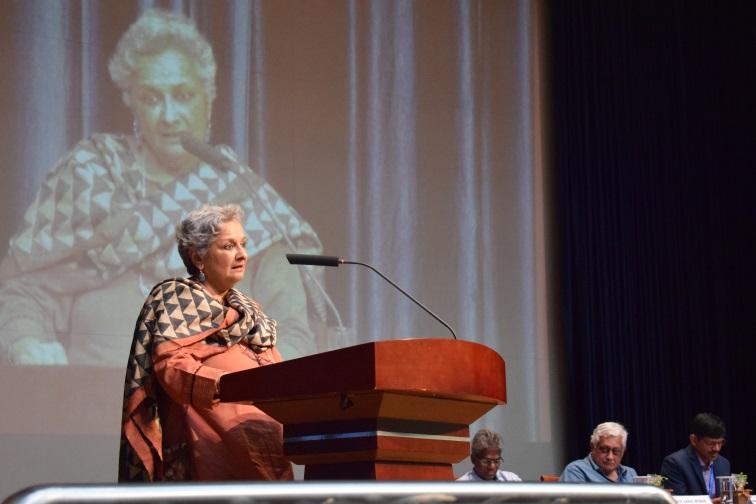
D:\sudipta.garai\Downloads\IMG-20191122-WA0005.jpgof Sociology and Social Work organized an MN Srinivas memorial lecture on the 22nd November 2019, from 12 to 1pm on the topic “Politics of Knowledge: The case of ‘indigenous’ medicine in India”. The event began with an introduction to MN Srinivas’ outstanding contribution to the sociology of India. Our guest lecturer, Prof. Leena Abraham, Associate Dean, School of Research Methodology and chairperson for Centre for Studies in Sociology of Education, TISS Mumbai, gave a brief account of the politics of ‘indigenous’ medicine in India. Her lecture started by explaining the concept of hegemony within the knowledge, politics of knowledge and the power struggles within indigenous knowledge systems. The lecture threw light on the various manifestations of these politics in indigenous knowledge systems in India such as Globalisation, colonization, and feminization of Ayurveda in the past few decades. The lecture by Prof. Leena Abraham was very insightful and helpful to understand in-depth, both the fields of knowledge production and sociology of medicine. The lecture followed by a short interactive session in which students and faculty members asked questions and clarifications. Apart from the Master's students of Sociology, many undergraduate students from other departments took part in the lecture. The president of the Sociology and Social Work Students Association thanked Prof. Leena Abraham for her insightful lecture and presented her with a memento.

South Asia in Transition

“South Asia in Transition” is an initiative taken by the Department of Sociology and Social Work in order to open a new arena of discussions and deliberations in comprehending the transitional changes of South Asia in the global order. 
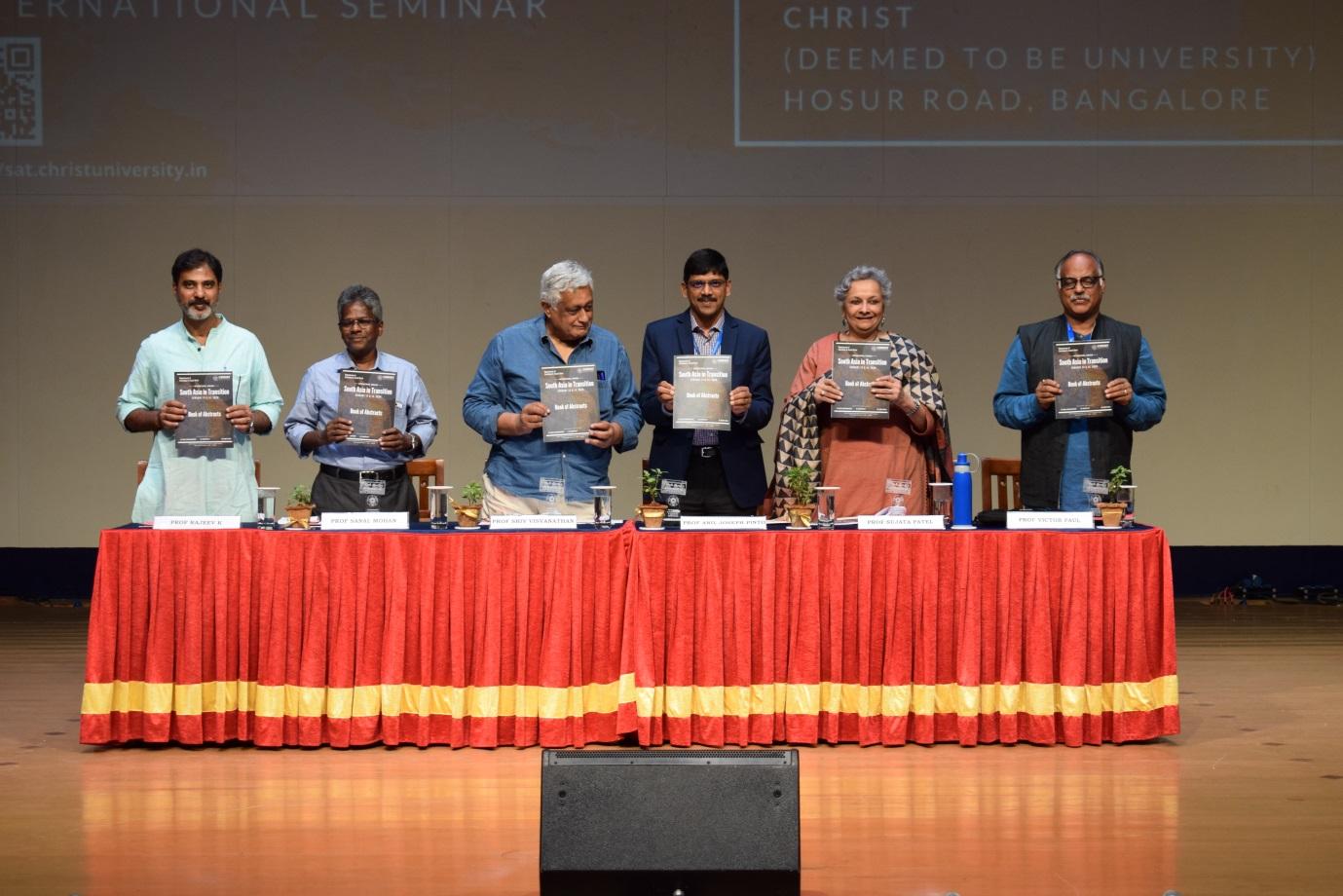
D:\sudipta.garai\Downloads\DSC_0143.JPGThe International seminar took its structural framework from the think tank of eminent faculties like Dr Rajeev Kumaramkandath, Dr Sudipta Garai and Dr Deva Prasad F. The idea was further supported by the head of the Department Dr Victor Paul, Vice-chancellor Dr Fr Abraham V M and Dr Tony Sam George Dean of Social Sciences.
The International seminar took place on 13th and 14th of February 2020, where a plethora of intellectual ideas collaborated making scholars and students across the globe ponder about various aspects of South Asia. 
On day 1, the conference began with a vibrant inauguration in the presence of brilliant minds such as Prof Sujata Patel who delivered a keynote address, Prof Shiv Vishwanath who articulated on Reinventing South Asia: On Nature, knowledge and Democracy and Prof Sanal Mohan who traced back Alternative Histories in South Asia. Further, there was a presentation on Canadian sizzlers to NRI cities: The culture of migration in Punjab followed by a panel discussion which was headed by Dr. Shiv Vishwanath on research papers related to SAARC and Andaman prisoners. This was followed by paper presentations by the participants at various venues. 
On day 2, there were elaborate sessions conducted in various venues, wherein, approximately 55 research papers were presented by various scholars across the globe on themes such as Education, empowerment and livelihood, Legal and political discourses, History and tradition, Global Networks and Cultural Hybridity, Gender and sexuality, Culture and Society, Media and technology.
D:\sudipta.garai\Downloads\DSC_0128.JPG

The seminar came to a conclusion with a valedictory session chaired by Dr. Fr. Joseph CC pro-vice-chancellor and Valedictory address delivered by Dr. Vathsala Aithal (University of Applied Sciences, Germany).
The end of the seminar has opened the beginning of new thoughts in the minds of students, faculties, and scholars which might further shape up into great ideas ahead.