Wednesday, 17 December 2014

Report on Interactive Session on Career Guidance and Personality Development

CII – Indian Women Network and Christ University
Interactive Session on Career Guidance and Personality Development

The Confederation of Indian Industries-Indian Women Network (CII-IWN) facilitated an interactive session on Career Guidance and Personality Development for the students of Christ University. This Interactive Session was organized by the Department of Sociology and CII IWN along the lines of a Panel Discussion to ensure that the students benefit from the expertise of the panelists.
MCs for the Day: Rusha Ghosh and Medha Bhattacharjee
Invocation
Lighting of the lamp by the dignitaries
Welcome Address by Suparna Majumdar Kar
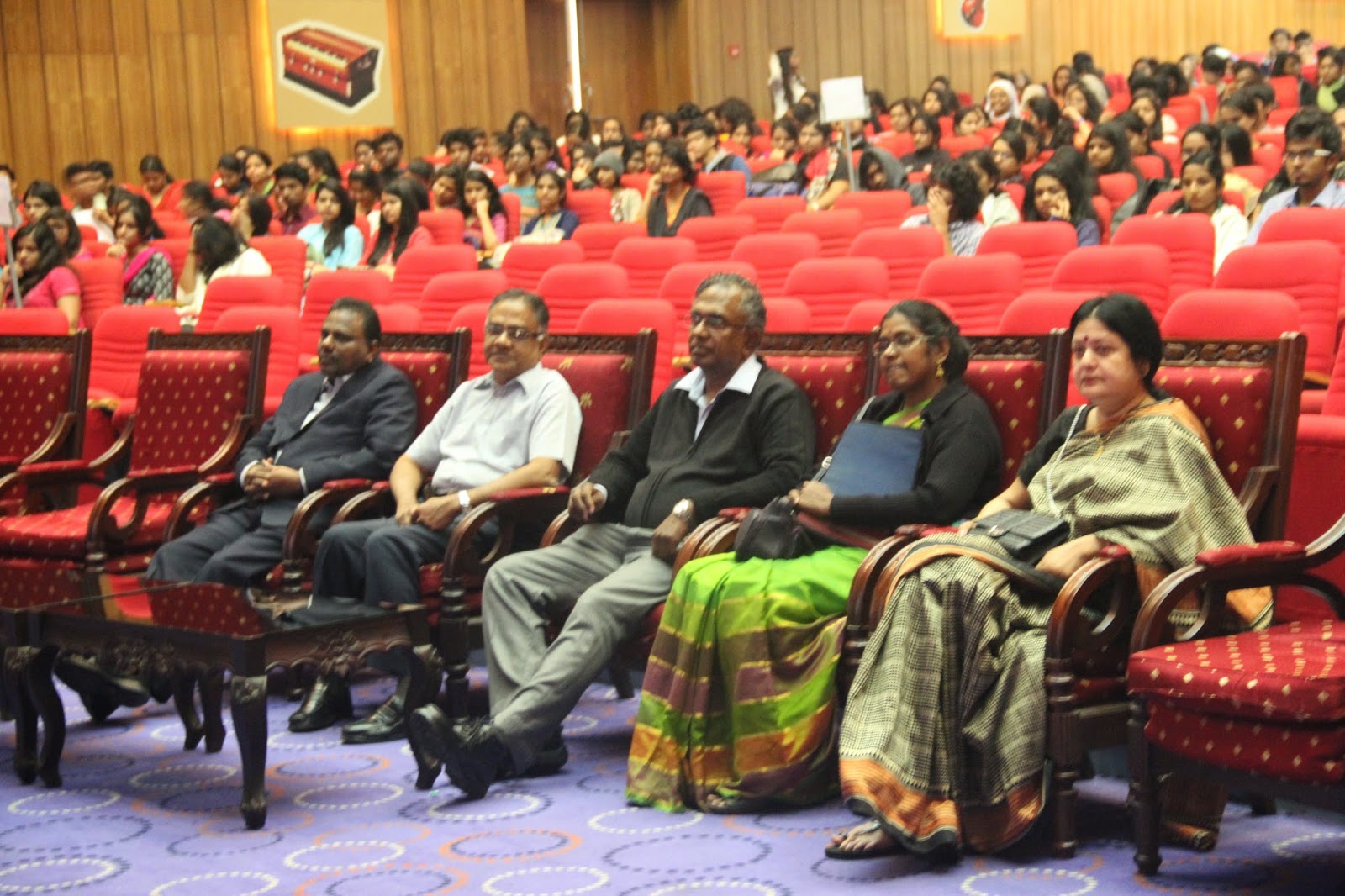
The Panel comprised of Mrs Priya Chetty Rajagopal, Executive Director -Leadership and Board Practice, RGF India Bangalore; Ms. Shalini Pillay, Head People, Performance and Culture, KPMG India; Ms. Suman Puri, CEO, Just Travel; Mr S V Venkatesh, Convener, Industry Institute Interaction Panel, CII Mysore & CEO, RiiiT, Mysore and Ms Meena Jain, Psychologist & Professional Career Consultant. Ms Priya Chetty Rajagopal moderated this session which was facilitated by Reshmi Mohandas. Suparna Majumdar Kar offered the welcome address.

Panelists

Address by Dr John Joseph Kennedy, Dean, Humanities and Social Sciences, Christ University

Address by Dr Mallika Krishnaswami, Co Dean, Humanities and Social Sciences, Christ University

 The session focused on some of the areas that the students need to focus on and develop in order to enhance employability. This becomes crucial keeping the demographic scenario in mind within which not all the graduates and postgraduates would find employment. As mentioned by the Deans of Humanities and Social Sciences, Knowledge, Skills and Attitude are crucial in the way we groom ourselves and prepare for our professional lives. This was reinforced by the panelists.


The luminaries from their varied respective fields focused on 5 points each that each student could take home from the session. These speakers covered the corporate sector as well as the social sector. Some of these points were communication skills, deportment, drive, perseverance and skills that need to be developed, such as technological skills, and time skills.
A complete personality that encompasses etiquette, emotional quotient, creative thinking, and effective communication (content to context) becomes important. A blend of smart skills and occupation skills is optimum for the career market. Identifying ones goals and creating a brand for oneself becomes significant as well. In order to succeed, the panelists also reinforced the element of joy and engagement with the work that one choses to do.
The panelists also focused on the difference between jobs and careers and spoke about the risks involved with frequent job shifts which could be interpreted as issues with integrity. Also addressed were social media, cyber law and Laws relating to the Prevention of Sexual Harassment in the work place (POSH).

This interactive panel discussion will prove invaluable for our students as they get ready to embark upon their careers.


Interactive session on career guidance and personality development


Tuesday, 16 December 2014

Photographs from Young Sociologist 2014

Dr John J Kennedy, Dean, Humanities and Social Sciences, Chief Guest,Dr S. S. Meenakshisundaram, IAS, Dr Anand Inbanathan, Head, CSSCD, ISEC and Dr Pritha Dasgupta, Head, Department of Sociology
Opening remarks by the MCs

Invocation by Sanjushree Choudhury

Lighting of the Lamp

Dignitaries

Welcome by Dr Sudhansubala Sahu

Address by the Dean, Dr John J Kennedy

Address by the Chief Guest, Dr S S Meenakshisundaram

Vote of thanks by Dr Maya

Paper Presentation

Paper Presentation

Paper Presentation

Paper Presentation

Theme Dance by I PSEng

Theme Dance by I PSEng

Paper Presentation

Paper Presentation

Paper Presentation

Paper Presentation by Dheeraj Thegala

Paper Presentation

Paper Presentation

MC


III Place, Karan Menon
Prize Distribution by Dr Pritha Dasgupta, Head, and Dr Victor Paul, Coordinator, Department of Sociology

II Place, Sheren Leah Coilpillai
Prize Distribution

I Place, Atreya Arun
Prize Distribution


Vote of thanks by Suparna Majumdar Kar


Young Sociologist 2014

YOUNG SOCIOLOGIST COMPETITION 2014

The national level Young Sociologist Competition 2014 on the theme ‘Environment, Development and Sustainability’ was held on Friday, 12 December 2014 at the Main Auditorium. The competition was open to all undergraduate students in India who have Sociology as one of their subject. Call for abstracts were announced in July 2014. The Department received 60 abstracts from across India and the selected students were asked to submit their full papers by 31 October 2014. There was a blind review of these papers and ten papers were selected for the final presentation. Out of these, nine participants presented their papers on 12 December. 

The inaugural function started at 9.30 Dr. Sudhansubala Sahu, YSC coordinator welcomed the gathering. In his introductory remark, Prof. John Joseph Kennedy, Dean Humanities and Social Sciences spoke about integrating a concern for environment in the development discourses. Chief Guest of the day was Dr. S.S. Meenakshisundaram IAS, Executive Vice Chairman, Myrada and a visiting Professor, School of Social Sciences, NIAS Bangalore. Being an experienced bureaucrat, he spoke about policy implications of development initiatives and urged students to think in terms of the question ‘development for whom’. Dr. Maya M proposed the vote of thanks.

The inaugural session was followed by paper presentations by the contestants. Each participant was given 10 minutes each to present their major findings and five minutes for discussion.  Karan Menon, Hindu College, Delhi had his paper on ‘Development and Violence: The tragedy of Unintended Consequences.  Shruthi P S from Bishop Cotton Christian College presented her paper on Water resource and the crisis we face today. Ramesh P of P S G College of Arts and Science, Bharathiyar University discussed on sustainable development and responsiveness of civil society. Dheeraj of Christ University presented his paper on Modern Food Production Techniques and its effects on sustainability. Sheren Leah Coilpillai of Bishop Cotton focused on the theme of waste management. Atreya Arun of Christ University discussed the case of Niyamgiri movement in Eastern India. Shajeem Fazal of Hindu College, New Delhi presented the paper titled ‘Development as a ‘secular question’: Questions of Adivasi subjectivity. Sowmya V from PSG College discussed on waste management and quality of life. Aswathi Prasad, Vimala college, Thrissur presented a case study on women, water and well being of ‘Kuttadampadam’ in Kerala.
 
The judges for the event were Prof. Anand Inbanathan and Dr. Asha Ketaram were the judges. Dr. Anand Inbanathan is the Head, CSSCD at Institute for Social and Economic Change. He has contributed immensely to the academic arena with his extensive research publications. Dr. Asha Ketaram is working as a scientist in Regional Occupational Health Centre (South), Indian Council of Medical Research. She has more than 20 years of research experience.
Atreya Arun won the first prize for his paper based on the Niyamgiri movement. Sheren Leah Coilpillai was the second prize winner and Karan Menon bagged the third prize.


The prizes were given away by Dr.Pritha Dasgupta, Head, Department of Sociology and Dr. Victor Paul, Coordinator, Department of Sociology. Prof. Suparna Kar proposed the vote of thanks and the programme got over by 1 pm. The programme was attended by students of PSEco, PSEng, EPS and MA Applied Sociology. It was an academically engaging session that benefited all the young budding sociologists. 

The dilemma of constructing a society without stratification

The first year students of EPS and PSEng were asked to construct a society without any form of social stratification and inequality. This exercise was part of their foundational paper in Sociology. It was undertaken to encourage the students to reflect upon the inevitability of inequality and how social stratification becomes and integral part of the social structure.
The various groups came up with fascinating examples which included artificial intelligence and genetic modifications. What was even more interesting was their experience while trying to construct such a society. Given below are some of the images from this exercise.


Thursday, 18 September 2014

Guest lecture on Tibetan culture

The Department of Sociology organized a Guest Lecture on Tibetan Culture on September 6, 2014, between 11 am and 12 noon, in Christ University. The resource person was Ven. Geshe Dorji Damdul. The program began with a welcome speech by Margret, wherein she gave a brief profile about the resource person. Ven. Damdul has served as the official interpreter to His Holiness the Dalai Lama for several years. In March 2011 he was appointed as the Director of Tibet House, Cultural Center of His Holiness the Dalai Lama, New Delhi, where he has been giving extensive teachings on Tibetan Buddhist philosophy, psychology and logic.  

Ven. Geshe Dorji Damdul began his lecture on Tibetan Culture by narrating the history of Tibet. The history can be divided into two phases, pre 7th century AD, which was dominated by the Culture of Bon, and post 7th century AD. In this he dealt with the influence of the Culture of India and Buddhism. He mentioned how they adopted some elements of culture from their neighboring regions like, the food from Chinese cuisine, dress from Mongolians and spirituality from India. He classified his exposition on Tibetan Culture into two parts, namely Expressions of culture and the Contents of the culture. He also spoke about the invention of Tibetan Script.
He also mentioned large scale social service conceptualized by Saint Drupthop Thangthong Gyalpo (1385–1464 AD. He also explained about the Lineage of Dalai Lamas in the political scenario of Tibet, wherein the temporal rule of Tibet was handed over to the Great V Dalai Lama by Mongolian Emperor Gushri Tenzin Choegyal . He added how the XIV Dalai Lama of Tibet was  the Last Dalai Lama in the Political Scenario of Tibet, who received the Noble Peace Prize in 1989. He also talked about how His Holiness, encourages Secular Ethics along  women’s education. After the lecture there was a session for questions and answers.
Vote of thanks was given by Annie Chirayath who thanked Ven. Geshe Dorji Damdul, Dhandup (Director, Tibetan Youth Hostel),  Dr.Victor Paul, Dr.Pritha Dasgupta , Suparna Majumdar Kar, other faculties’, students and supporting staff. As a token of gratitude,  mementos  were gifted by Dr. Victor to Geshe Dorji Damdul and to Dhandup by Suparna Majumdar Kar. The master of the ceremony was Meghana, the photographer was Soumya, and the report was prepared by Ann Tresa.


Sunday, 24 August 2014

Young Sociologist Deadline Extended

LAST DATE FOR SUBMISSION OF ABSTRACT
FOR 
YOUNG SOCIOLOGIST 2014
EXTENDED
TILL AUGUST 30, 2014