Saturday, 23 September 2017

Guest Lecture

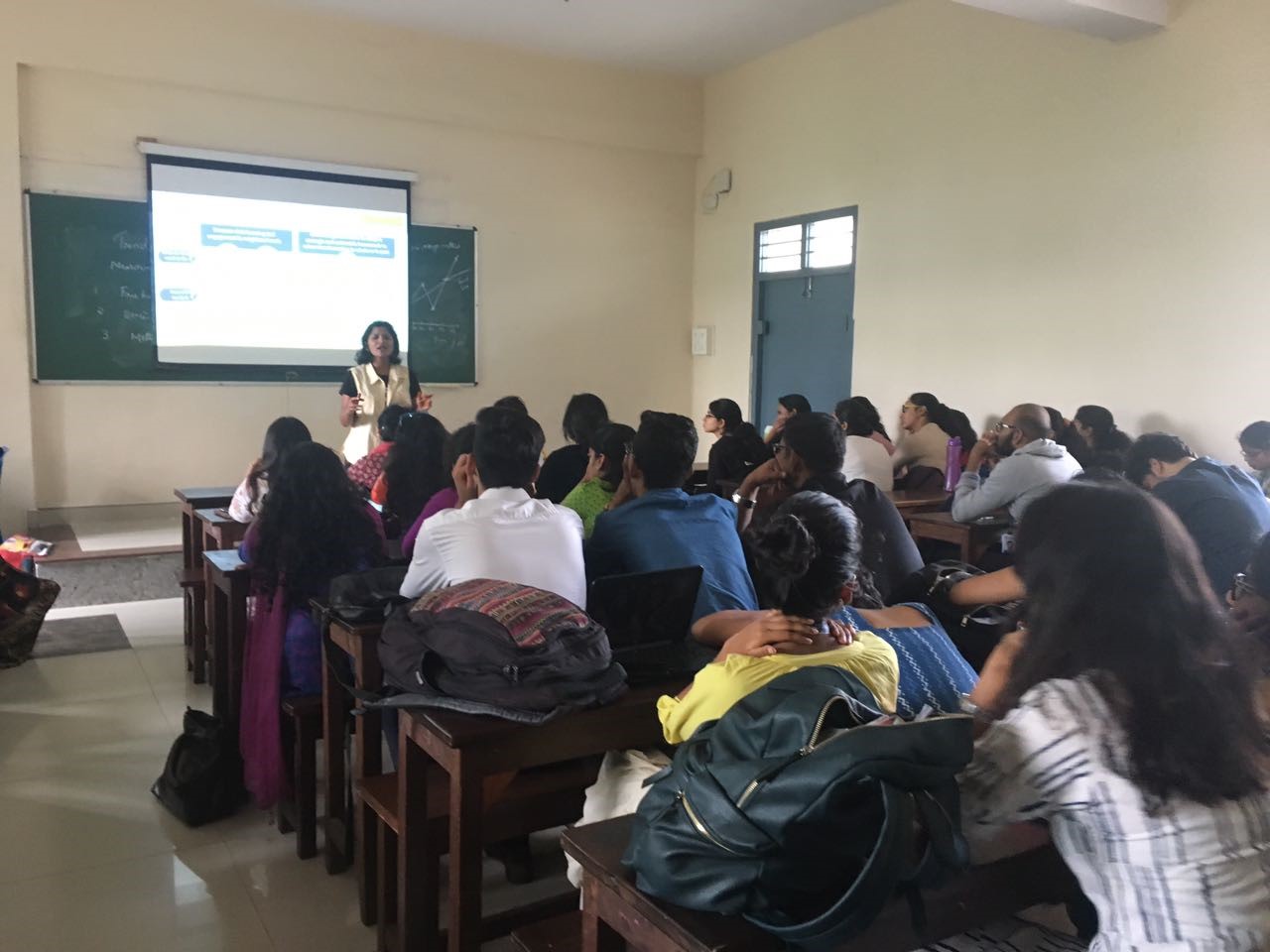
On Thursday, the 21st of September, the elective class of Analysis of Contemporary Social Problems taken by Dr. Sudhanshubala Sahu, was addressed by resource persons Ms. Sangeetha and Ms. Varsha, representing the non-profit organisation Janaagraha. This lecture, rather, a productive interactive session, proved to be quite a success, proven by how involved the students seemed to get as the talk progressed.
The resource person, Ms. Sangeetha, spoke about the organisation, its vision, mission and objectives. Their emphasis is on “improving the quality of life” of Indians through active citizenship, and community initiatives. The organisation seeks to bridge the gap between the people and the government, thereby attempting to facilitate good governance and full utilisation of government facilities. Their main focus, therefore, is on strengthening democracy by enhancing civic sense, awareness, and involvement in the urban domain. It also extends to empowering the local government by spreading awareness about the benefits of a more representative government, and high-level citizen-engagement.

A few highlights include their unique corruption-curbing initiatives such as I Paid A Bribe, which serves as a model in countries abroad, where anyone can log onto Janaagraha’s website and lodge more of a “report” than a complaint, about a bribery that they have witnessed or themselves participated in, with complete anonymity, thereby creating a consolidated log book presenting the pervasiveness of bribes in the country, to lobby for stringent action against the same.
Another stellar scheme is I Change My City, a platform to build a network of local elected bodies and citizen communities, to provide a feasible and extremely useful database, training and networking circles, to tap into the local government’s highest potential for effective governance and constituency welfare.
Janaagraha has an important off-shoot called Bala Janaagraha, which aims to establish a reciprocal relationship with student communities of the city that the respective branch of the organisation is set in – by rendering training programs about civic engagement, active citizenship, and change-making. And in return, as Ms. Sangeetha narrated a few exemplary instances of brilliance of young minds, students contribute to the world of knowledge and innovation with ingenious inventions, ideas, and creativity. A plethora of such initiatives are the brainchild of Janaagraha, such as imatter, My City My Budget, City Blueprint, etc.

Reflecting on this session, most students found it quite stimulating, and refreshing as they had previously engaged in or at least been exposed to NGOs that focus only on the underprivileged, or the marginalised. This organisation was considered novel for it concentrates in the urban sector, hence making it more relatable to the students. The motives with which Janaagraha was established and functions, namely, promoting active citizenship and efficient governance, were most appealing. All in all, the session provided exposure, motivation, and information, testified by a show of hands, where a bunch of students were even eager to prospective participation in Janaagraha. 

Thursday, 24 August 2017

A Talk on Man-Wildlife Conflict

A guest lecture was arranged for the students of Social Ecology elective (V semester BA) on Wednesday, 26 July 2017 during 2-3. It was held at Room no 105, central block. The topic was Man wild life conflict. Dr Maya M, the faculty in charge introduced the guest. Prof P U Antony is a senior professor in the Department of Zoology, Christ University. He is a member of the Biodiversity Management Committee, Bruhat Bangalore Mahanagara Palike and also the honorary warden to take care of the maintenance of Byrasandra lake in Jayanagar. Professor also is a voluntary member of Wildlife Crime Control Bureau, Ministry of Environment and Forest, GoI. He has initiated n active student movement for conservation called Green Army.


Prof P U Antony began with providing an overview of biodiversity in the country and Bangalore in particular. Through his personal experience, he narrated the perceptions with which human beings identify themselves with their environment and emphasized on the need to have a holistic understanding of the ecosystem as well as the ecosystem people. He narrated various instances of man animal conflict and discussed the reasons as well as possible solutions. Another learning we had was about treating every species as equally significant be it ants, cockroaches or bigger animals like elephants. 

Tree Plantation Drive

The students of Social Ecology elective (V Semester BA) were part of a tree plantation drive organized by the Department of Life Science and the Christ University Alumni association on Saturday, 8 July 2017.
The team went to the Byrasandra lake in Jayanagar. It was a joint effort by the student volunteers, NGO volunteers, local community members, officials Alumni members and also few school children. We started with the cleaning of the area followed by planting trees.

It was a great learning where we understood how the lakes are dying in the city and also about the initiatives to rejuvenate lakes. The team was happy to be part of such an initiative and have plans to be a part of the follow-up actions in coming months.  


Thursday, 13 July 2017

Announcement: Young Sociologist Competition 2017


The Department of Sociology, Christ University, Bengaluru, organises an annual National Young Sociologist Competition for undergraduate students having Sociology as one of their subject. It aims to encourage the young generation to carry out small research projects on socially relevant subjects and issues to enhance their critical and analytical thinking. The Competition seeks to fulfil this aim by inviting the participants to write original papers on topics prescribed below to participate in the paper presentation competition which will be held on 08 December 2017.


Theme and Topics


The theme for the National Young Sociologist Competition 2017-18 is Science and Society. The interrelation between science and society can be understood at both theoretical and empirical level. At theoretical level the paradigms for the sociology of knowledge help in building the relation between knowledge and other existential factors. Similarly, at empirical level the production of science as a social process, creation of scientific knowledge, social construction of technology and gender issues help in understanding the relation between science and society. Combining both the theoretical and empirical understanding of the relation between science and society can help in production of knowledge which furthers the social aspects of scientific enquiry. This competition aims to bring in both the dimensions to understand the interrelation between society and science under various sub themes. Contributions beyond the subthemes are also invited which further add to the overall theme of the competition.


Sub themes

a.)    Theoretical contributions to the relation between society and science.

This theme engages itself at the theoretical level trying to make sense of the relation between science and society.

b.)   Social construction of technology.

This theme tries to understand how technology comes into being analysing its evolution and making.

c.)    Understanding gender in relation to science and society.

Understanding the relation between society and science remains incomplete without decoding how gender relations are re-formed, established and modulated. This theme tries to understand these relations.

d.)    Effects of scientific research on society.

Production of science has multiple effects on the society be it in terms of technology (gadgets), medicine, scientific knowledge, etc. This theme tries to understand the effects of scientific research from various fields like chemistry, biology, physics, etc.

e.)    Analysing artefacts as a social construction.

What goes behind the making of an artefact is what contributes to its social, economic and political ramifications. This theme thus tries to understand how artefacts are created or produced.

Eligibility


The competition is open to all regular undergraduate students studying Sociology as one of their subjects in any of the institutions in India.


Submission Guidelines


1.      As a first step to participate in this competition all participants need to send a 250 word abstract of their paper by August 15, 2017 to the following e mail:


or

send a hard copy to

National Young Sociologist Competition 2017-18

C/o Dr Sudhansubala Sahu, Department of Sociology

Christ University

Hosur Road, Bangalore–560029


Tel: 91-80-4012 9637


2.      An abstract is a short summary in 250 words about the research project that the student has done/is planning to undertake. It should mention the overall purpose of the study and the research problem(s), the methodology, major findings/trends/scope of the research.

3.      The abstracts should be accompanied by the contact details of participants including name, college/institution details, postal address, email address, and phone number.

4.      Participants need to enclose a bonafide certificate from the Head of their Institution and a copy of their college/university identity card along with the abstract.

5.      The academic papers can be conceptual or empirical. The length of the paper need to be around 2500-4000 words. The references should be given in the APA format (the style prescribed by the Publication Manual of American Psychological Association-6th edition).

6.      A conceptual paper should develop arguments or theoretical perspectives on issues related to Science and Society using evidences from prior research. It should present a comprehensive and focused review of the relevant literature to support the argument.

7.      Empirical paper should have a brief and focused literature review to justify the need of the study. It should mention objectives of research, explain methodology, present the data and their analysis, arrive at logical conclusion and discuss the theoretical/practical implications of the research, the limitations as well as the scope of research.

8.      There is no limit to the number of entries from a single institution.

9.      All entries should be original works of the participant with appropriate references. Plagiarized entries will be disqualified. Plagiarism is the inclusion of someone else's verbatim or paraphrased text in one's own written work without immediate reference. Verbatim text must be in quotes or indented if it is longer than four lines.

A citation must follow right after borrowed material (usually the author's name and year – eg (Stephen, 2000)) and the full details of the reference must be incorporated at the end of your full paper.

10.  Co-authored papers will not be considered.

11.  Submitted abstracts will be screened and the authors of shortlisted abstracts will be notified by August 25, 2017.

12.  Authors of shortlisted abstracts have to submit two hard copies and the soft copy of their full-length paper in word format to the above-mentioned e mail or addresses by November 1, 2017.

13.  Participants whose papers have been selected for the final presentation at Christ University, Bangalore will be notified by November 15, 2017.

14.  Travel will be reimbursed (second class sleeper) for outstation paper presenters.

15.  Accommodation will be provided for outstation paper presenters.

16.  Final papers will be considered for publication.


Evaluation Process and Rewards


1        The entries will be evaluated by an eminent panel of judges and the authors of the ten best entries will be invited to Christ University to make a presentation and to defend their ideas in the presence of students of Humanities and Social Sciences.

2        Awards are given to the prize winners. The first prize carries Rs 15,000/-, the second Rs 10,000/-, and the third Rs 7,000/-. The conveyance expenditure of the finalists would be reimbursed as per Christ University guidelines and the finalists would receive hospitality from Christ University community.


Important Dates

August 15,  2017
 Last date for submission of abstract
August 25, 2017
Notification of shortlisted abstracts
November 1, 2017
Submission of full-length paper
November 15, 2017
Announcement of finalists for paper presentation
December 08, 2017
Final paper presentation at Christ University


Friday, 23 June 2017

Alumni Connect: Interactive session with Medha and Yudhvir on Public Relations


As an initiative by the Department of Sociology for students of 2nd year Sociology pursuing a paper on Public Relations (PR), two ex-Christ University Students who Studied MA Applied Sociology, Medha and Yudhvir were asked to talk to students about how PR functions in the field. They are currently working with one of the leading names in the field, Edelman. Though the classroom is a very important place to gain knowledge and form a strong base for our future employment opportunities, often we need to know what’s happening out there in the field. So to bridge the gap between academics and the field, this interaction took place.

Initially the discussions were about what kind of work they are given in the office and what are the kind of expectations that the organization they were working with had of them. They talked about the kind of work they had to put in on various projects and spoke about how they approached projects. They discussed the steps that are taken with the projects that come in and how occasionally one’s unique way of thinking is what can contribute to the projects that they are working on. They also spoke about how PR can be pressurizing and can have an impact on one’s social life but the work can be engaging and enjoyable.

According to our guest speakers, they describe PR as a form of storytelling which has an intention of creating an impression to the public. Based on the demands of the clients, the stories are formed. Occasionally, PR professions with minimum information from clients should have the ability to create a narrative to influence the public opinion of them in positive way. We also found out it’s a field which involves meeting top management level in various organizations, travelling and attending various events.

Students of Sociology often go through this anxiety if they’re going to get placed over an MBA or a M. Com student, the ex-students were able to give us some amount of hope that we are strong competitors for students of other departments as the company that came in for placements hired more students from our department than some of the students in other departments which specialize in such managerial and corporate based knowledge.

They also spoke about how much of what they learnt in class helped in the Field. The seniors confessed that none of the theories that we learn in class can really be directly applied to understand their field or work, But then they admit that the theories that they learnt were influential in forming a base for their understanding of the field and alter it for it to work. A strong base in theory can sometimes provide us with deeper insights, which seem to be required in PR.  

So this was an informative and productive session for not only the students who want to do PR but any student who wants to take up a job in the near future. From their exposure to the field, they were able to bring out the relevance and value of a sociological understanding in the Corporate word which definitely gives us hope of a future in this competitive world. 
Report by Dheeraj

Wednesday, 22 March 2017

Class presentation on Why I am not a Hindu


A presentation was made by a group of students from PSEco on the much discussed and debated work of Kancha Ilaiah, titled Why I am Not a Hindu. Each one of the group members took a few aspects of the book and explained them thoroughly – starting from the status of women among the dalit bahujan society in contrast to the relatively oppressed status of women in the brahminical society; to the stark difference between them and the mainstream Hindu society with respect of modes of worship or deities. Not only this, they were also able to bring out the passion with which Kancha Ilaiah wrote this book, and the passion with which he believed in his ideals. All in all, it was a very informative and well structured presentation.