Tuesday, 23 February 2021

The Development of Teaching and Research in Sociology in India

 Socius, Applied Sociology Students Collective, DSSWA organised the guest lecture ‘The Development of Teaching and Research in Sociology in India’ by Prof R S Deshpande on 23rd February 2021. Prof Desphande is the former Director of ISEC and a Rajiv Gandhi National Fellow of ICSSR. He has worked with various policy bodies of the Government of India and the Government of Karnataka. He has also been a consultant to various projects of the World Bank, Asian Development Bank, and Land Equity International and was the Vice-Chairman of the WTO Cell of Karnataka.

The welcome speech and introductory note were delivered by Anshu Pal.

Dr Deshpande started out by outlining the development of sociology by the founding fathers. The depth of observations, the strength of the theory, the conceptualisation of sociological terms by early scholars are what laid the foundation for the discipline of sociology. He then shifted the focus to the trends and development of sociology in India. Prof. Deshpande is of the opinion that discussing the works of prominent sociologists in India chronologically does not reveal trends in the discipline, rather it is more important to look at the development change in the components of sociology over the years through the conceptualisation and development of concepts.

Three typologies of trends mentioned by Dr Deshpande are:

  • Through the schools of sociology
  • Through gurus - initiators and followers
  • Through conceptualisations, which would be the primary focus of his talk

British and American were the two international schools of thought. Most of the early sociology students in India, who later became early generation sociologists did their PhDs in the USA and Britain, and thus these schools had a great influence on Indian schools. This is similar to the trend seen in other disciplines in India, like economics There are three prominent Indian schools of sociology. The first is the Bombay School, which was initiated by Patrick Geddes who held a position in Sociology and Civics at Bombay University from 1919 to 1925. The second school is the Delhi School of Economics which had an amalgam of social sciences. The emphasis initially here was on villages, village economy, rural sociology. The third school is the Lucknow School started by Radhakamal Mukherjee. He had a deep interest in economics and sociology. He made attempts to bring fieldwork and empiricism into sociology, long before Srivinas did. Prof Desphande then talked about how prominent sociologists had specific methods and areas they specialised in, and often their students would be ardent followers of these methods, thereby creating a ‘cult’. He believes that colonisation, cult creation, and politicisation are present in every social science. He further discussed trends through conceptualisation, detailing them in order.

Prof Deshpande concluded by emphasising the need for Indianisation of sociology, Indianised methodologies, an understanding of Indian societies from an insider’s perspective, and the need to teach both sides of a concept - both its merits and its criticisms as well. The highly informative lecture was followed by an interesting Q&A session where attendees asked questions on the role sociology can play in policymaking and transdisciplinary and interdisciplinary trends in sociology.

The session was concluded with a Vote of Thanks delivered by Anshu Pal.

Friday, 12 February 2021

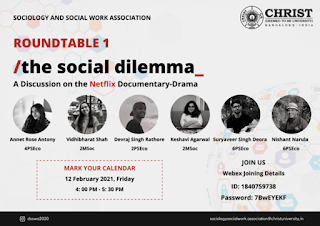
Roundtable 1 - The Social Dilemma: A discussion on the Netflic Documentary-Drama

The Department of Sociology and Social Work Association organized a Roundtable Discussion on the topic ‘The Social Dilemma- Netflix Documentary’ on 12th February 2021. The panellists were students from various courses within the department- Devraj Singh Rathore (2PSEco), Annet Rose Anthony (4PSEco), Suryaveer Singh Deora (6PSEco), Nishant Narula (6PSEco), Vidhibharat Shah (2MSoc) and Keshavi Agrawal (2MSoc).

The session commenced at 4 PM, with an opening note from the President of the Department of Sociology and Social Work Association, Aashik Matthews. Following this, the first panellist, Keshavi kickstarted the discussion by giving the audience a prelude to the topic. She also spoke about human-algorithm interaction.

Next, Devraj talked about how instant gratification has become a necessity for many today, and how social media has become a new addiction. Vidhi examined the effect of the algorithms behind social media platforms, and how they are engineered to induce users to spend more time on social media.

Nishant picked up this discussion and continued to speak more about the algorithm and the benefits it can provide as well, as the privacy vs. personalization issue. Suryaveer discussed the reasoning behind the tech giants’ motive for obtaining users’ data and attention. He further spoke about concepts like ‘monetisation of thought’. Finally, Annet gave clarity on the public sphere in the era of big data.

The session was wrapped up with a question-answer session open to the audience and ended at 5:30 PM with a vote of thanks delivered by Archana. The roundtable received positive feedback and was tagged as a success.


Tuesday, 22 December 2020

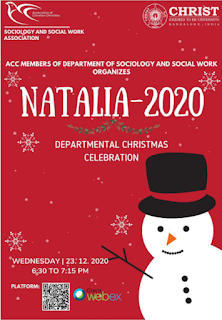
Natalia - Departmental Christmas Celebration

On the 23rd of December 2020, Wednesday, The Association of Christian Christites (ACC) and The Department of Sociology and Social Work Association (DSSWA) hosted the annual departmental Christmas celebration.

The hosts for the day, Sharon Abraham, 1 MSOC, and Sharril Prascila, 2 MSW HRDM, introduced the event to the gathering. The event was bestowed by the Lord Almighty’s blessings as Mary Catherine led the gathering in prayer. Dr Mary Tariang, Assistant Professor, Department of social work at Christ (Deemed to be University), welcomed the audience. This was followed by a welcome address by Dr. Victor Paul, Head, Department of Sociology and Social work. The event was later led to the festive aura as Jennifer Ellen Daniel,1 MSW CCP, hosted an icebreaker session with games that were Christmas themed.

The Chief Guest of the event Mr Livin Varghese, a former student of Christ and a prominent Jesus Youth Representative, spoke about the spirit of Christmas during pandemic times. This was followed by Christmas carols sung by the student and faculty teams of ACC which lifted the spirits of the evening.

Fr. Lijo, The ACC faculty member concluded the event by addressing the gathering. Lastly, Sharril Prascila proposed the vote of thanks extending gratitude towards the gathering, eminent guests, faculties and students, performers and both the associations, the ACC and the DSSW Association, for making the event an enjoyable one.


Wednesday, 2 December 2020

Equal World Campaign

 December 3 is designated as International Day of Persons with Disabilities and is dedicated to raising awareness and initiating dialogues on the rights of differently-abled persons. We at the DSSWA decided to make an initiative to invite people to join us as proud allies and to become a part of the Equal World campaign. We urged candidates to put images related to it as their status on their social media handles and to use the hashtags #IDPWD2020 and #NOTALLDISABILITIESAREVISIBLE.


Monday, 30 November 2020

AIDS Pandemic - Social Media Campaign

 International World AIDS Day, December 1, is dedicated to raising awareness of the AIDS pandemic caused by the spread of HIV infection and mourning those who have died of the disease. On this occasion, the Sociology and Social Work Association initiated and invited people to join us on a social media campaign in order to raise awareness regarding the AIDS Pandemic.

Volunteers were urged to update their status with the related image in social media handles and use the hashtags #stopthestigma and #rocktheribbon.


Tuesday, 24 November 2020

The International Day for the Elimination of Violence Against Women

Face Painting Event

The theme for this face painting event - Colours of Violence.

Violence has many forms, students are asked to express what violence means to them using colours and different shades which represent and encompass all emotions and thoughts associated with violence. Giving artists this freedom of expression lead to different interpretations of results as they used the beauty of colours to represent their thoughts instead of using their words. Colours of Violence was an event that showed the hidden emotions of violence that cannot be expressed in words, rather only understood through face-art. It bridged the gap between the silence of violence and the deep-seated manifestation of violence through art.

Poster-making competition

Theme: Cyber violence

“The internet records everything and forgets nothing”

This sentence may seem sinister, but cyberviolence has been on the rise, especially during the pandemic. Violence doesn't always have to be outward, in fact, the most impactful and severe violence is mental and psychological. Cybercrime is a serious threat and a source of violence in today’s digital age which can be dangerous for several young women who face cyber-crime. Cyberbullying is another form of violence that intends to damage people’s social image that might be un-erasable due to the very nature of the internet and social media.

This is to call attention to the issue that cyber-violence is a serious and under-rated form of violence that needs to be addressed. This event not only raised awareness on the seriousness of cybercrime but also allowed students the freedom to give their own inputs on cybercrime using posters.

Wednesday, 18 November 2020

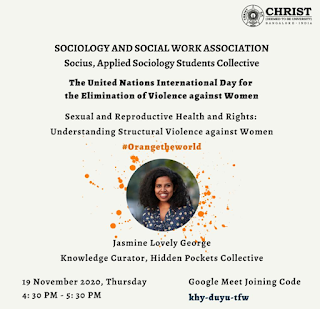
Sexual and Reproductive Health and Rights: Understanding Structural Violence Against Women

The Department of Sociology and Social Work Association in collaboration with Socius, Applied Sociology Students Collective organised a talk on Sexual and Reproductive Health and Rights: Understanding Structural Violence against Women. The session was organised with the organisation Hidden Pockets Collective. Their Knowledge Curator, Jasmine Lovely George was the speaker for the session. The event was organised to observe The United Nations International Day for the Elimination of Violence against Women. 


Thursday, 8 October 2020

Catharsis Through Art

Artistic expressions provide a sense of solace during adversities. The current pandemic has significantly affected the mental health of most people. Art's cathartic nature helps individuals to express their emotions, feelings and apprehensions freely. “Catharsis Through Art” was a small exercise conducted amongst the students of MA Applied Sociology. Students were invited to send entries of their original artwork and also pen down their feelings about the pandemic. Art is a medium through which most of us express ourselves and our apprehensions. The idea was to compile different forms of artistic expressions to provide a sense of solidarity and solace during the pressing times of the pandemic. Students submitted their artworks ranging from painting, photography to cooking and farming. Since September is Suicide Prevention Awareness month, this activity is also highly relevant in spreading awareness about mental health. 

The entire exercise was a success as many students sent in their artwork. These entries were then compiled in a form of zine and circulated amongst the students and the faculty members. Going through the artworks of fellow classmates and also seeing one's own work in the zine was indeed a cathartic experience for the students.

To view the zine, you can click the following link: 

https://drive.google.com/file/d/19BWRxcIbmF8DexRtyN6q-vlpwdtro8Sc/view?usp=sharing


Saturday, 3 October 2020

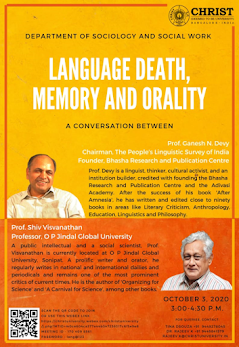
Language Death, Memory and Orality

 The Department of Sociology and Social Work organised a webinar titled ‘Language Death, Memory and Orality’ on 3rd October 2020. The speakers for this event were Prof. Ganesh N. Devy, Chairman, The People’s Linguistic Survey of India and Founder of the Bhasha Research and Publication Centre, and Prof. Shiv Visvanathan, Professor, O.P Jindal Global University. The webinar was aptly subtitled as ‘a conversation between’ the two speakers. An introductory note was given by the organisers and opening remarks by Dr Rajeev. The conversation explored the vast array of linguistic diversities present in India and the world.

Linguistic imperialism and the resultant processes with respect to dominant languages and dominated languages, the clerical approach towards languages which creates an “othered” category of non-citizens by denying means of expression and the dangers of this in an oral society like India, was discussed by Prof Devy. He also shed light on the drawbacks of the technology - how artificial memory, as opposed to human memory, is linear and therefore lacks a myth-making ability and the ability to look into the future.

Prof. Visvanathan addressed issues around cognitive violence and knowledge systems - certain pedagogies and knowledge cannot be accessed without language since they are all intimately tied together. He also spoke about how the diversity of language is beyond the efficiency of technology, and if languages die, democracy dies, and thus, the need for new languages arises. Prof. Visvanathan talked about having the space for diversity in the future, and Prof. Devy about being able to carry forward our knowledge of diversity that we so far have had. Nearing the end of the session, the speakers invited queries from the audience. The rich discussion that ensued proved that the session had indeed been a fruitful and thought-provoking one for all present!


Saturday, 26 September 2020

Inauguration of the Department of Sociology and Social Work Association 2020-2021

On September 26th, 2020, the Sociology and Social Work Association of the Department of Sociology and Social Work, CHRIST (Deemed to be University), Bengaluru, organised the inauguration and investiture ceremony of its newly elected office bearers for the academic year of 2020-202. The inaugural ceremony was attended by Dr Tony Sam George, Dean of the School of Social Sciences, Dr Victor Paul, Head of the Department, Department Cluster Coordinators, Faculty members, office bearers of the academic year 2019 - 2020, and the undergraduate and postgraduate students of the Department of Sociology and Social Work.

The President and the Secretary for the academic year 2019-2020 addressed the audience sharing their experiences and the importance of the association for the department and the student community.

The event was graced by Dr Tony Sam George, Dean of the School of Social Sciences. Dr Tony Sam Geroge delivered the keynote address discussing the importance of leadership in these difficult times. He emphasized the importance of understanding leadership as a spiritual exercise encouraging a holistic approach towards leadership and the activities of the association.

The keynote address was followed by the investiture ceremony of the newly elected office-bearers. The oath was administered by Dr Victor Paul, Head of the Department. Mr Aashik Mathews B Paliyath, Ms Archana Jayaprakash, Ms Gurneesh Arora, and Ms Asmita Bhattacharya were elected as the President, Vice President, Secretary, and Joint Secretary for the academic year 2020 - 2021. Ms Ahana Mukherjee, Mr Pradhyumna Poojari, and Ms Salma Ilyas were elected as the Treasurer, the Sports Secretary, and the Cultural Secretary respectively

The felicitation address was delivered by Dr Victor Paul, Head of the Department, Dr Hemalatha K MSW HR Cluster Coordinator, Dr.Suparna Majumdar Kar, Sociology Cluster Coordinator, and Dr Amaresha C, MSW CCP Cluster Coordinator. This was followed by the presidential address by Mr Aashik Mathew B Paliyath, the newly elected President of the association. He presented the proposed activities for this academic year. The association had decided to dedicate the activities of the academic year to discuss and act on the Sustainable Development Goals - Agenda 2030. The vote of thanks was delivered by Ms

Archana Jayaprakash.