Thursday, 1 April 2021

Annual Sociology Lecture Series - Lecture 4: Revisiting the Woman Question from a Gender Economics Perspective

 The Sociology and Social Work Association and Socius, Applied Sociology Students Collective organised the Annual Sociology Lecture Series. The fourth lecture of this series was on the topic ‘Revisiting the Woman Question from a Gender Economics Perspective’ and was delivered by Dr Vibhuti Patel, a renowned academician, researcher and social thinker who has extensively contributed to the field of gender economics.

The introductory note was delivered by Neha Ashar of I MA Applied Sociology.

Dr Vibhuti Patel’s lecture gave a comprehensive overview of gender economics in the Indian context. The main focus of the lecture was on the impact and issues faced by women in the economy.

Dr Patel discussed the gender perspective and its three approaches - Women in Development, Women and Development, Gender and Development, and how they have panned out in India. She also briefly discussed the importance of having an intersectional approach in dealing with the ‘woman’ question in gender economics. She also offered a critique of the conventional development indicators, which she stated has “bypassed women and enhanced the gender gap”.

She discussed the socioeconomic and political bases of the disadvantageous position of women in the current economic systems. Insightful examples like - how the nutrition of women is affected by the practice of women eating after the rest of the household made the situation more apparent to the audience. She also discussed the importance of political participation of women and how there are economic bases to customary and family laws. Thus the position of women in the economy is affected by factors that are not apparent as completely economic.

The woman question was also discussed with regard to economic theory. Dr Patel discussed gender bias in theories of value, distribution, and population. An example is the Nobel Laureate Gary Backer’s model of ‘competing interests’ which has been criticised by women’s studies scholars as sexist and as merely promoting the status quo.

The next topic discussed was measures that have made women more visible in statistics and data systems. Dr Patel briefly discussed the Gender Development Index and the Gender Empowerment Measure.

Dr Patel also presented HDI-related figures related to women.

The final part of her lecture was dedicated to discussing current issues and experiences of women during the COVID-19 pandemic, ways to achieve gender mainstreaming and the role it can play in attaining SDG goals.

The lecture was followed by a question and answer session. The vote of thanks was proposed by Tina Dsouza from I MA Applied Sociology.

Monday, 29 March 2021

Annual Sociology Lecture Series - Lecture 3: Tales of the Field: Doing Ethnography Today

 The Annual Sociology Lecture Series held by the Department of Sociology and Social Work Association conducted its third lecture on the 30th of March, Tuesday from 4:30 to 6 pm. Dr Nilika Mehrotra conducted the lecture series on the topic, “Tales of the field: Doing ethnography today”. It was a highly enlightening session that was attended by many students from the Sociology and Social works department.

Dr Nilika Mehrotra started the session by briefly explaining what ethnography means. It is a process of fieldwork and monograph writing. She highlighted that ethnography is a research design. Dr Mehrotra further answered a common question of whether ethnography and qualitative methods are the same by pointing that the former is not the same as a survey but can be considered as a component. She went on to detail the two types of ethnography, little and big ethnography. In classical anthropology, ethnography is an understanding of both the people and communities, for instance, religions, urban space, hospital and so on. Therefore for ethnography careful selection of fields in a natural setting in a social space is key.

Dr Mehrotra then moved on to tracing the history of Ethnography in Sociology and Anthropology.

Dr Mehrotra also drew attention to the many kinds of literature available on even the local communities, which the ethnographers can use as a reference to prepare research questions. However, Ethnography is a research methodology that is very flexible and therefore the questions can be modified according to the social setting. In such a case, Dr Mehrotra emphasizes how ethnographers need to have different strategies for different social settings and different types of data. From her personal experience, she pointed out that researchers who are older, experienced and are socially skilled make better ethnographers. Nowadays Visual anthropology and visual photography are useful tools to collect data. To ensure the validity of data cross-checking, triangulation and interpretation, self-introspection and self-criticism are very important. She went on to talk about the ways technology is being used today in this field, for jotting down notes.

Dr Mehrotra pointed out various challenges that lie in the way of carrying out ethnographic studies. These include over-participation, difficulty in taking sides, the lack of access to specialised knowledge, and more.

With this, Dr Mehrotra wrapped up the session, saying that ethnography is imbibing more and more usage of digital sources and only time will tell how the future of this field is going to look. Following this, Neha Ashar thanked Ma’am for the insightful lecture and opened the floor for questions from the audience. The audience actively engaged and an informative discussion ensued. Questions regarding perspectives (etic and emic), disabilities,over-participation and more were asked. Dr Mehrotra answered the questions in detail and supplemented them with examples from personal experiences and anecdotes. Post the question-answer session, a vote of thanks was delivered by Neha and the session came to a close.

Wednesday, 24 March 2021

Annual Sociology Lecture Series - Lecture 2: Vernacular Feminism

On the 23rd of March, 2021, the Sociology and Social Work Association organized the fourth lecture of the Annual Sociology Lecture Series, on ‘Vernacular Feminism’. The lecture was delivered by Dr J. Devika. Ananya Sunil Nair introduced and greeted the participants into the meeting. She then introduced Dr J. Devika, a Feminist researcher and Professor at the Centre of Developmental Studies in Kerala. She is also a translator of literature and social science writing in both Malayalam and English and has started a website displaying a few of the earliest writings on feminism in Kerala.

Dr Devika began the session by explaining in detail what ‘Vernacular’ really means. Vernacular is a word used in a pejorative sense, according to her it was in some way the colonial thinking which divided language into English and vernacular. The main topic of discussion during the session was the meaning of ‘Vernacular feminism’. Dr Devika successfully explained this concept, providing solid instances and highlighting the subtleties of the concept. Vernacular feminism often emphasizes the importance of everyday forms of language idiom and this has been particularly strong in media studies and cultural studies. To explain this point, Dr Devika elaborated on some of the advertisements presented in the Indian media, especially in Kerala, which tries to include feminism but fails with the consumer interpretation. Dr Devika argued that it is important to follow vernacular feminism even if you do not agree with a lot of what happens in those debates or arguments. People often think language has one primary layer whereas it is not, in every language, there are certain layers and it has the ability to translate feminism into other layers of language.

Dr Devika argued that there are two modes of translating particular political ideas including feminism, and one of them is a faithful mode where you aim for a one-to-one correspondent and the second mode is called grounded translation. Grounded translation involves picking an idea derived from a modern critical possibility is chosen and then they are explained in a local area in which it helps serve the local. She further talked about how the feminist theory was being absorbed into everyday articulations in very intriguing ways. Towards the end of the session, Dr Devika encouraged the participants to ask questions and answered them very briefly with valid points. While answering the questions she highlighted the importance of feminists to consciously make an effort to change the local words to bring in a new lens of understanding in the society. As the session came to an end, the students expressed their immense gratitude for having Dr Devika conduct the session and for introducing a topic that is very essential in today’s society.

Sunday, 21 March 2021

Roundtable 4: Sustainable Living: Towards a Better World Everyday

 The Department of Sociology and Social Work conducted its fourth student roundtable of the academic year 2020-21 on Monday, 22nd March 2021. The panellists were Niyanta Desai (6EPS), Manisha D (2MSW-HR), Rahil Parekh (2PSEco), Ahana Mukherjee (2MSoc) and Nishaanthini M. (2MSW-CCP). The moderator was Suryaveer Singh Deora from 6PSEco

The session started with an introduction to the topic by Teethi Nag, who gave the audience a background on the topic and introduced the key speakers for the day. The first speaker was Ahana, who spoke about what exactly is sustainable living and why it is important for our future. She also outlined the importance that the youth play in perpetuating this issue.

PANELISTS’ INSIGHTS

Sustainable Lifestyle at Home

Manisha spoke about how consumers can collectively influence companies, by choosing to say no to polluting products. Next, Nishaanthini gave deep insights into the topic of sustainable practices at home. She spanned over electricity consumption at home, plastic usage, water purifier systems, and much more. She also highlighted how meat consumption is detrimental to society. She gave tips to the audience, like switching to bamboo toothbrushes over plastic ones, installing rainwater harvesting systems and solar panels, and concluded her inputs by urging everyone to adopt such practices.

Sustainability Goals and their Importance

Rahil took up this topic, emphasizing building a future that is efficient and in harmony with the environment. Sustainable goals go hand in hand with social goals like gender equality. Moreover, minimalism also is connected to sustainable living, as it has to do with doing the most with the least resources.

Food Industry and Sustainable Practices

Ahana talked about the food industry. She started off by explaining organic food, and although it is completely environment-friendly, it is not affordable. The water resources are also heavily stressed, and expected to last only for the next 30 years or so. Plus, the world is facing water scarcity for around 4.7 million all over the world. Virtual water is the water required for the process of producing food, and a lot of this water is wasted. Hence, the food industry also stresses already depleting natural resources. She further iterated how groundwater and freshwater resources are being overexploited by governments. Moving on, she spoke about the various methods that can be used to replenish these water resources. Sustainable packaging is also an emerging concern for many companies today. Rahil continued this topic by speaking about organizations that are propagating sustainable practices. Many start-ups are working toward sustainable agriculture and renewable energy.

Fashion Industry’s Impact

Manisha addressed how society induces us to consume more fashion products than we actually need. Also, the fashion industry is one of the leading waste producers in the world, with the third-largest carbon emissions and being the second largest water consumer worldwide. A single pair of jeans and a cotton t-shirt can take up to 30,000 litres. Moreover, many garments are made of plastic-based materials and particles from this enter the water bodies when we watch them. Several corporations make claims that they are green, but this is not always true. Manisha further suggested tips each person can follow to reduce fashion consumption and brought up an idea for a club where students can swap clothes to be ‘green’ in fashion.

Sustainability in Developed and Underdeveloped Countries

Niyanta gave the audience an overview of the scenario and spoke at length about the state of developing countries. They are more vulnerable and have a lack of financial resources to cope with natural calamities. Climate change and its various calamities are one of the major causes of many deaths, globally and annually. The gender issue is also rampant in climate change issues, as women and girls are more vulnerable to the ill effects of climate change. She posed the question ‘should countries with historical responsibility for emission be obliged to compensate?’

She further iterated that the need of the hour is that developed nations must spearhead the attempts toward fighting climate change and pave the way for developing countries to do the same.

Post this, Suryaveer opened the floor for questions from the audience. Finally, Manisha spoke about consumer behaviour and how we need to change. She also said that collectively, consumers can coerce organizations to take actions that are environment-friendly. Ahana added to this and talked about biodiversity issues and other various issues that are present today.

The session was wrapped up by Suryaveer with a concluding note and a vote of thanks. It was a fruitful session and provided great insight on the topic of discussion.

Thursday, 18 March 2021

Annual Sociology Lecture Series - Lecture 1: The Necessity of Theory by Prof Dilip Menon

 The Department of Sociology and Social Work Association and Socius, Applied Sociology Students Collective organised the first lecture of the Annual Sociology Lecture Series on 18th March 2021. The lecture was on the topic ‘The Necessity of Theory’ and was delivered by Prof Dilip M Menon.

Archana Jayaprakash from 4 MSOC welcomed the gathering and introduced the speaker. This was followed by Prof Victor Paul delivering the introductory note.

Prof Dilip Menon began by talking about the uniqueness of the theoretical imagination of sociology and the diverse ways in which it has been used to explain the social world. He focused on the unique conditions of theorising in India, a diverse, colonial space. He elaborated on how the colonial influence has shaped the way Indian sociological thought has been shaped; it has been a mixture of elements like the colonisation of thought, and questioning of the knowledge received from colonial forces, like the colonial archives. He highlighted the role of oral histories in constructing theories on Indian societies.

Prof Dilip also discussed the Europhone Theory and the influence European and other Western histories have had on the narration of India’s history. There has been a change in how we understand communities, societies, and individuals. Our focus now is more on the atomisation of human beings.

He discussed all these aspects with several examples and then went on to remind everyone of the continued relevance of sociology in a rapidly changing India, where there are many societies changing in a multitude of ways.

Prof Dilip’s talk thus touched on many areas of theorisation and the unique conditions and challenges faced in theorising India. His thought-provoking talk was followed by a fruitful Q&A session. Nithya from 4 MSOC proposed the vote of thanks.


Saturday, 6 March 2021

CHRIST Women of the Year

 The Sociology and Social Work Association of Christ Central Campus celebrated International Women’s Day on March 6th by hosting the event, Christ Woman of the Year 2021. This was the third consecutive year that this event had been held. The host welcomed the gathering and introduced the agenda for the event. The event began with a prayer song by Rishi and Tina from the department. This was followed by a welcome address, given by Ahana Mukherjee. She talked about the importance of celebrating International Women’s Day and detailed this year’s theme, “Women in leadership achieving an equal future in Covid”.

Prof. Hemalatha, who played a key role in planning the event, then took to the stage to deliver a few words regarding the necessity of celebrating this event every year. She acknowledged the celebration of “Christ Woman of the Year” as a worthy tradition and traced world history to pinpoint when women started protesting against the long working hours and pay disparities. The professor also directed attention towards the increasing number of powerful women, across ages, in all spheres, be it online, industry or political. She encouraged women to amplify their voice and remember the theme of the women’s campaign, “Choose to challenge’, through which we need to continue to celebrate women's achievements.

This enlightening address was followed by the HOD, DR Victor Paul sir, who introduced esteemed awardees. The awardees are from three categories: faculty, support staff, and housekeeping, to recognise women’s efforts in different university sectors.

The HOD expressed his gratitude to the association members and staff and invited the respected Vice-Chancellor to honour the awardees.

He introduced the first awardee, Dr Suniti Phadke, the current Chief Advisor in the Office of International Affairs. She holds a PhD in the area of Management and obtained her MBA from New York University. She has played an important role in conceiving and implementing plans that helped develop connections with international universities.

The second awardee, Ms Cimimol Jacob, is the programme manager in the IT section of the university. She has served in the university for ten years and has experience ranging from 20 years in the IT profession. Prof Victor Paul identified Ms Cinimol as a critical driver behind technological innovations and who has been responsible for the smooth functioning of Christ’s Knowledge Portal.

The third awardee, Ms Pattamal, the head of the university’s housekeeping staff, was praised for her punctuality, sincerity, and for being solely responsible for unifying the management and housekeeping sections of the university.

The Vice-Chancellor honoured the esteemed recipients with awards and tokens of appreciation and then delivered his address. He began his speech by acknowledging the struggles of women and extended his sincere gratitude to all awardees. He praised each of the awardees for their respective efforts extensively.

Dr Anil Joseph Pinto, the Registrar, who supported the planning and implementation of the event, remarked that the award’s value lies in the valuable contributions offered by the recipients of the award. He congratulated each of the awardees and appreciated them for their dedication, professionalism, innovation and constant effort.


Prof. Suniti expressed her sincere gratitude and talked about the importance of women's day. She raised the question, whether the day is still relevant and answered this question with alarming facts about women’s position in today's society and the things yet to be done. She further listed some role models and encouraged men to change their mindset, to start the change from the grassroots level. Ms Cinimol expressed her gratitude to her superior officers, department, team members, university and family members; She further dedicated the honour to her team members. Ms Patturmal expressed her gratitude to supervisors and the university for the opportunity and remarked on her happiness in doing her work. The event was concluded with a vote of thanks delivered by Niranjana.

Thursday, 25 February 2021

Equality, Diversity, and Inclusion (EDI) Unit

The Equality, Diversity, and Inclusion (EDI) Unit is an initiative by the Student Association of the academic year 2020-2021 to promote an inclusive culture that provides opportunities for all the students to learn, explore, and grow, personally, professionally, and intellectually. The EDI Unit will lead, coordinate, and guide all the clubs, cells, societies, and other initiatives that focus on critical issues concerning equality, diversity, and inclusion.

Objectives

  • To build an active peer community of future leaders and budding activists and advocates
  • To create a platform for interdisciplinary conversations and to serve as an important adjunct to course work through various student-initiated activities
  • To facilitate holistic and collaborative learning by creating opportunities for developing creative and critical thinking

Equality Committee

The Equality Committee elected once every year will be responsible for coordinating the activities of all the cells, clubs, and societies within the department that focuses on various aspects of equality, diversity, and inclusion. The committee will consist of two faculty coordinators, the president of the student association, and 3 EDI coordinators representing BA, MA, and MSW programmes. The Sociology and Social Work Association will be responsible for initiating elections each year to elect the representatives from each cluster. The Equality Committee will lead on the planning, development, and delivery of various activities organized under the EDI Unit.

Responsibilities of the EDI Coordinators

  • Work collaboratively with the various clubs functioning within the EDI Unit, to increase participation and develop robust knowledge sharing mechanisms
  • Work in conjunction with the club coordinators for setting objectives, initiating activities and projects, and ensuring the principles of equality, diversity, and inclusion are embedded and informing all undertakings of the clubs
  • Oversee the conduct and documentation of all the activities of the club and function as the point of contact for the Association and the Department
Cells and Club within the EDI Unit

The Student Association of the academic year 2020-2021 initiated three clubs/cells within the EDI Unit.

Gender and Sexuality Cell

The Gender and Sexuality Cell under the Sociology and Social Work Association is an initiative to contribute to the achievement of SDG Goal 5 - Gender Equality.

The UN explains that gender equality is not only a fundamental human right but a necessary foundation for a peaceful, prosperous and sustainable world. The activities of the cell are aligned with the 9 Targets and 14 Indicators for SDG 5. The cell creates forums for discussions on gender equality, queer rights, violence against women, reproductive and sexual health, gender-responsive policy analysis and evaluation, empowerment through technology, etc. The cell aims to give profound importance to creating opportunities for members and the student community to voice against long-standing inequalities and organize awareness campaigns and programmes.

The club committed its activities for its first academic year 2020-2021 to organizing activities that initiated discussions on some of the crucial issues in establishing a sustainable pathway toward achieving gender equality.

Objectives

  • To facilitate a platform for discussions on the importance of gender equality in achieving sustainable development
  • To encourage individuals to take action that redresses long-standing inequalities by organizing awareness campaigns and programmes
  • To document, analyze, and understand gender data on COVID19 (objective specific to the current academic year)

Environmental Justice Club

The concept of environmental justice is not yet fully integrated into the language and spirit of the SDGs. This club is based on the premise that “many ‘environmental’ problems are, by their very nature, problems of justice.” Committing to the realization of the Sustainable Development Goals - Agenda 2030, the Environmental Justice Club will initiate discussions and debates to understand the intersection of environmental and social issues. The club will provide a platform for students to transform into environmental justice leaders and advocates for those affected by ecological injustice.

SDG 10 calls for reducing inequalities in income as well as those based on age, sex, gender, disability, race, ethnicity, origin, religion, economic or any other status within a country. The Environmental Justice club proposes to facilitate activities such as campaigns for environmental literacy, a sustainability champion programme to recognize the various initiatives and efforts of the students, and so on. SDG 12 discusses responsible consumption and production. In this regard, the club aims to initiate small-scale projects within the university campus to promote environmental sustainability and contribute to the university's effort to build and sustain a green campus. The club will also organize discussion forums and pitch competitions to encourage innovation and creativity to contribute to the SDG goal of ensuring clean water and sanitation for all.

Objectives

  • To facilitate a platform for interdisciplinary conversations on environmental justice and raise awareness of environmental justice issues
  • To train students to become advocates for environmental justice issues
  • To promote sustainability on campus and actively support the efforts taken by the administration, faculty, and student community in sustaining a green campus

Human Rights and Social Justice Cell

The Human Rights and Social Justice Cell aims at operationalizing the commitment of the 2030 Agenda for Sustainable Development to Leave No One Behind (LNOB). All the activities of the cell will emerge from the core belief that we cannot hope for sustainable development without realising human rights and strengthening social justice.

Human rights and social justice are an intrinsic part of sustainable development. The cell aims at training budding leaders and advocates to develop a human rights-based approach to policy formulation, implementation, and evaluation. The cell will create platforms for the discussion of the human rights dimensions of the 2030 Agenda and contemporary issues in human rights and social justice by bringing together students, academicians, researchers, advocates, and other experts.

Objectives

  • To create a platform that promotes sensitization and awareness regarding various aspects and issues concerning human rights and social justice
  • Operationalise the commitment to Leave No One Behind (LNOB) by initiating various activities such as awareness campaigns, workshops, discussions, lectures, research, and competitions that address the intersectional experiences and the root causes of inequalities
  • To encourage and train individuals to understand and adopt a human rights-based approach to research, advocacy, and programming

Roundtable 2 - Why We Should All Be Feminists

The Department of Sociology and Social Work organised the second roundtable of this academic year on the topic – "Why we should all be feminists", on 25th February 2021. The panellists were students from various courses within the department- Ananya Sunil Nair (2PSEco), Pooja A (4PSEco), Shifa Mohammad (4PSEco), Gurneesh Arora (6PSEco) and Tina Maria Dsouza (2MSoc). Nithya R. from 4MSoc was the moderator for the event.

The session commenced at 4 PM with a welcoming note from Ahana Mukherjee, followed by an introduction to the topic and an overview of feminism by Nithya. Following this, panellist Ananya Sunil kicked off the session by discussing the history of feminism. She glossed over the four waves of feminism and ended with a note on modern-day feminism.

The influence of social media on feminism and activism was picked up by Pooja A. She spoke about how the advent of online platforms had changed the discourse relating to modern-day feminism, and how feminist issues have been combined with a broader call for social justice. She also talked about how language helps perpetuate patriarchy.

Following this, Shifa talked about the heavy stigma around feminism and busted popular myths regarding feminism. She ended her segment with a note on how these myths have created a burden for feminism, which needs to be shed in order to move forward.

Next, Gurneesh spoke about the stereotypes that are present in today’s society. She provided many facts and valuable insights and helped the audience gain a real-world picture of all the issues that plague today’s society. Finally, Tina, the final panellist, discussed the necessity of ‘intersectionality’ in feminism. Her discussion extended toward discussing how the different identities every person has influenced their lives, opinions and experiences. Moreover, she examined the privileges that different identities have over others. The session came to end at 5:30 PM, with all the panellists giving a concluding note and with a vote of thanks given by Archana. This roundtable proved to be a great success, and the audience gained well-rounded information on the topic of discussion.

Tuesday, 23 February 2021

The Development of Teaching and Research in Sociology in India

 Socius, Applied Sociology Students Collective, DSSWA organised the guest lecture ‘The Development of Teaching and Research in Sociology in India’ by Prof R S Deshpande on 23rd February 2021. Prof Desphande is the former Director of ISEC and a Rajiv Gandhi National Fellow of ICSSR. He has worked with various policy bodies of the Government of India and the Government of Karnataka. He has also been a consultant to various projects of the World Bank, Asian Development Bank, and Land Equity International and was the Vice-Chairman of the WTO Cell of Karnataka.

The welcome speech and introductory note were delivered by Anshu Pal.

Dr Deshpande started out by outlining the development of sociology by the founding fathers. The depth of observations, the strength of the theory, the conceptualisation of sociological terms by early scholars are what laid the foundation for the discipline of sociology. He then shifted the focus to the trends and development of sociology in India. Prof. Deshpande is of the opinion that discussing the works of prominent sociologists in India chronologically does not reveal trends in the discipline, rather it is more important to look at the development change in the components of sociology over the years through the conceptualisation and development of concepts.

Three typologies of trends mentioned by Dr Deshpande are:

  • Through the schools of sociology
  • Through gurus - initiators and followers
  • Through conceptualisations, which would be the primary focus of his talk

British and American were the two international schools of thought. Most of the early sociology students in India, who later became early generation sociologists did their PhDs in the USA and Britain, and thus these schools had a great influence on Indian schools. This is similar to the trend seen in other disciplines in India, like economics There are three prominent Indian schools of sociology. The first is the Bombay School, which was initiated by Patrick Geddes who held a position in Sociology and Civics at Bombay University from 1919 to 1925. The second school is the Delhi School of Economics which had an amalgam of social sciences. The emphasis initially here was on villages, village economy, rural sociology. The third school is the Lucknow School started by Radhakamal Mukherjee. He had a deep interest in economics and sociology. He made attempts to bring fieldwork and empiricism into sociology, long before Srivinas did. Prof Desphande then talked about how prominent sociologists had specific methods and areas they specialised in, and often their students would be ardent followers of these methods, thereby creating a ‘cult’. He believes that colonisation, cult creation, and politicisation are present in every social science. He further discussed trends through conceptualisation, detailing them in order.

Prof Deshpande concluded by emphasising the need for Indianisation of sociology, Indianised methodologies, an understanding of Indian societies from an insider’s perspective, and the need to teach both sides of a concept - both its merits and its criticisms as well. The highly informative lecture was followed by an interesting Q&A session where attendees asked questions on the role sociology can play in policymaking and transdisciplinary and interdisciplinary trends in sociology.

The session was concluded with a Vote of Thanks delivered by Anshu Pal.

Friday, 12 February 2021

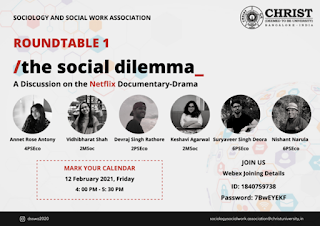
Roundtable 1 - The Social Dilemma: A discussion on the Netflic Documentary-Drama

The Department of Sociology and Social Work Association organized a Roundtable Discussion on the topic ‘The Social Dilemma- Netflix Documentary’ on 12th February 2021. The panellists were students from various courses within the department- Devraj Singh Rathore (2PSEco), Annet Rose Anthony (4PSEco), Suryaveer Singh Deora (6PSEco), Nishant Narula (6PSEco), Vidhibharat Shah (2MSoc) and Keshavi Agrawal (2MSoc).

The session commenced at 4 PM, with an opening note from the President of the Department of Sociology and Social Work Association, Aashik Matthews. Following this, the first panellist, Keshavi kickstarted the discussion by giving the audience a prelude to the topic. She also spoke about human-algorithm interaction.

Next, Devraj talked about how instant gratification has become a necessity for many today, and how social media has become a new addiction. Vidhi examined the effect of the algorithms behind social media platforms, and how they are engineered to induce users to spend more time on social media.

Nishant picked up this discussion and continued to speak more about the algorithm and the benefits it can provide as well, as the privacy vs. personalization issue. Suryaveer discussed the reasoning behind the tech giants’ motive for obtaining users’ data and attention. He further spoke about concepts like ‘monetisation of thought’. Finally, Annet gave clarity on the public sphere in the era of big data.

The session was wrapped up with a question-answer session open to the audience and ended at 5:30 PM with a vote of thanks delivered by Archana. The roundtable received positive feedback and was tagged as a success.