Saturday, 30 October 2021

Thrifting - A Sustainable Virtue

The Department of Sociology and Social Work Student Association, in collaboration with Millennium Fellowship (Class of 2021), presented this refreshing Webinar on Thrifting - A Sustainable Virtue. The two speakers invited, Ms Kinjal Jain and Ms Punya Chhajer, run successful thrift store online businesses on Instagram. The course of this Webinar followed an interactive question-answer session moderated by Manisha D from 3MSW HRDM and Keerti Narayanan from 3PSEco.
To better understand the concept of Thrifting, Ms Punya introduced us to some of the essential concepts related to thrifting. She spoke about Fast Fashion, Ethical Fashion, Sustainable Fashion and Slow Fashion.
Fast fashion is a highly profitable and exploitative business model based on replicating catwalk trends and high fashion design at a mass scale at a low cost. Most of these clothes are made by workers with low wages in deplorable conditions below the poverty line. Ethical fashion focuses on human and animal rights which implies good working conditions, fair wages, pensions and fair treatment of humans and animals—maintaining a balanced ecosystem while respecting animals and our environment and designing fashion garments according to ethical guidelines.
Sustainable fashion is being concerned about the environment. It includes a fashion with recyclable, organic fibres, which can also be repurposed. Fashion items with minimal chemical fibres, toxic dyes, and less virtual water and energy consumption are sustainable. Slow fashion emphasises the importance of quality over quantity. It tries to understand the nuances behind clothing. The shelf life of a particular piece of clothing should be at least more than two years, and the company that manufactured the clothing should be transparent enough to reveal its policies and practices.
Ms Kinjal added to the discussion by covering the environmental impact of fast fashion on oceans due to microplastics and microfibres taking over the marine ecosystem. Promoting second-hand wear requires a change in mentality; Fast Fashion items should be reused and recycled.
The next question addressed some of the pros and cons of thrifting, wherein Kinjal provided a practical insight by showing thrifting's positive and negative sides. She gave the audience tips encouraging them to start thrifting. She cautioned the audience about scams on social media sites in the name of thrift stores.
The discussion then took a turn to address some of the policies of thrift shops regarding unused clothing. Punya addressed this question by elaborating on some of her return policies which may go back to the seller or get donated if the item is not sold. She talks about her pricing mechanisms based on the condition of the clothing item - whether it's not worn, old, new, et cetera. Kinjal specified having fair prices by grounding high prices to match the realistic expectations of the buyers and sellers. She focuses more on the sustainable aspect of thrifting rather than thrifting as a business model for second-hand clothing.
Kinjal shares the history of her store as she saw her friends thrifting for the first time and then continued to thrift more in the future. "Making people conscious of thrifting trends is one of my cherished memories." Punya specified that one could buy items from other second-hand stores; however, it is becoming more popular than social media influencers endorse. Thrifting should not be undertaken as a trend; one must make a conscious effort to become more sustainable through thrifting.
Following this discussion, both the speakers elaborated on some of the myths related to thrifting. Kinjal explains some of the major misconceptions between thrifting and reselling clothes and hand-picked items, often displayed in thrift stores online. "Customers should know which ones are the thrift stores, reselling stores, and other hand-picked curated items."
Both the speakers elaborated on some of the myths related to thrifting. Kinjal explains some of the major misconceptions between thrifting and reselling clothes and hand-picked items, often displayed on thrift stores online. "Customers should know which ones are the thrift stores, reselling stores, and other hand-picked curated items."
Punya says that many thrift stores are marketed as being affordable; hence it is looked down on. She says, "Only people of a certain financial level thrift. This is not true as thrifting is not about financial status; it is more about giving an item a longer life." Thrifting is affordable; however, there should not be misconceptions about prices and thrifting.
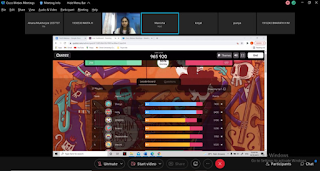
Post the discussion, a short quiz was held, moderated by the session's facilitators, and then a short Q and A session resulted in further discussion. Some important points were about the future of thrift stores and India and the inclusivity of sizes in these thrift stores. An interesting discussion also occurred regarding the ethical and sustainable practices of thrifting itself. Thrifting is more about giving life to an already worn piece of clothing rather than consciously only buying sustainable and ethically sourced fashion items.
The session was brought to a close by a vote of thanks delivered by Keerti Narayanan of 3PSEco.

Wednesday, 13 October 2021

Cancer Awareness and A Healthy Lifestyle

In collaboration with Sanjeevani - Life Beyond Cancer, the Department of Sociology and Social Work Student Association organised a webinar on Cancer Awareness and Healthy Lifestyle. The webinar began with a short video depicting the achievements of Sanjeevani - Life Beyond Cancer, an organisation that works in the field of comprehensive cancer care. Ms Annu, a member of the organisation, introduced the founder, vision, and goals. She then talked about their different initiatives and invited the main speaker, Ms Florina Singh.
Ms Florina Singh briefly talked about all the topics she planned on covering throughout the webinar. She defined cancer as the growth of abnormal cells and explained the factors that contribute to this growth and control these factors, such as low immunity and unhealthy lifestyles. She stated that cancer is the second leading cause of death in the country and is also affected by genetics. She then presented a video on how cancer cells and immunity cells work. She then spoke about food and nutrition, determined by timing, quantity, combination, and mindset. She highlighted that one must be thankful for the food, as our emotional attitude affects digestion. Next, she covered the importance of breathing and spoke about how we should take more prolonged and deeper breaths. Then she talked about mental health and how one must discuss issues about mental health more. Negative thoughts, anxiety and depression create an environment for cancer cells to develop and thus must be processed the right way. She highlighted some techniques to control negative emotions, such as reverse counting and journaling.
Next, she discussed cancer's early signs and symptoms that are ignored much too often. These include unusual bleeding, minor sores, painful lumps, gastric issues, sudden changes in moles, a nagging cough and more. She also demonstrated a self-check for breast cancer by checking for lumps.
She mentioned the different treatment options, such as chemotherapy and radiation. She then spoke about the various risk factors of cancer such as tobacco and marijuana use, obesity, stress, lack of sleep, low physical activity and an unhealthy diet. She also showed the audience a small video on the importance of good sleep. She spoke about the most common types of cancer, the first being lung cancer for men, followed by breast cancer for women.
In conclusion, Ms Florina emphasised the importance of psychosocial support to help cancer patients process their diagnosis and treatment options. One must be empathic and try to be as inclusive as possible. She shared anecdotes about how she and people she knows help patients by going for walks or cooking for them. She said that 80% of cancer might be treated by medication, but 20% of it depends on one’s willpower.
She ended with a quote by Stuart Scott, “You beat cancer by how you live, why you live, and in the manner in which you live.”
The co-host then thanked all participants and announced a quiz for the audience. This was followed by a question-answer session as well as sharing of experiences. Dr Victor Paul thanked the guest speaker and commended her work. He also thanked the organising team and the association, following which the quiz winners were announced. Ramya Mohini Yerram, the General Secretary (UG), delivered the vote of thanks, which concluded the session.

Friday, 1 October 2021

Christites Against Substance Abuse (CASA) Roundtable - What We Can Learn from Gandhi: Combating Substance Abuse


Christites Against Substance Abuse (CASA) under the Department of Sociology and Social Work Student Association conducted the semester’s first student roundtable on the 1st of October. A panel of five students was set to participate in a discussion on the theme ‘What we can learn from Gandhi: Combating Substance Abuse’ on Gandhi Jayanti and National Anti-Drug Addiction Day. The welcome address was presented by Pooja A from 5PSEco. She warmed up the audience by conducting a short quiz, promising a gift for the first person to answer each question correctly. She then introduced the panellists - Isha Singhal from 1MSW HRDM, Nikita Choudhary from 1MSOC, Monica Mohanasundaram from 1MSW CCP, Divyajyoti Swain from 5PSEco, and Rahith Saini (name changed) from 5PSEco.


Isha initiated the discussion, talking about abuse and misuse, tolerance and dependence, and forming plans to prevent the same. She quoted Gandhi on his perspective on substance use and its effect on gender and domestic violence, morality and society. She ended by stating that we must either reduce or entirely eradicate the use of such substances, as it is not worth the fleeting moment of ecstasy, and related it to Gandhian Marxism and his notions of ahimsa.


Next, Nikita highlighted the increase in substance abuse, especially in adolescents, during the pandemic. This could be attributed to loneliness, sudden mental changes, and higher domestic violence rates. The announcements of lockdowns led to hoarding of alcohol.

Nikita talked about how Gandhi perceived alcohol to be a manifestation of the devil that destroyed both the individual and society and advocated for compulsory sobriety. She spoke about how political parties use alcohol to maintain political dominance in specific constituencies. She also talked about Gandhi’s principle of Sarvodaya and how it led to the upliftment of society.


Next, Monica highlighted the sexual abuse aspect of substance abuse, such as harassment and marital abuse. She also talked about how the patriarchy ingrained into our society forces women to stay silent about this abuse. She put forth a fundamental question, can a ban on alcohol consumption substantially reduce domestic violence? Such violence has several other dimensions, but alcohol prohibition can reduce its reduction. She talked about how Bihar and Mizoram have tried implementing such measures, but its success was debatable in practice due to a lack of mandates that regulate the black market and other such loopholes. She then questioned the state of today’s generation due to such prominent substance abuse in recent years. She ended by saying that we should keep in mind the dharmas of Gandhi, especially the principle of ahimsa.

Then, Divyajyoti took the discussion forward by talking about substance abuse as a growing problem and then looking at it from Gandhi’s perspective. He then highlighted research that prohibition does not reduce substance abuse. Personal freedoms in the modern world mean the forced ban is often counterintuitive, and thus we must inculcate Gandhi’s notions of responsibility and understanding into a balanced use of substances. He talked about the development of self-control as a skill. Further, he said that labelling alcohol as synonymous with the devil creates a stigmatised society, and one must thus approach the issue differently.

Finally, Rahith Saini (name changed) ended the discussion by summarising Gandhi’s thoughts on alcohol, smoking, and vices. He supported these thoughts that such substances cause severe issues to public health and society but also said that we must not go so far as to call it the drink of the devil. Instead, we must find a balanced and responsible point of use. He highlighted India’s long-standing history of cannabis use and thus said that responsible use is possible if we have constructive discussions about the same. He talked about Gandhi’s belief in naturopathy and rejection of medical drugs. He used this to talk about how some drugs are indispensable for medical use and thus disagreed with Gandhi on this point. He concluded that bans never work; however, the decriminalisation of substances combined with better mental health infrastructure can better solve the problem. We must look at it as a societal problem instead of a criminal one.

Following this, Pooja took over, throwing the floor open to the audience for any questions. One student asked Rahith Saini (name changed) about how we can induce a cultural shift when it comes to substance abuse, who replied by talking about the importance of being open-minded and communicative. She also welcomed closing remarks from the panellists, who spoke about how we must work towards reducing the negative effect of substance use and how there is a lot to be learned from Gandhi about the same.

She then invited Dr Reena Merian Cherian to address the audience, who talked about the practical applicability of self-control and appreciated the emphasis on women. This concluded the session, as the association extended their gratitude to the audience and the panellists.


Wednesday, 29 September 2021

Careers in Social Sector

The session organised by the Department of Sociology and Social Work Student Association began with a welcome speech for Mr Ravi Sreedharan. He has worked in the corporate sector for 24 years before quitting to join the social and developmental industry in 2011. The speech began with a small story on the unfortunate situation of the Indian education system, mainly related to the government where the majority of the population is getting educated and how one can bring in a systemic change to reform the education sector as a whole.
He emphasised the need to enter the social sector and how the time is never better than during the Covid 19 pandemic. He reiterated the fact that it was neither capitalism nor was it the market that helped everyone. Instead, the civil society, i.e., the social sector, was helping everyone in their hour of need.


Sovereignty, socialism, democracy, justice – India failed as the pandemic hit us, where the fractures in India came to light with the plight of migrant workers during the pandemic. The social sector and civil society are the country's essential pillars, and working with them will lead to a meaningful and impactful life. He highlighted how important it is for youngsters to enter the social and developmental sector for the better growth of India. Such a feat requires a big heart and cognitive and technical skills to solve complex problems. The proper knowledge, attitude, and skills will go a long way in the future.

Being the founder of the Indian School of Development Management (ISDM), Mr Ravi explained the importance of developmental studies, sectoral expertise, and opportunities offered through social work. He also highlighted the curriculum at ISDM, which has been meticulously tailored to meet the needs of the emerging social and developmental sector ecosystem.

He talked of the importance of sustained impact – where there is persistent problem solving and not creating more problems to solve just one. One should give critical importance to social issues at scale and, when not shown, can develop into much more severe problems.

The session concluded with the Alumni of CHRIST, Ms Ann, who studied at ISDM sharing their experiences and their transition into the developmental sector. Mr Aseem Purohit, a part of the leadership team at ISDM, who also moved to the social industry after being in the corporate sector for over 32 years, shared his experiences.


International Food Loss and Waste Reduction Day - Online Campaign


 The Department of Sociology and Social Work Student Association posted on their Instagram page for the International Food Loss and Waste Reduction Day on 29th September 2021. It would not be beyond any of us to realize that food ownership carries with it a weight of responsibility - an understanding that we are its custodians bound to treat it carefully.

The Sociology and Social Work Student Association keeping this responsibility in mind observed the international food loss and waste reduction day on the 29th of September 2021. The Instagram post reached an audience of 152 viewers and garnered interactions based on users sharing the post on their own handles as well.

We got to know a lot about waste and how households generate around 61% of waste and India shares about 8.7% of annual per capita food wastage.

Food loss can happen due to a lot of reasons such as bad weather, processing problems, lack of cold storage, overproduction and unstable markets.

But Food waste can be controlled at an individual level for the greater good of the community.

How can one contribute towards waste reduction?

  1. Plan your meal – Every day at the start of the day we should plan our day along with the meals to avoid food wastage.
  2. Turn waste into compost pits – All the food waste is biodegradable which means that it can be put into the soil which will act as a good fertilizer.
  3. Love your leftovers – Once you start loving your leftovers you will find ways to reuse them and not just throw them in the bins.
  4. Practice FIFO; First In First Out – During FIFO is a storing and rotating food system in which the food which has been in the storage longest will be out first and then the next food will be used.
  5. Shop Smart – To reduce food wastage we should always shop smartly and thought rationally as to what to buy.
  6. Sharing is caring – When you feel that some food is extra or some resources are extra it is always advisable to share it with someone who lacks it so that there is no loss of food and resources in general

All the things mentioned above work on an individual basis. Our actions should reach a global level so that maximum food is produced, used and not wasted. The introduction to technologies, innovative solutions, and finding new ways to work and manage food will only help us achieve SDG goal 12 which is responsible consumption and production.


The Instagram post can be accessed through the following link:

https://www.instagram.com/p/CUZcx3BIN2n/?utm_source=ig_web_copy_link


Friday, 17 September 2021

Inauguration of International Alumni Association - New Zealand Chapter

The Department of Sociology and Social Work Student Association organized the inauguration of the International Alumni Association - New Zealand chapter. The host for the event was Ms Shrutilaya S. The program commenced with the lighting of the lamp and invocation song. Ms Ankitaa Mohanty welcomed the dignitaries, faculty members, coordinators, and other participants to the program. Prof Cyril John, the Alumni coordinator, introduced the necessity of the international alumni forum to the participants.
This is a platform that helps the students connect with the alumni. Followed by this, Dr Victor Paul, Head of the Department of Sociology and Social Work, and Fr Dr Jose C C, Pro-vice Chancellor, addressed the gathering, respectively. Ms Neha Ashar introduced the office bearers of the alumni association of the region. Mr Ajith Wilson (President), Ms Shiny Joseph (Secretary), and Mr Nithin Manuel (Treasurer) are the office bearers of the international alumni association of the New Zealand chapter.
On behalf of Ms Shiny, the report was presented by Mr Justin. Followed by this, Mr Ajith shared the program's vision with the participants. Mr Samuel George and Dr Hemalatha K felicitated the gathering. Dr Victor Paul addressed the alumni about the recent developments and changes in the department. Mr Nithin, Mr Ephrem, Mr Justin, Mr Alen, Ms Madhavi, and Mr Manoj shared their experiences of being in CHRIST (Deemed to be University) and their current job positions. The session ended with a vote of thanks by Ms Neha Ashar of 3MSOC.


Tuesday, 14 September 2021

Inauguration of Student Association (Department of Sociology and Social Work)


    The Inauguration of the Department of Sociology and Social Work Student Association was held on the 15th of September, 2021. On this day, the elected office bearers of the Student Association were officially enlisted and administered the oath of office. Ms Meenakshi Prashanth and Ms Ashni Maria Jose were the event’s hosts. The event began with the Lighting of the Lamp coupled with a melodious rendition of the Invocation song by Ms Dishita. Ms Sanhitha Nama welcomed the dignitaries gracing the occasion. The chief guest - Dr Sapna S, Head, School of Law, CHRIST (Deemed to be University), Bengaluru, the Chair - Dr Tony Sam George, Dean, School of Social Sciences, CHRIST (Deemed to be University), Bengaluru and Dr Victor Paul, Head of the Department of Sociology and Social Work were part of the event.

    Dr Tony Sam George addressed the gathering asserting that “we can no longer lead like how we led before.” He imparted his pearls of wisdom regarding leadership and social contributions in the pandemic and post-pandemic era and congratulated the office-bearers. The chief guest Dr Sapna addressed the gathering and spoke extensively about how the association members need to be aware and mindful of the opportunities they can create, come across, and use effectively to contribute to empowerment and community transformation.

    After the dignitaries addressed the gathering, Ms Meenakshi invited and welcomed the office-bearers. This was followed by Ms Ashni asking Dr Victor Paul to conduct the oath-taking and install the office-bearers to the Student Association. After Dr Paul administered the oath, he addressed the gathering. He congratulated the previous Association members on their hard work and achievements and welcomed the new members.

    Mr Aashik Mathews, Former President of the Association, was invited to felicitate the gathering. He shared his experiences in the Association and presented the annual report for the previous academic year. He also inspired and encouraged the current members to take on challenges and uphold the integrity of the Association. Dr Om Prakash LT, the Sociology cluster coordinator, was then invited to address the gathering. He shared a couple of instances that helped great leaders build leadership qualities to inspire the office-bearers. Ms Keshavi Agarwal, President of the Association, shared the vision for the Student Association. Finally, the event was concluded with a vote of thanks delivered by Ms Nikita H, Vice-President (UG).

Wednesday, 8 September 2021

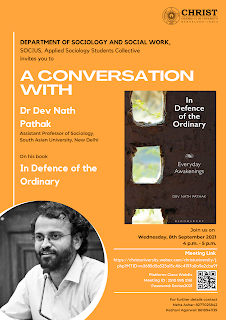
Book Talk: In Defence of the Ordinary by Dr Dev Nath Pathak

 In collaboration with Socius, the Applied Sociology Students’ Collective, the Department of Sociology and Social Work Students Association organised a conversation with Dr Dev Nath Pathak, Assistant Professor of Sociology, South Asian University, Delhi, on his book “In Defence of the Ordinary”. The event took place on 8th September 2021.


The event began with Neha Ashar of 3 MSOC delivering the welcome address. This was followed by Prof Victor Paul, Head of the Department, addressing the gathering. Meenakshi from 1 MSOC was then called upon to introduce Dr Dev Nath.

The discussion began with Dr Dev Nath discussing the central premise of his book. Dr Dev describes the book as one which could be read at ease. It is written in a conversational style and has been an excuse to interact with young scholars.

The book aims to make the self of the reader the subject of analysis; it is a rumination on the idea of ‘ordinary’. It tries to understand ways of looking at the ordinary from the ordinary itself. This view offers a point of departure from the structures we see in social reality. The focus here is on non-glamorous, mundane, imperfect aspects of our lives—for example, the drudgery of bringing up a child. The aim is not to romanticise the difficulties of bringing up a child but to understand the various possibilities that accompany it.

It celebrates an old and almost forgotten perspective called Lokayata. Dr Pathak says the book operationalises the Loyaktic tradition. An essential part of this tradition is Vitanda Vaad, a form of debate where a thesis is countered with an anti-thesis. However, the persons involved in this debate aim to understand the other’s perspective.

Human beings are psychoanalytic creatures with colliding emotions and inherently rebellious beings. Despite the hierarchy of emotions we have established, it is the recognition of less-talked-about emotions like hate.

Dr Dev proceeded to talk about addabhaasi (chitchat), and its variants across South Asia. Chitchat is a way by which we make sense of our ordinary lives. Here, we make observations and witty comments about our lives and one another that would have slipped even the attention of anthropologists and other scholars.

In response to a question asking what prompted him to write this book, Dr Dev says that the book is not an objective work and contains the author’s self. He also has commonsense ideas that are essential to social sciences. No science is free from commonsense, and there is a great deal of jugaad in scientific innovations.

He wrote this affected by a system where our professional priorities are misplaced. Everyone is expected to be a ‘famous name’ who performs extraordinarily well in any field they pursue. This book is, thus, a protest against the formula for success and the anxiety-inducing regime we are a part of.

Dr Pathak answered questions related to his book. One of them was concerned with truth becoming the dictum of the scientific empiricist faith. He answered this with various examples derived from multiple areas like mythology, films, and pop culture. The emphasis was on understanding the truth concerning half-truths to make sense of a post-truth world.

Dr Dev then shifted the conversation to classroom teaching. He questioned the practice of looking down upon students’ commonsensical understandings and the imperfect articulations of their observations and experiences. He believes that it is important to engage with these thoughts that provide the locational embodied knowledge of the students.

In response to a question from the audience, Dr Pathak discussed what he believes to be a ‘data war’ in the contemporary post-truth world. Data is presented by people with different perspectives, in a crisp format. He discusses Rushamon as his preferred resolution of this issue. The data war makes us forget that we all have half-truths or different perspectives of reality. We forget that we often selectively engage with data. Ordinariness on the contrary is not a monolithic whole but has dynamic layers to it. He notes that there can exist multiple perspectives and interpretations, as long as no one of them is proclaimed as the Truth.

The ordinary is also the site where various oppressions come into practice. We look to release ourselves from oppressive layers of ordinary to layers that are more liberating.

Dr Pathak aims to pass on to scholars the discomfort that he believes is necessary to improve our understandings, to go beyond the clear distinctions between various disciplines. It is necessary that we nurture this discomfort and sense of playfulness for a young discipline like Sociology to grow. We need to grow out of this fear of certain kinds of data such as photography and other visual media. We have been copying from sociology in the West but have not learnt some lessons such as moving forward from debates concerning objectivity and subjectivity, for example. In this context, he also stresses the importance of enabling students to connect classical sociology with contemporary sociology.

In response to a question on the ordinariness of silence, Dr Pathak talked about streams of consciousness that cannot be translated into speech. Silence has speech value but cannot always be articulated, just like dreams cannot be fully retrieved. Speech and silence can be vulnerable and distorted, but they are also incredibly powerful.

The session was concluded with a vote of thanks by Keshavi Agarwal of 3 MSOC.


Thursday, 29 April 2021

Christities Against Substance Abuse (CASA)

Alcohol and drug abuse has emerged as a serious concern in India with more children, adolescents, and young adults susceptible to substances and developing long term consequences. Christites Against Substance Abuse (CASA) is an initiative by the Student Association of the academic year 2020-2021 to contribute to the measures taken by the university to create and maintain a campus environment that is free of all forms of substance abuse. CASA is committed to its mission of building an active community of volunteers, peer educators, faculty, experts, and counsellors dedicated to raising awareness about issues involving substance abuse.

As young leaders of tomorrow, CASA realizes the immense responsibilities on our shoulders to call for a collective action to support the realization of the 2030 Agenda for Sustainable Development. The activities of the cell are dedicated to the realization of Goal 3 of the 2030 Agenda, ensure healthy lives and promote well-being for all of all ages, with a specific focus on Target 3.5, strengthen the prevention and treatment of substance abuse, including narcotic drug abuse and harmful use of alcohol.

Objectives of CASA

  • To build an active peer community that strives to raise awareness on issues involving substance abuse by planning and organizing prevention activities at various levels
  • To encourage and support the various initiatives or projects of the department and the students aimed at substance abuse prevention, and to create opportunities for research and service-learning
  • To create a safe and inclusive environment that can facilitate discussions on substance abuse prevention, addiction, treatment, rehabilitation, and recovery

CASA and Nasha Mukt Bharat Abhiyan

CASA will work at the forefront of the University’s mission to develop the institution as a hub for nurturing clubs and other platforms to achieve the targets under the aegis of Nasha-Mukt Bharat Abhiyan. CASA will take the lead in initiating and coordinating awareness generation programmes at various levels within the university, and support the initiation and formation of youth clubs within the urban slum communities and schools adopted by the University.

Specific Objectives with Regard to Nasha Mukt Bharat Abhiyan

  • Educate and train the CASA volunteers on various issues involving substance abuse by organizing workshops and interactions with experts
  • Organize awareness generation programmes within the University through peer education, campaigns, workshops, service learning, certificate courses, competitions, etc.
  • Take the lead in the initiation and formation of youth clubs in the project areas and support the various capacity building exercises and training programmes organised by the University by mobilising the energy and potential of the youth towards the development of their community

Action Plan

The Association had initiated the formation of CASA Core Committee 2020-2021 by the second week of March. The aim for the rest of the current academic year was to build a strong foundation for the full functioning of CASA from the next academic year.

Christites Against Substance Abuse Inauguration Ceremony

On the 30th of April, the Department of Sociology and Social Work conducted the Inaugural Ceremony of the CASA- Christites Against Substance Abuse. Pooja A and Ananya from the Department of Sociology moderated the ceremony, which began with a peaceful prayer song.

Following this, Dr Reena Merian Cherin, Assistant Professor and Faculty Coordinator from the Department of Sociology and Social Work delivered the welcome address and welcomed the faculty members, student body and students from different campuses. Dr Victor Paul, Head of Department, Sociology and Social Work and the Principal Investigator of Nasha Mukt Bharat Abhiyan in association with Christ, then talked about the crucial role of CASA and the larger campaign in making a difference. His address helped in highlighting the importance of Nasha Mukti Bharat Abhiyan as an agent of change. He stated key statistics underlining the need for intervention. In India, almost 16 crore people consume alcohol and about 3.1 crore individuals use cannabis products. In light of these alarming numbers, the Ministry of Social Justice and Empowerment, the nodal Ministry for Drug Demand Reduction, launched ‘Nasha Mukt Bharat Abhiyaan’, a campaign in 272 districts that have been identified as most vulnerable in terms of substance use. The Abhiyaan's focus is on educating and empowering the youth of the nation to fight against the problem of substance abuse through preventive education and awareness generation, capacity building, treatment and rehabilitation, focused intervention in vulnerable areas, skill development, and livelihood support of ex-drug addicts. It also aims to conduct surveys, studies, evaluation and research. The period for this programme is one year. Dr Victor Paul then highlighted the importance of university-based prevention since colleges offer an environment for prevention through the support of teachers and peers. A university-based prevention program also sets a platform to teach students valuable life skills like assertiveness which can help students make informed decisions.

Being the only university from the city to have joined with the government for this program, Christ (Deemed to be University) has a key role to play. Dr Victor Paul then highlighted the core objectives of the programme, which are to generate awareness, prevent substance abuse, promote community outreach, strengthen counselling facilities, and initiate capacity building programmes. The expected outcomes range from raising awareness, community participation, training to equip key service providers and creating drug-free environments. He further detailed strategies for sustainability, and the components included reaching the goals. The detailed action plan and proposed activities were then shared, where the target of ten villages, three campuses and two urban areas were proposed. 

Aashik and Archana, the President and Vice-President respectively of the Department of Sociology and Social Work, then detailed the plans for the student body of CASA and its objectives. They drew attention to statistics to highlight the importance of this initiative and spoke about the three major objectives: building an active peer community, encouraging and supporting development initiatives, and creating a safe and inclusive environment. The plan for student activities was also proposed, and it included student roundtables, awareness campaigns, peer intervention programmes, community outreach programmes, certificate programmes and service learning.

Dr Tony Sam, Dean of the School of Social Sciences and Head of the Department of Psychology, was highly appreciative of the initiative and congratulated the members. He expressed how it is high time for such an intervention in society and encouraged the members to continue the initiative as a lifelong project. The potential of this project to make a great change was also highlighted.

The floor was then open for a question and answer session, following which Dr Amaresha C, Assistant Professor and Faculty Coordinator from the Department of Sociology and Social Work, delivered the vote of thanks.