Friday, 16 February 2024

Empowering Research Exploring Societal Narratives and Transformative Practices

 Department of Sociology and Social Work

Empowering Research Exploring Societal Narratives and Transformative Practices


At CHRIST (Deemed to be University), Bangalore, the School of Social Sciences recently

hosted an enriching seminar titled "Doing Research" on September 12, 2023. The event aimed

to delve into the fundamental processes of research while exploring the intersection of diverse

societal narratives, aligning with the Sustainable Development Goals (SDGs).


Empowering Research Initiatives

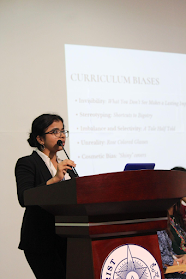
The seminar featured insightful presentations by PhD scholars and students from the Department of Sociology and Social Work. Ringngheti Khenglawt, Apeksha Singegol D, Anoushka De, Rajan Gupta, Shivani S, Shreeganesh, and Balaji shared their research endeavours and experiences, shedding light on critical societal issues.


Key Insights and Takeaways

Apeksha emphasised the importance of diverse sources for a robust literature review, while

Ringngheti highlighted the significance of identifying research gaps with a professional and

non-judgmental approach. The need for strong work ethics and empathy towards research

participants emerged as essential themes.


Exploring Societal Narratives

Ringngheti discussed the cultural implications of dubbed Hindi soap operas and Korean dramas

in Mizo entertainment. At the same time, Apeksha examined the evolution of Tamil cinema as a

reflection of Tamil politics and social issues. The presentations underscored the role of media in

shaping cultural identities and societal discourse.


Transformative Practices and Experiences

The research interns shared their diverse experiences, offering insights into fields ranging from

child rights advocacy and cybersecurity awareness to spirituality in plural societies. Through

internships at organizations like CRY, The Nudge, and the Centre for Development Studies,

students engaged in impactful research on education, rural development, and social

empowerment.


Aligning with the SDGs

The seminar resonated with several Sustainable Development Goals:

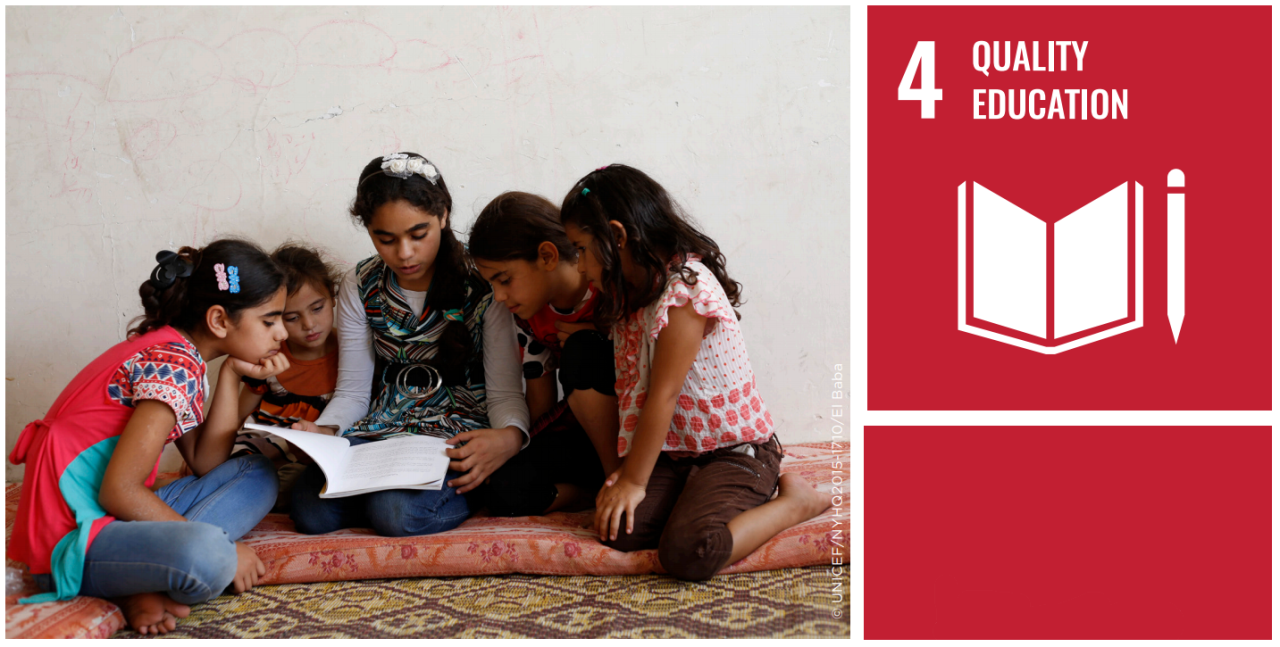
Goal 4: Quality Education - Research initiatives focused on education policies and practices,

contributing to quality education and lifelong learning opportunities.

Goal 5: Gender Equality - Efforts to address societal issues such as cybersecurity awareness

and rural development promote gender equality and social inclusion.

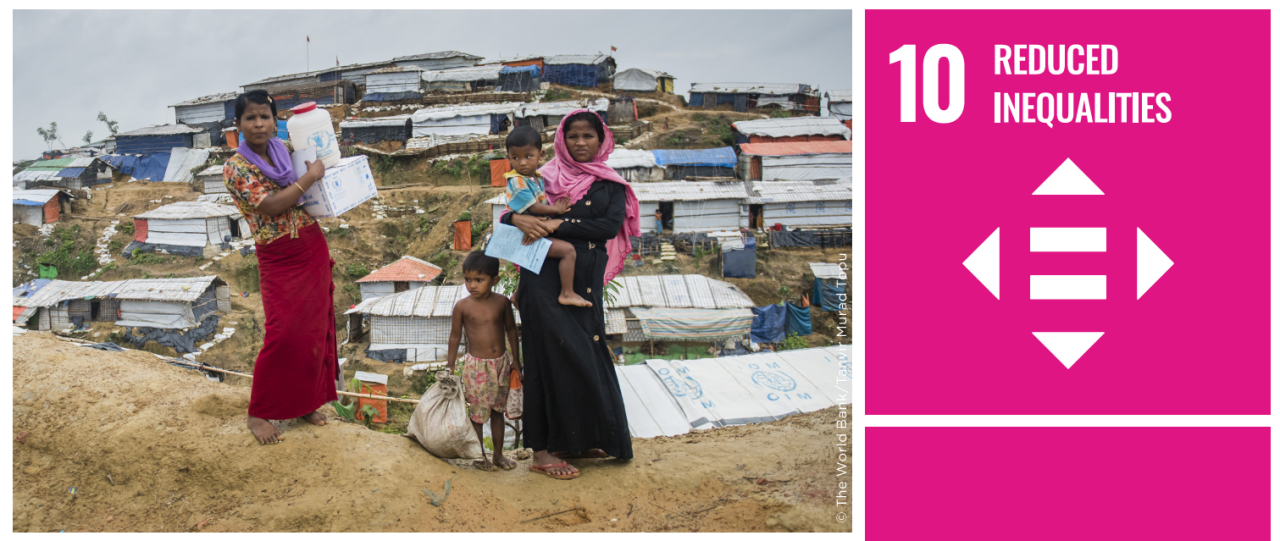
Goal 10: Reduced Inequalities - Research on caste dynamics in Tamil cinema and rural

development policies in Telangana addresses inequalities and promotes social justice.


Follow-up and Action

The seminar served as a platform for students to grasp the intricacies of research

methodologies and ethical practices. Emphasis was placed on refining theories and

methodologies to address specific research topics, fostering professionalism, teamwork, and

empathy.


Tuesday, 13 February 2024

Student Panel Discussion Inequalities and Education

  Department of Sociology and Social Work


Student Panel Discussion

Inequalities and Education 


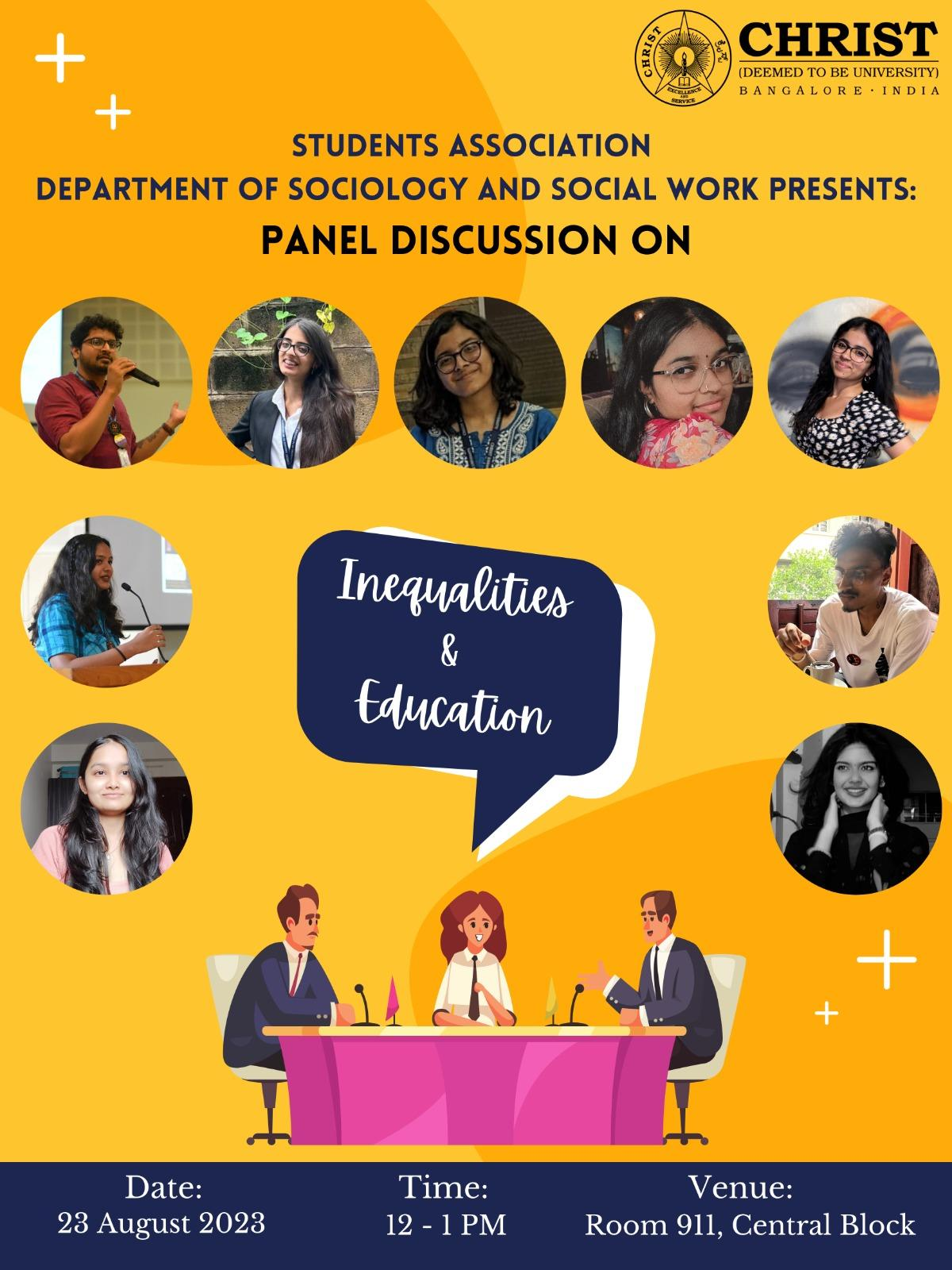
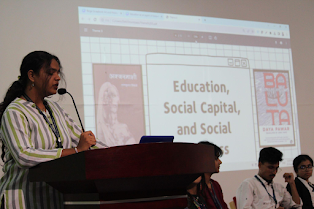
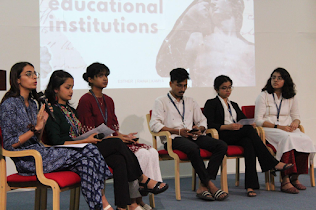
The Department of Sociology and Social Work Student Association hosted a panel discussion at Christ University titled "Inequalities and Education" on 23rd August 2023; student panellists explored three overarching themes, each offering unique insights into the intricate relationship between education and societal disparities.


Theme 1: talked about Structural Inequality and Accessibility in Education, where panellists Kamya Malik, Raina Mishra, and Esther Rachel Stanley illuminated the pervasive structural inequalities obstructing access to education, particularly for marginalised and economically disadvantaged sections of society. The lens through which these issues were examined included caste, class, race, and gender. The speakers emphasised the role of education in breaking the cycle of poverty but lamented social stigmas and inherent limitations in educational resources tied to caste, race, and gender identities. Geographical disparities between urban and rural areas further compounded the issue, creating a stark contrast in educational opportunities.

 Additionally, the conceptualisation of 'Cultural Reproductions' as outlined by Bourdieu, the sidelining of cultures through language proficiency emphasis, and the effects of privatisation in education were highlighted.


Theme 2: Education as an Agent of Inequality and Reproduction of Ideology where Bela Redkar, Fionn Firoze Sheik, and Ishani Choudhary delved into the nuanced topic of education as an agent of inequality, exploring how it can perpetuate societal ideologies rather than acting as an equaliser. The panellists interrogated the distortion of education's primary ideals and aims in the present context, along with a call for reevaluation of the current state of education and its impact on societal ideologies.


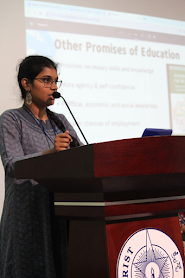
Theme 3: Promises of Education, represented by Roshan, Ilakya, and Dheekshitha D, the participants under the theme of Promises of Education, scrutinised whether education was fulfilling its overarching promises. They critically examined education’s primary ideals and aims, offering insights into how these promises have been distorted in the contemporary education system. They presented a poignant summary of how structural inequalities adversely affect educational accessibility in India. It underscored the concerning reality of education serving as an agent that perpetuates ideological and structural disparities.


Aligning with the SDGs


Goal 4: Quality Education - The discussion highlighted the pervasive structural inequalities obstructing access to education, especially for marginalised and economically disadvantaged sections of society. By addressing the barriers related to caste, class, race, and gender, the panel emphasised the role of education in breaking the cycle of poverty.


Goal 10: Reduced Inequalities - Exploring how education can perpetuate societal ideologies and calling for a reevaluation aligns to reduce inequalities. By addressing the root causes of educational disparities, the discussion contributes to creating a more inclusive educational system.


This panel discussion meticulously examined the nuanced relationship between education and societal disparities. The speakers unearthed the multifaceted challenges of structural inequalities, the potential for education to become an agent of inequality, and the distortion of its promises in the present context. The goal is to create a space for constructive dialogue, fostering a culture of inclusivity and understanding within the academic community.


Gandhi's Idea of Swaraj: A Path to Social Justice and Sustainable Development

 Department of Sociology and Social Work


Gandhi's Idea of Swaraj: A Path to Social Justice and Sustainable Development

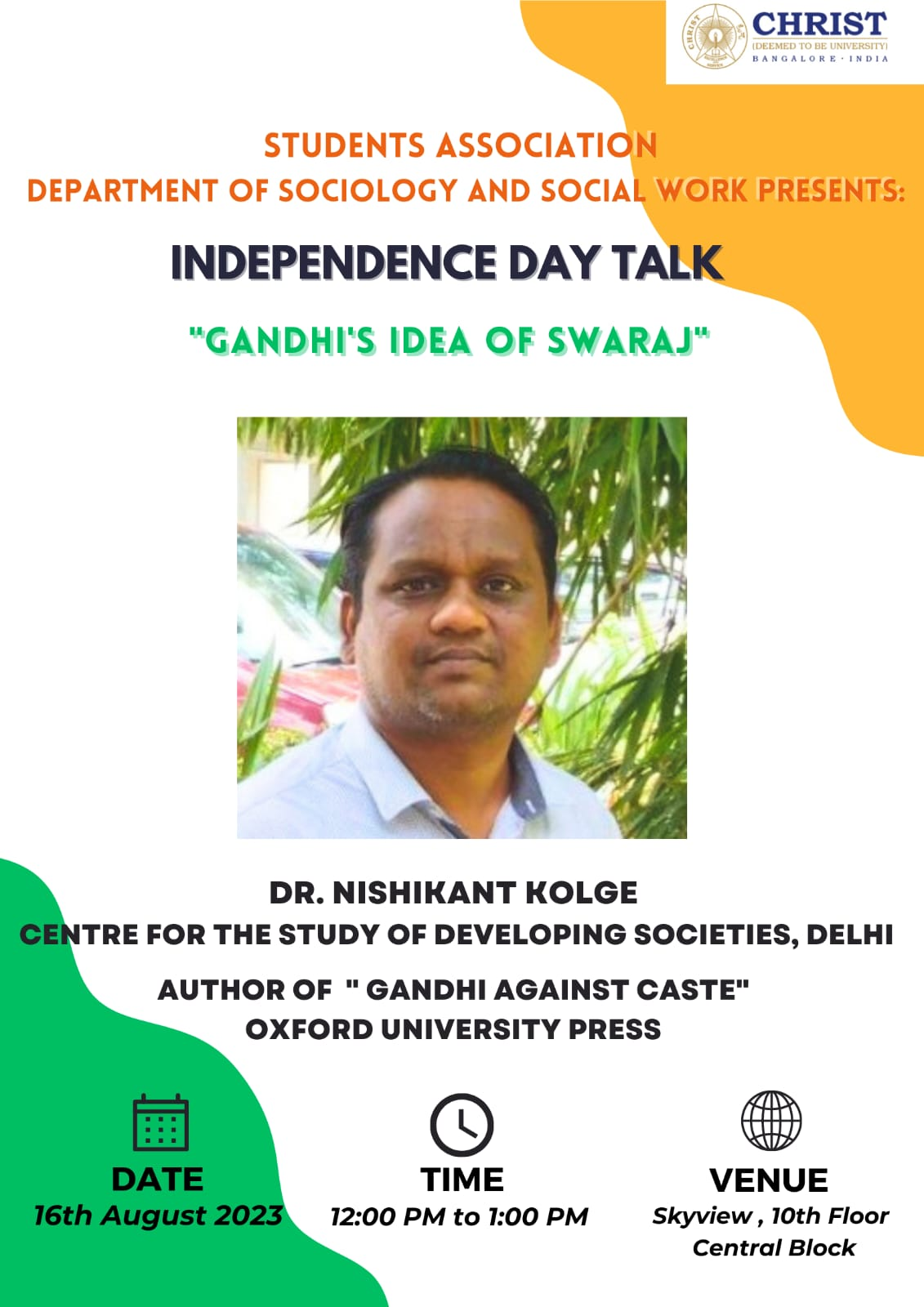
Mahatma Gandhi, the Father of the Indian nation, left an indelible mark on history through his philosophy of 'Swaraj' or self-rule. On the occasion of Independence Day, the School of Social Sciences at CHRIST (Deemed to be University), Bangalore, hosted an enlightening talk titled "Gandhi’s Idea Of Swaraj" by Dr. Nishikant Kolge, Professor at the Centre for the Study of Developing Societies, Delhi. The event aimed to delve into Gandhi's vision of Swaraj and its relevance to contemporary issues, aligning with the Sustainable Development Goals (SDGs).

Gandhi's Vision of Swaraj

Dr. Kolge eloquently elucidated Gandhi's philosophy, emphasizing its resonance with social justice and sustainable development. Gandhi envisioned Swaraj not merely as political independence but as the empowerment of individuals to govern themselves in harmony with others and nature. His conception of Swaraj transcended the boundaries of spirituality, delving into the material dimensions of human existence.

Key Insights from the Talk

1. Practical Idealism: Gandhi embodied the principle of 'Practical Idealism,' where lofty ideals were translated into pragmatic action. His constructive programs, such as the promotion of the Charkha (spinning wheel) and Hindu-Muslim unity, aimed at societal transformation from within.

2. Agency of Change: Gandhi believed in the inherent capacity of individuals to effectuate change. His emphasis on nonviolent resistance and the resolution of conflicts through dialogue underscored the transformative potential of every individual.

3. Universalism and Social Justice: Rejecting the divisive ideologies of the time, Gandhi stood against the two-nation theory and the caste system. His idea of Swaraj was inclusive and universal, rooted in the principles of equality, justice, and human dignity.

4. Materialist Interpretation of Moksha: Drawing from the Upanishads and Buddhism, Gandhi redefined Moksha (liberation) as the realization of individual and collective freedom from social and economic oppression. His vision encompassed the pursuit of material well-being alongside spiritual enlightenment.

Aligning with the SDGs

Gandhi's philosophy of Swaraj resonates deeply with the Sustainable Development Goals, particularly:

Goal 1: No Poverty - Gandhi's emphasis on self-reliance and community empowerment aligns with efforts to eradicate poverty and ensure economic inclusion.

Goal 10: Reduced Inequalities - By challenging caste-based discrimination and advocating for social justice, Gandhi's vision promotes equality and inclusivity.

Goal 16: Peace, Justice, and Strong Institutions - Gandhi's advocacy for nonviolent resistance and conflict resolution contributes to building peaceful and inclusive societies.

Follow-up and Action

The talk catalyzes further exploration and application of Gandhian principles in contemporary contexts. Students are encouraged to delve deeper into Gandhi's critique of caste and his vision of social transformation. Dr. Kolge's book, "Gandhi Against Caste," offers valuable insights into Gandhi's anti-caste crusade and its implications for social justice.

As we commemorate Independence Day and reflect on Gandhi's legacy, let us heed his call for Swaraj - a journey towards social justice, sustainability, and human flourishing.

In embracing Gandhi's idea of Swaraj, we embark on a path of collective empowerment and transformative change, guided by the principles of peace, equality, and universal brotherhood. Let us walk this path together, towards a more just and sustainable world.

Tuesday, 18 October 2022

DISABILITY AWARENESS ORIENTATION & INTRODUCTION TO INDIAN SIGN LANGUAGE


 DEPARTMENT OF SOCIOLOGY AND SOCIAL WORK

 With regard to International week for the Deaf and the International Day of Sign languages a Disability Sensitisation programme was conducted at Christ Deemed to be University on the 24th of September, 2022 by Winvinaya Foundation. P

WinVinaya Foundation, a Charitable Trust, is one of the very few NGOs in India which trains Persons with Disabilities(PWDs) in niche and futuristic skills including Software Development, Data Visualization, Robotic Process Automation(RPA) and more.  

 Report

Disability sensitization program was conducted at Christ University, Bengaluru as part of the International week for the deaf and the International Day of Sign languages for 100+ students.

 Quite a few students expected this to be a non-stop lecturing event about disability and inclusion.  But it turned out to be an enjoyable, informative and interactive event.

 Ms Akila, the co-founder of WinVinaya foundation, grabbed the attention of the audience by starting the session with interactive games in which even last benchers participated eagerly.

 Then Akila explained to us the Common Disability categories and also introduced us to the world of the two different disabilities- hearing and speech impairment and visually impairment .

 To comprehend the world of the visually impaired individual better, Akila (the resource person) chose two student volunteers, blindfolded them and handed them a white cane, and instructed them to walk around the hall. Three more student volunteers were brought in as obstacles in the walking path. After facing initial difficulties, in understanding their surroundings, the volunteers started relying on their auditory and sensory perceptions which allowed them to navigate around the hall without much of difficulties.  After seeing the volunteers try their hand at the activity, there was a demonstration by Yogitha who is a person with visual impairment and she walked around the same place where our volunteers were facing difficulties with such ease even though she was not using a cane and was new to that place.

 To understand the world of hearing and speech impaired individuals better, Ms. Gayathri who is a person with Hearing Impairment gave us insight into the Indian sign language and taught the students the sign language alphabets, and basic phrases like how are you? What is your name? etc.

 Then, Akila (the resource person) picked a few volunteers, gave a sentence, and asked them to communicate through sign language to Gayatri. It was fun watching the volunteers trying to converse with Gayathri since they did not know much of the sign language and they had to rely on their expressions and generic signs. The message was pretty clear that to have effective communication you don’t need vocal language as a medium.

 A demo on screen readers was done by Yogitha who is also a trainer working at the foundation. She demonstrated how she uses the screen readers in her laptop .and also showed how she orders food and shops from the online shopping applications on her smart phone (using the talk back feature).All of us learnt a lot and I hope the WinVinaya foundation organizes many more such events in the future, to build awareness about disability to build an inclusive community for all.

Monday, 17 October 2022

Placement Orientation for VPSEco


Interactive session with Mr Claudius V, Placement Officer, Center for Placements and Career Guidance

Date: July 18, 2022                

Venue: 201Classroom, Block 1

Time: 12 noon -1 pm

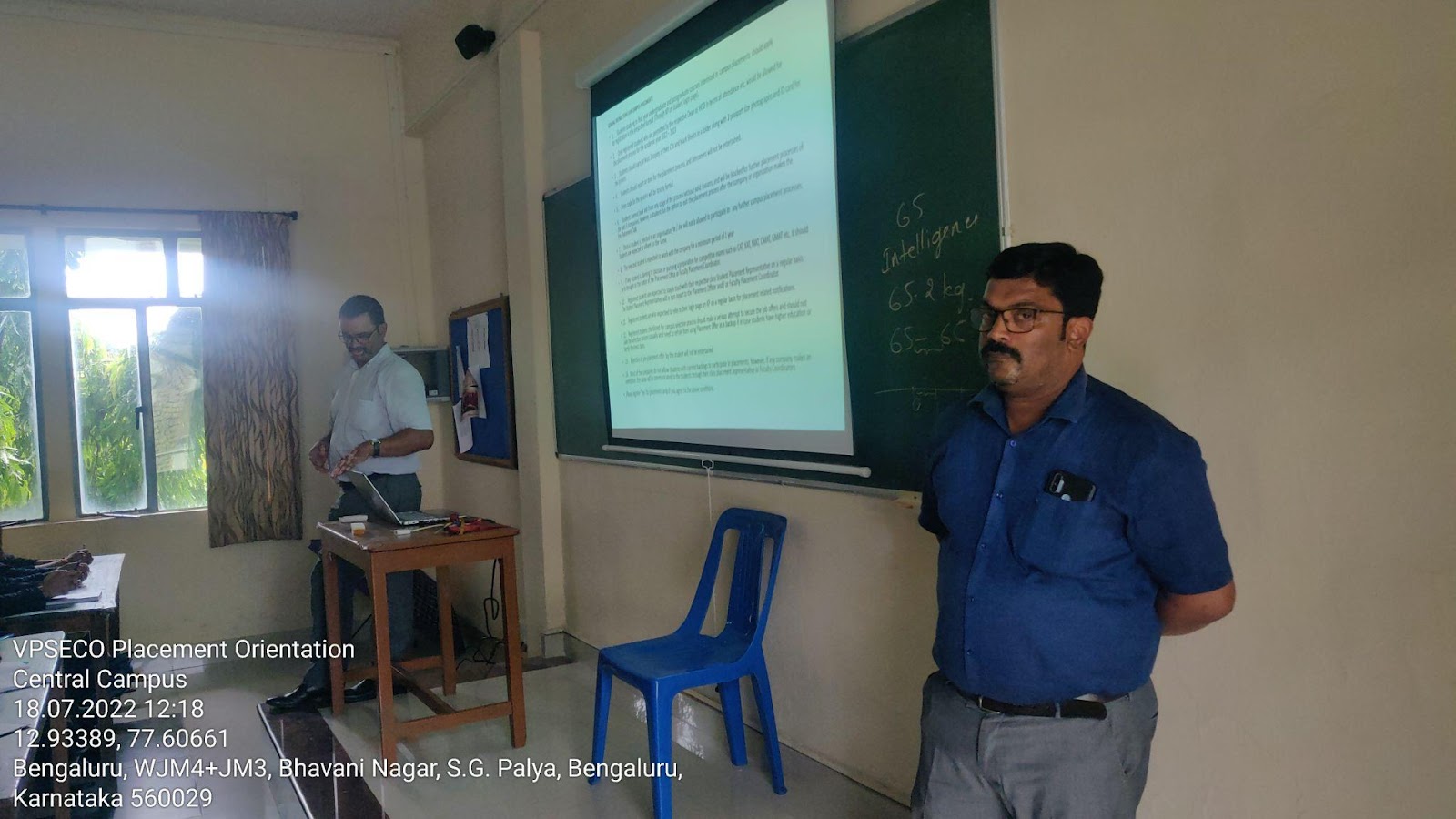
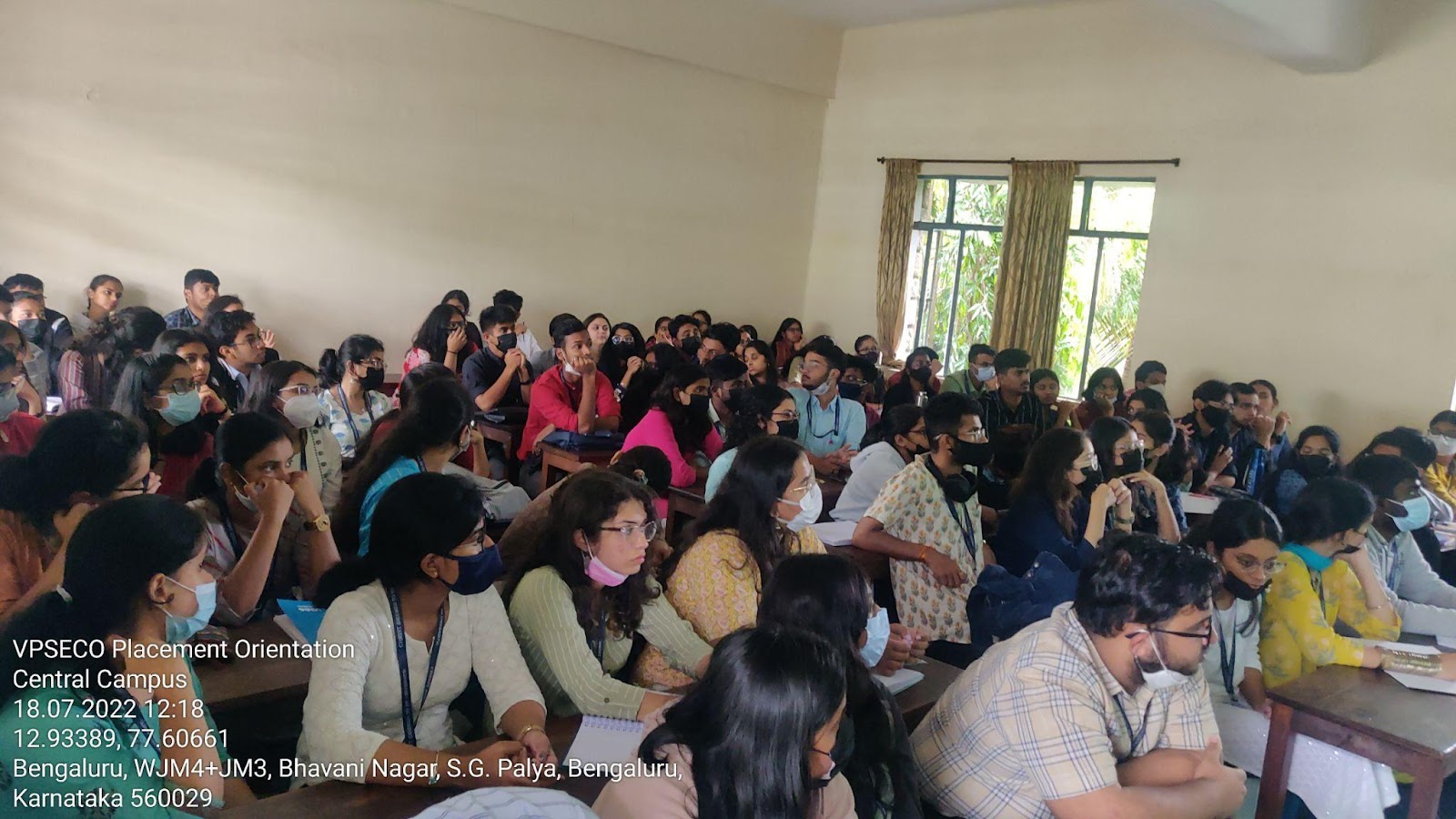
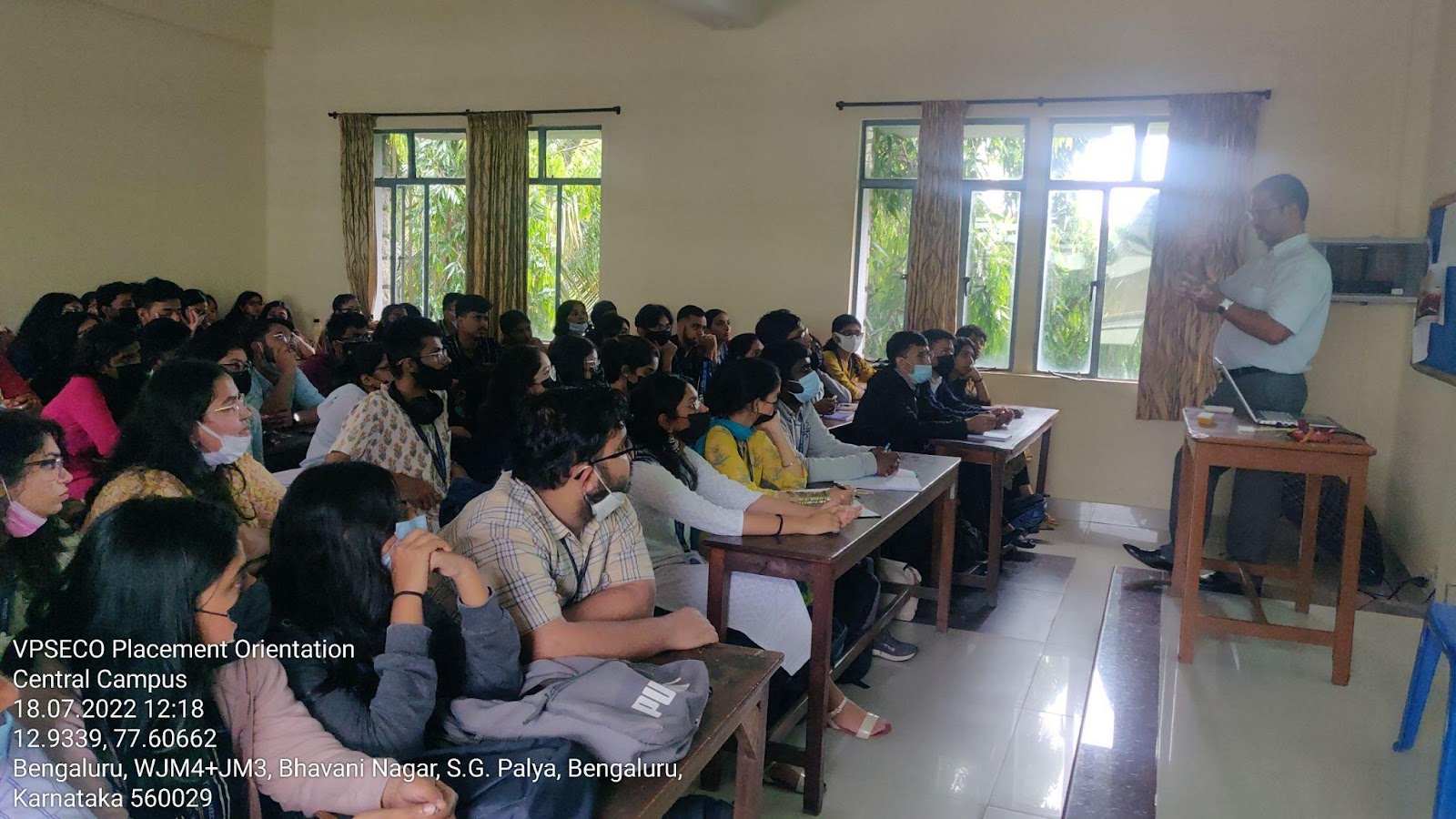
The Center for Placements and Career Guidance, CHRIST (Deemed to be University) offered an orientation session for the students of V PSEco. This orientation session was organised to help them to prepare themselves for the placement process and to clarify any doubts they may have. 

Mr Claudius V and Mr Anil P conducted the session. They provided an overview of the process followed at CHRIST, the registration process through the Knowledge Pro Accounts, as well as details on the offers received from organisations by students from the outgoing batch.

The hour-long session ended with a discussion during which they clarified doubts posed by the students.

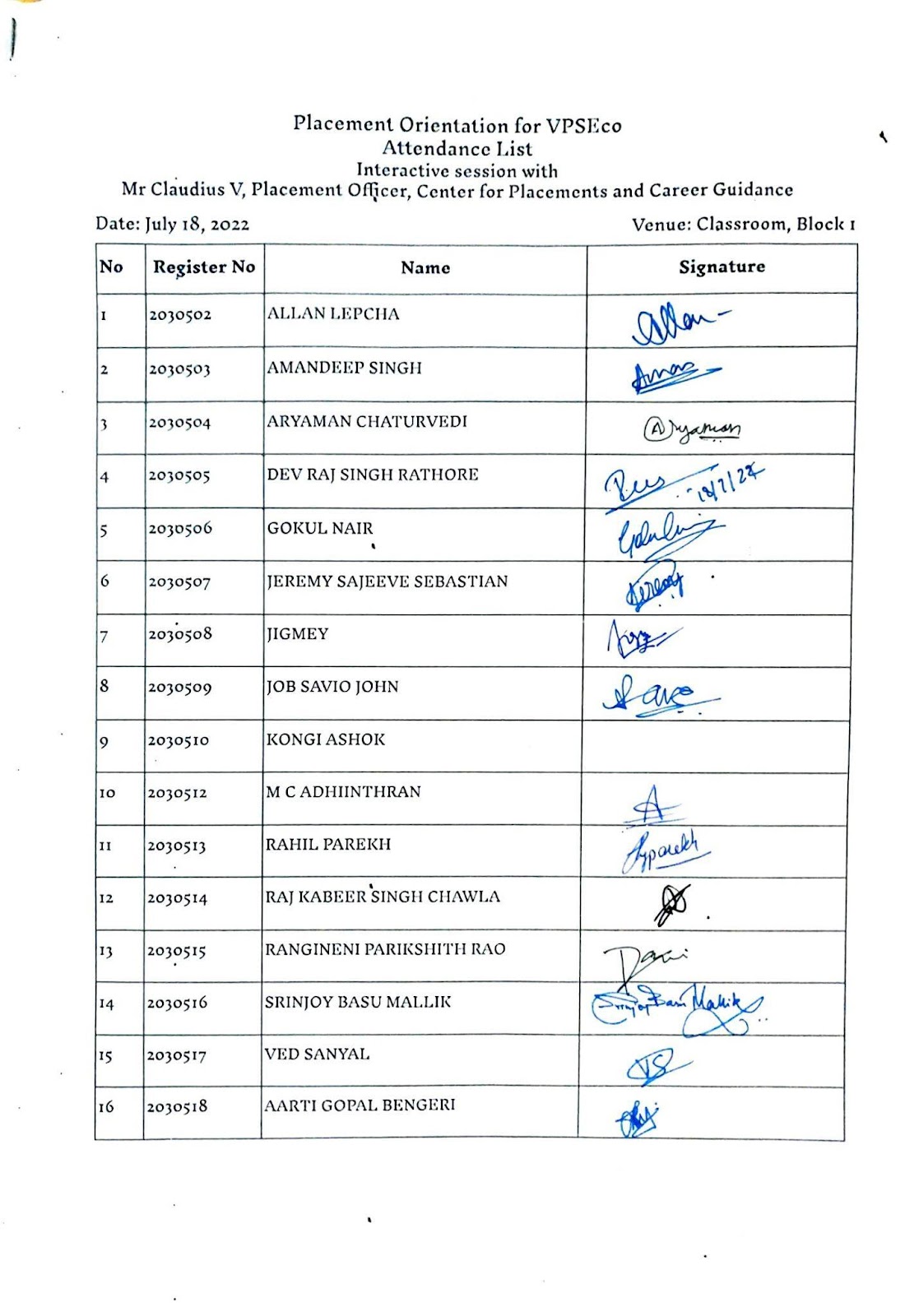
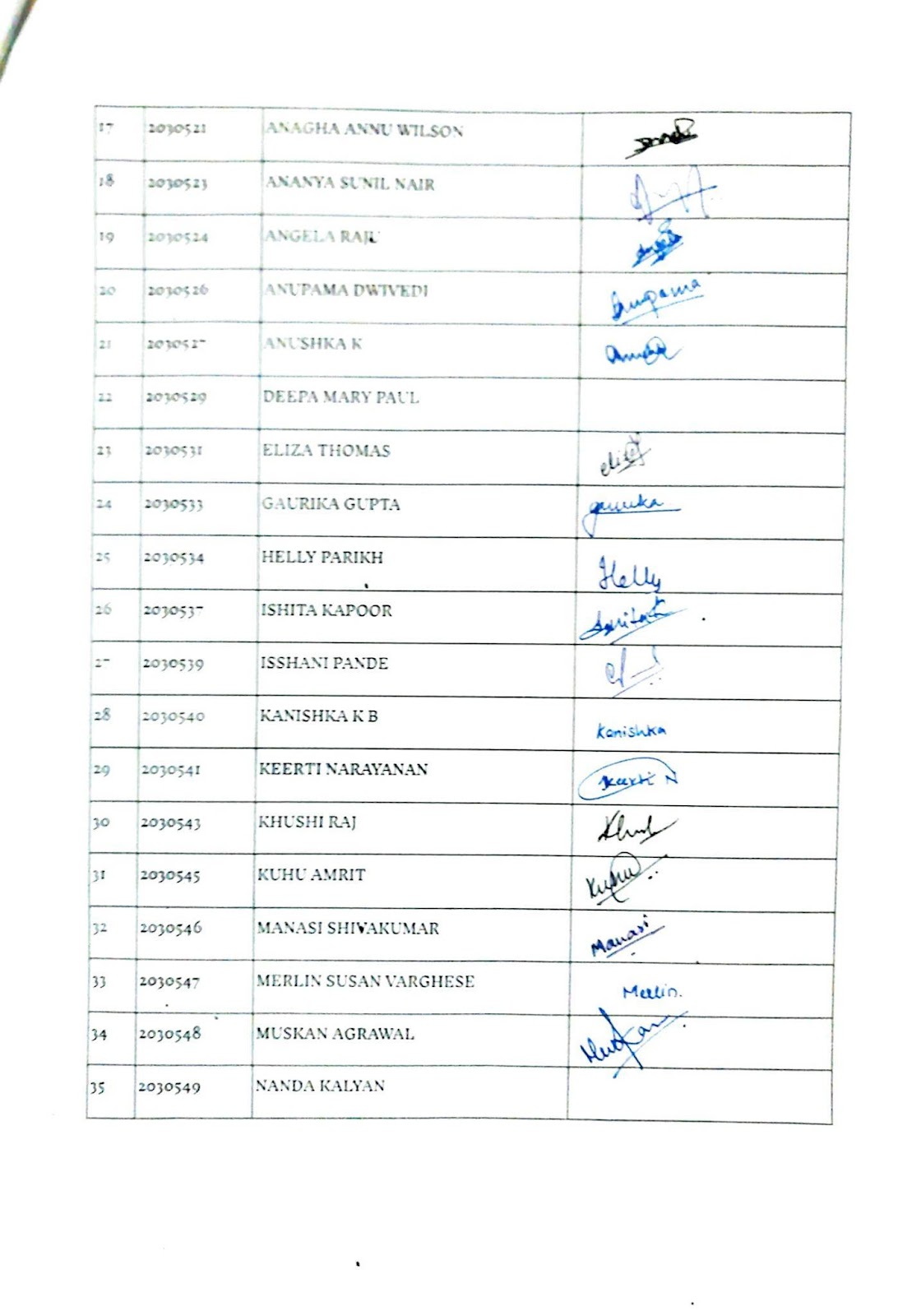
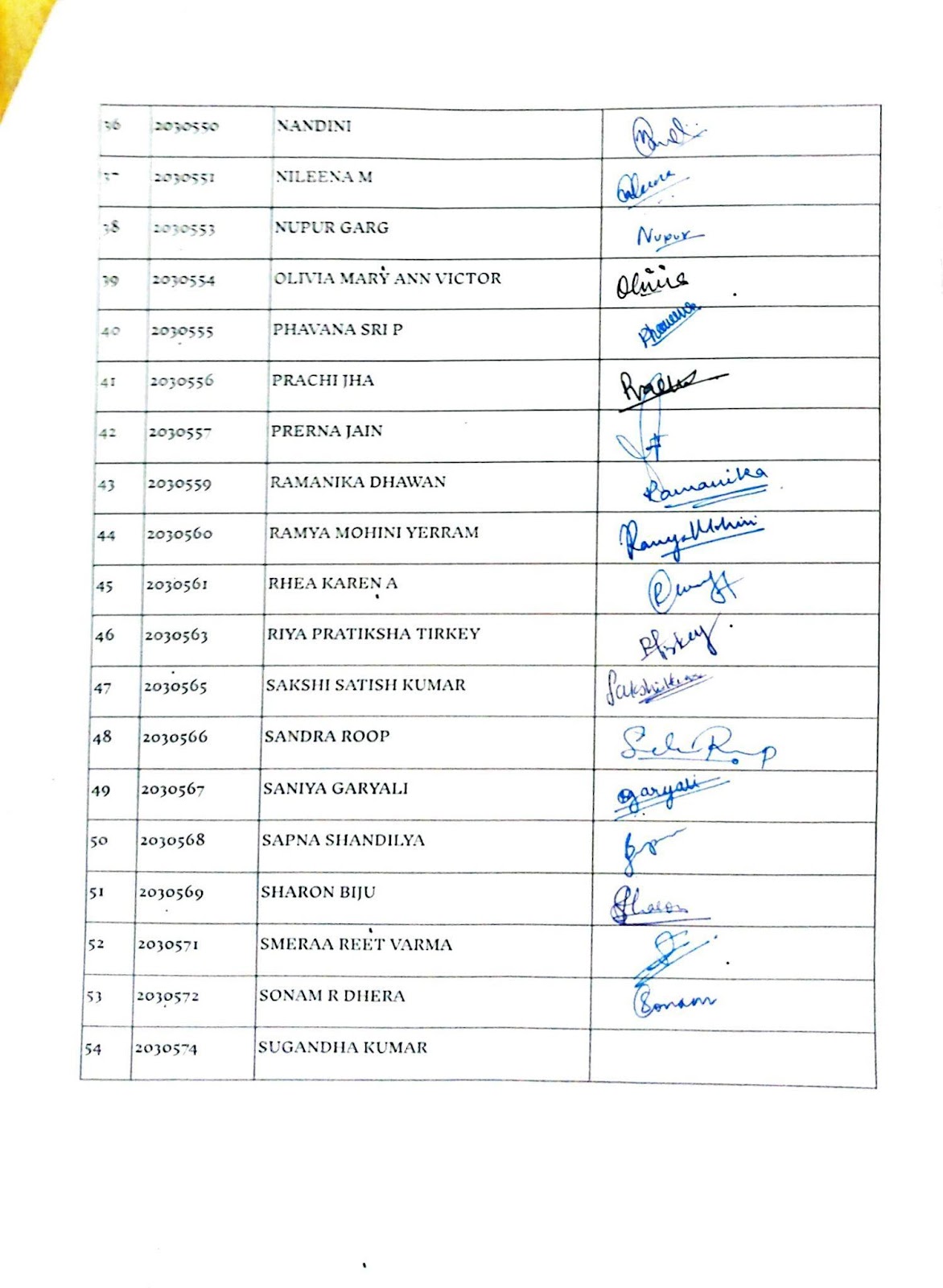
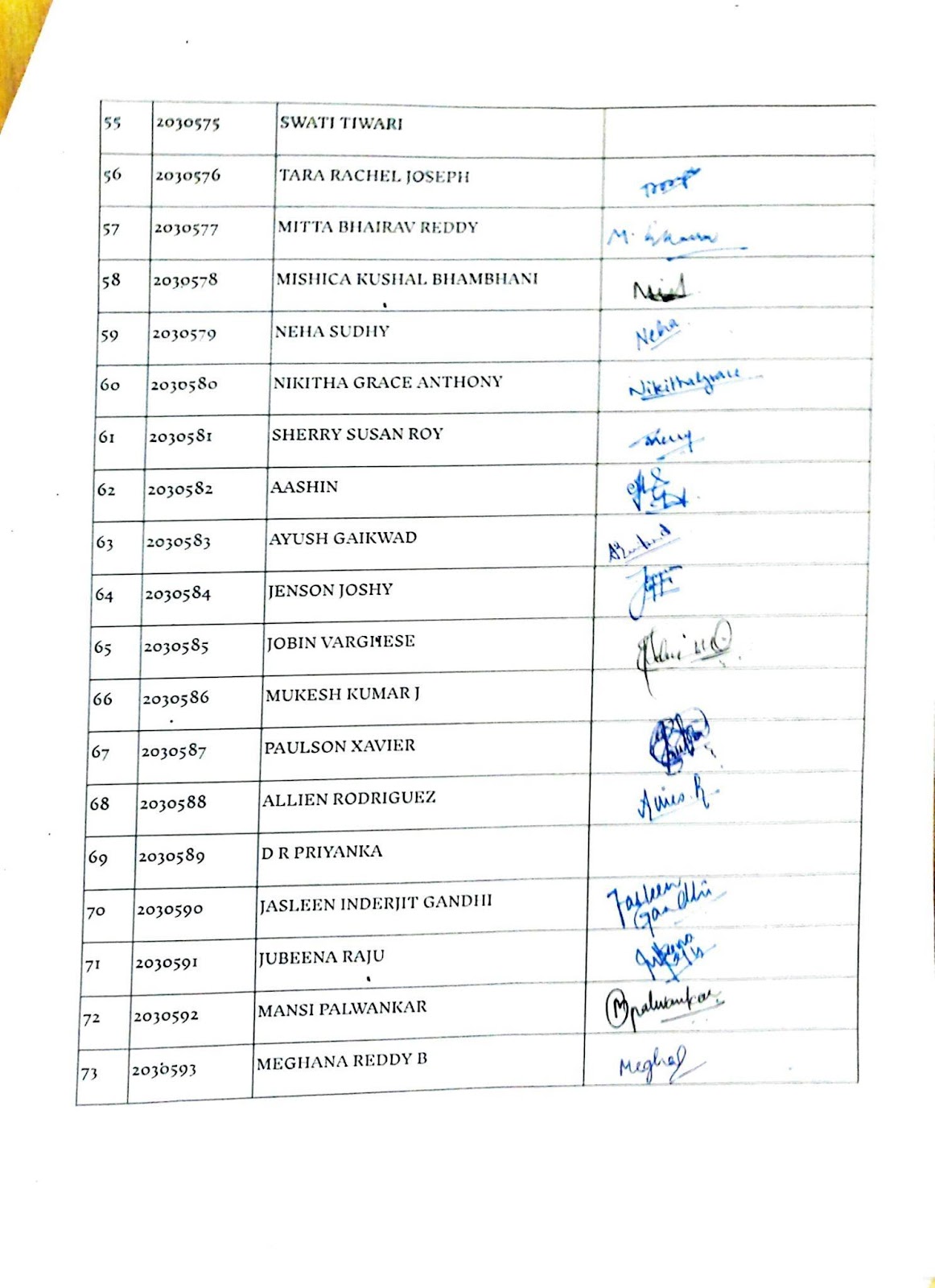
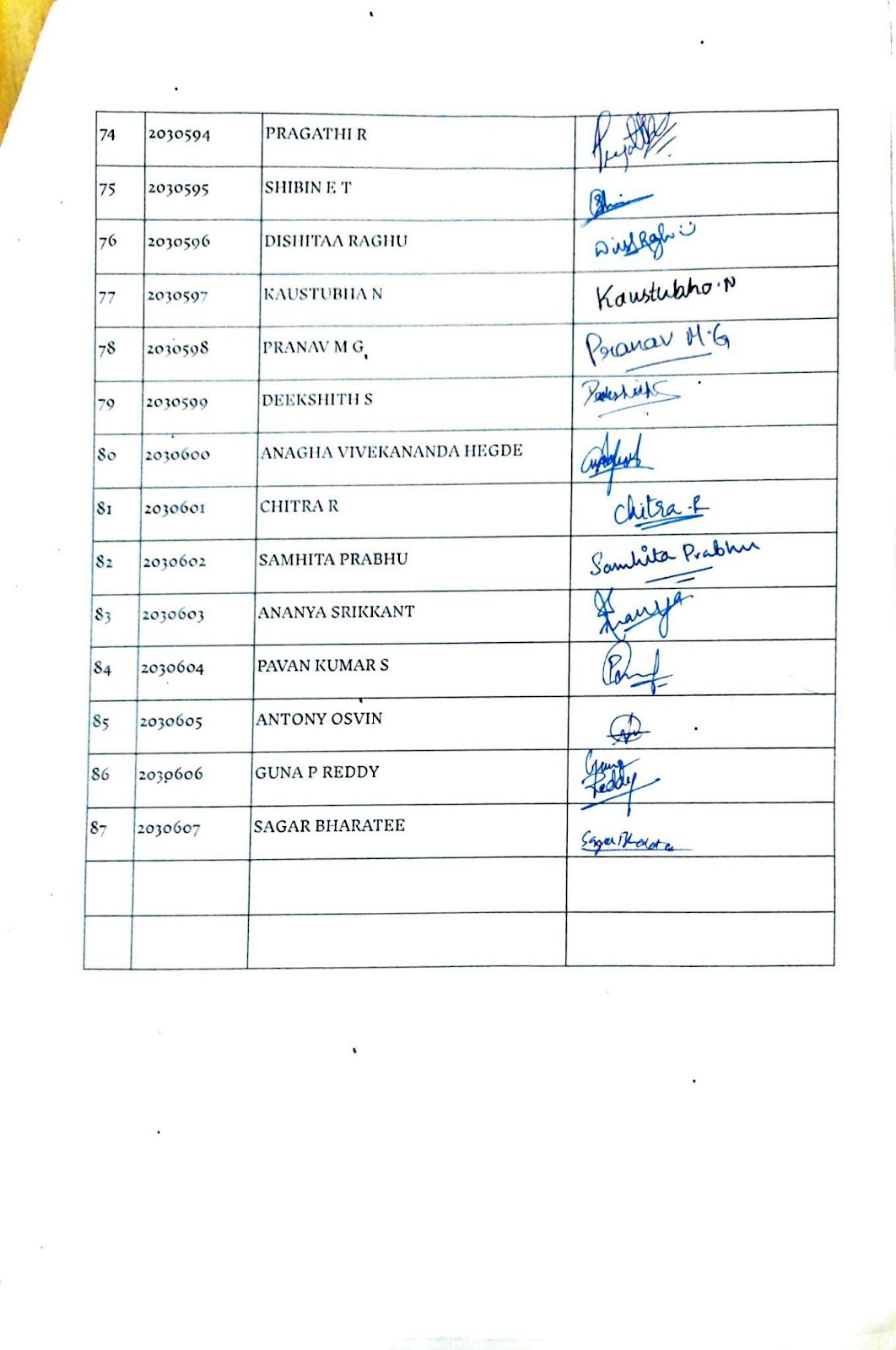
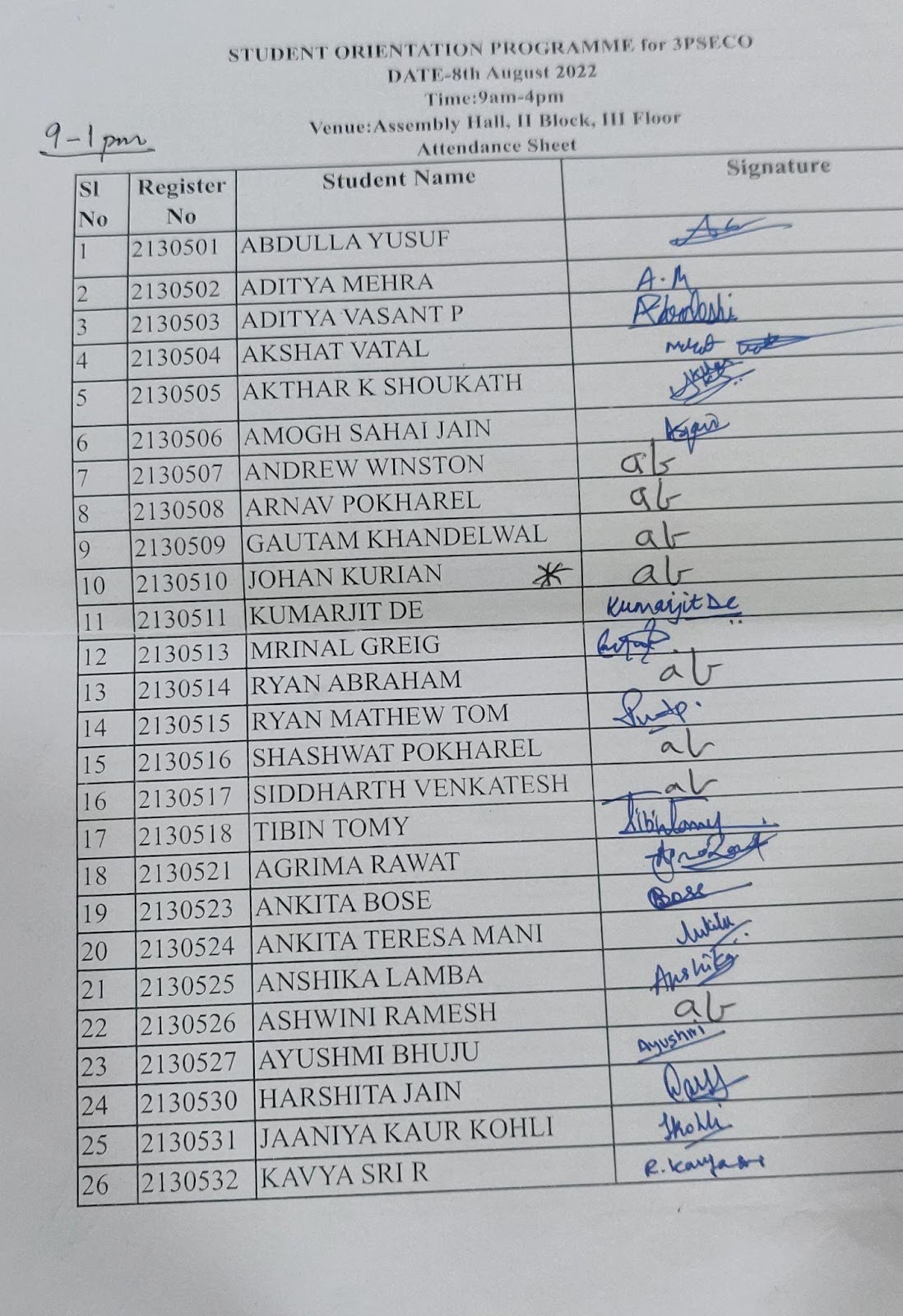
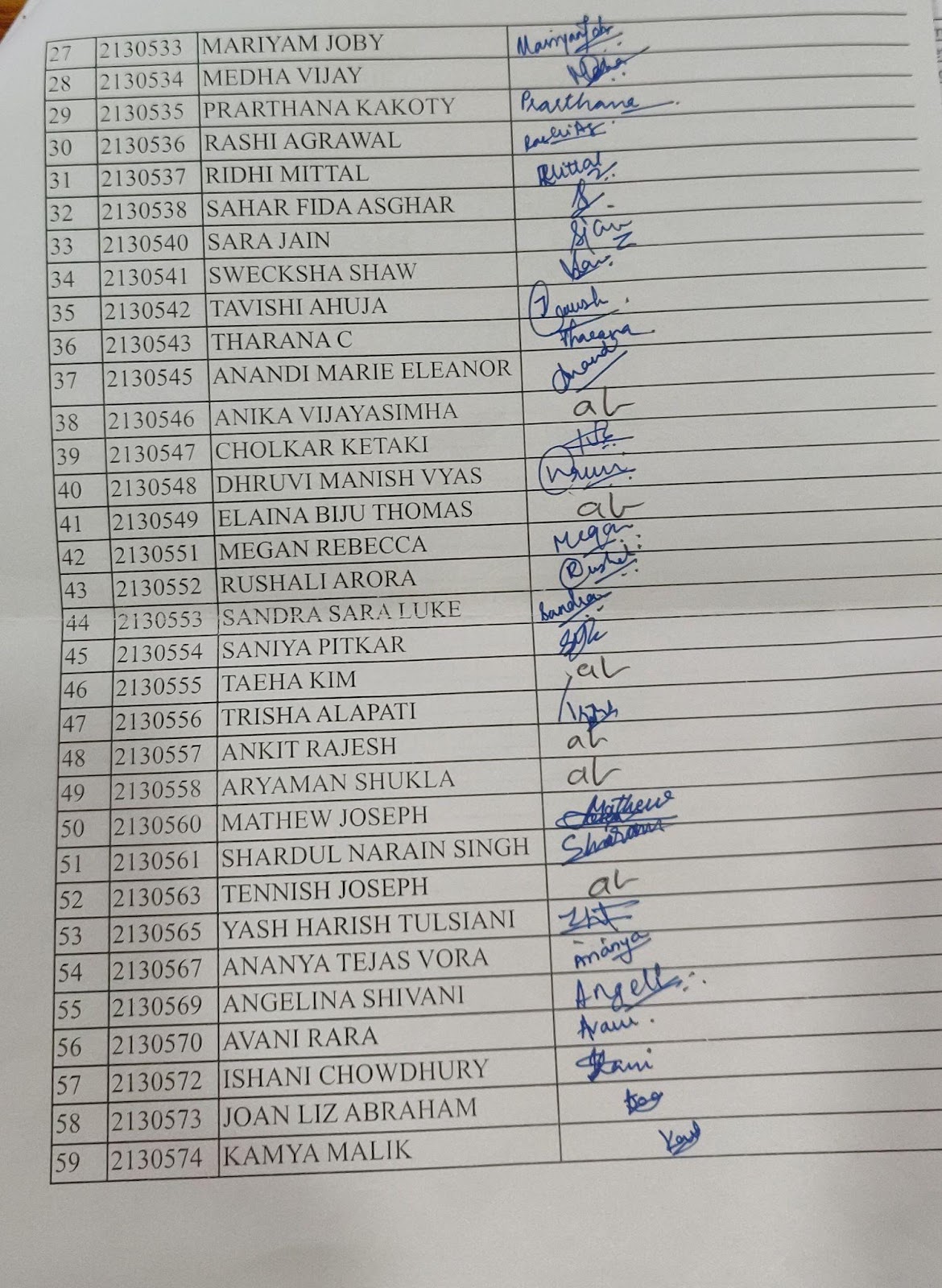
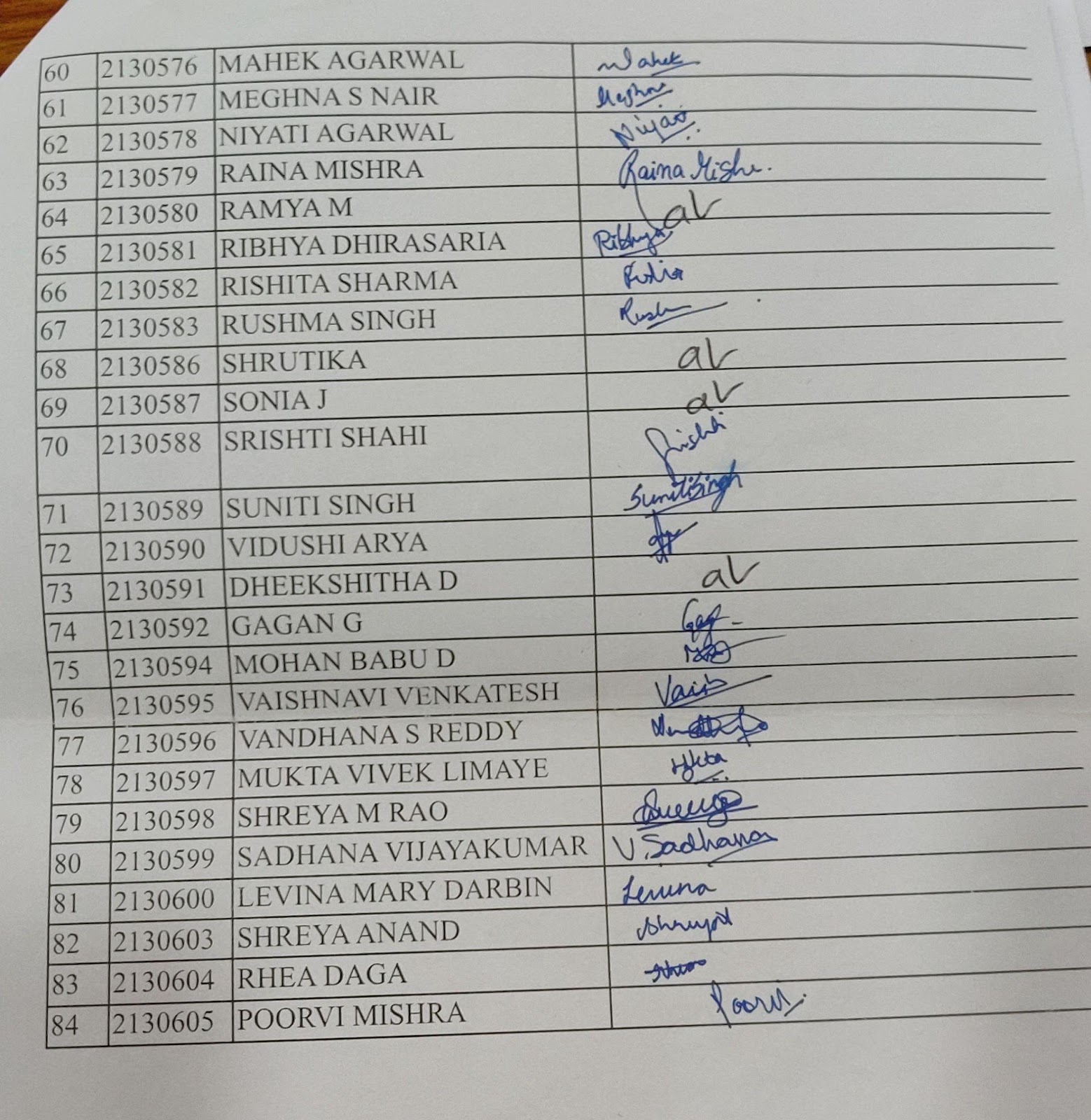
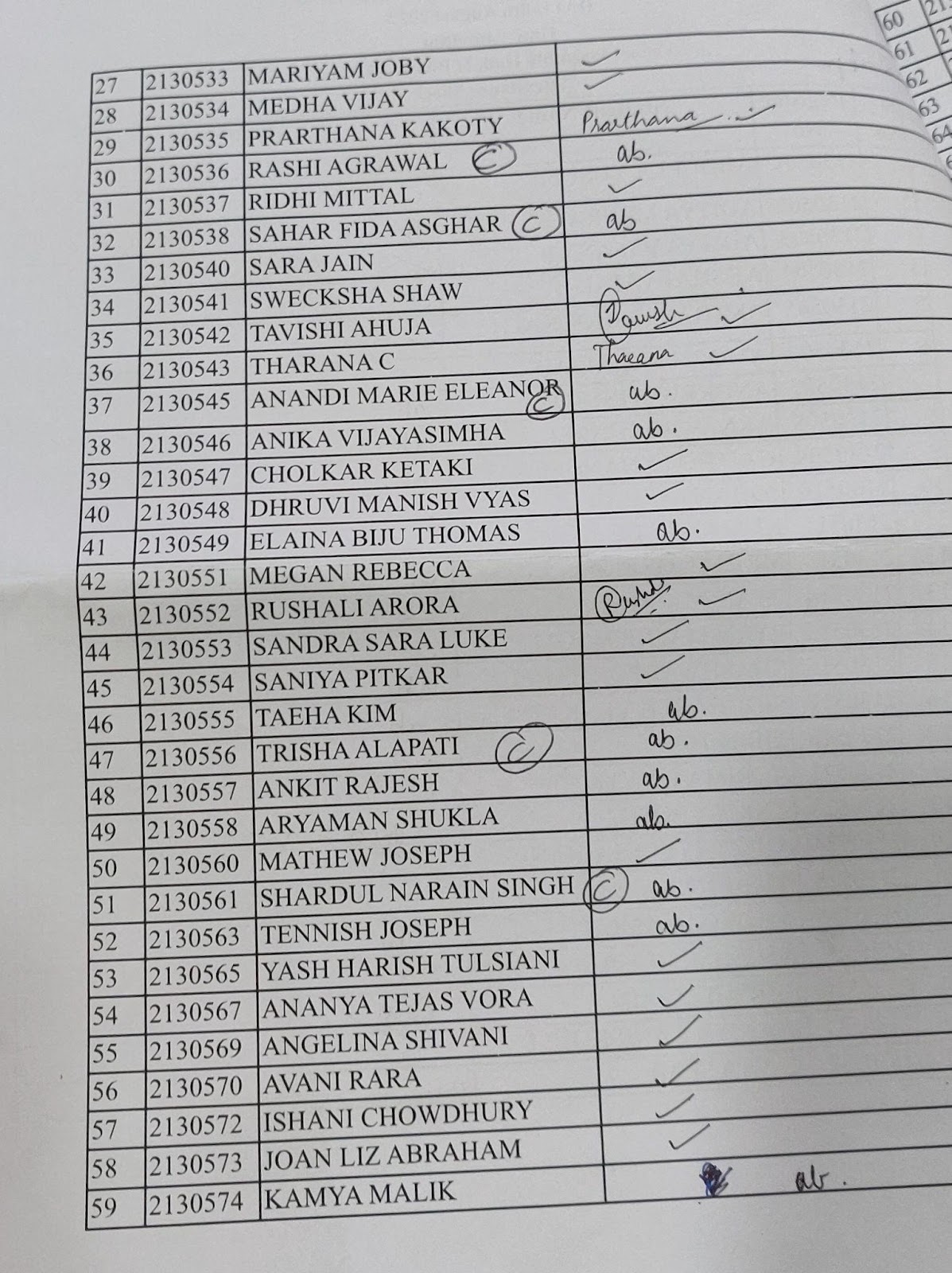
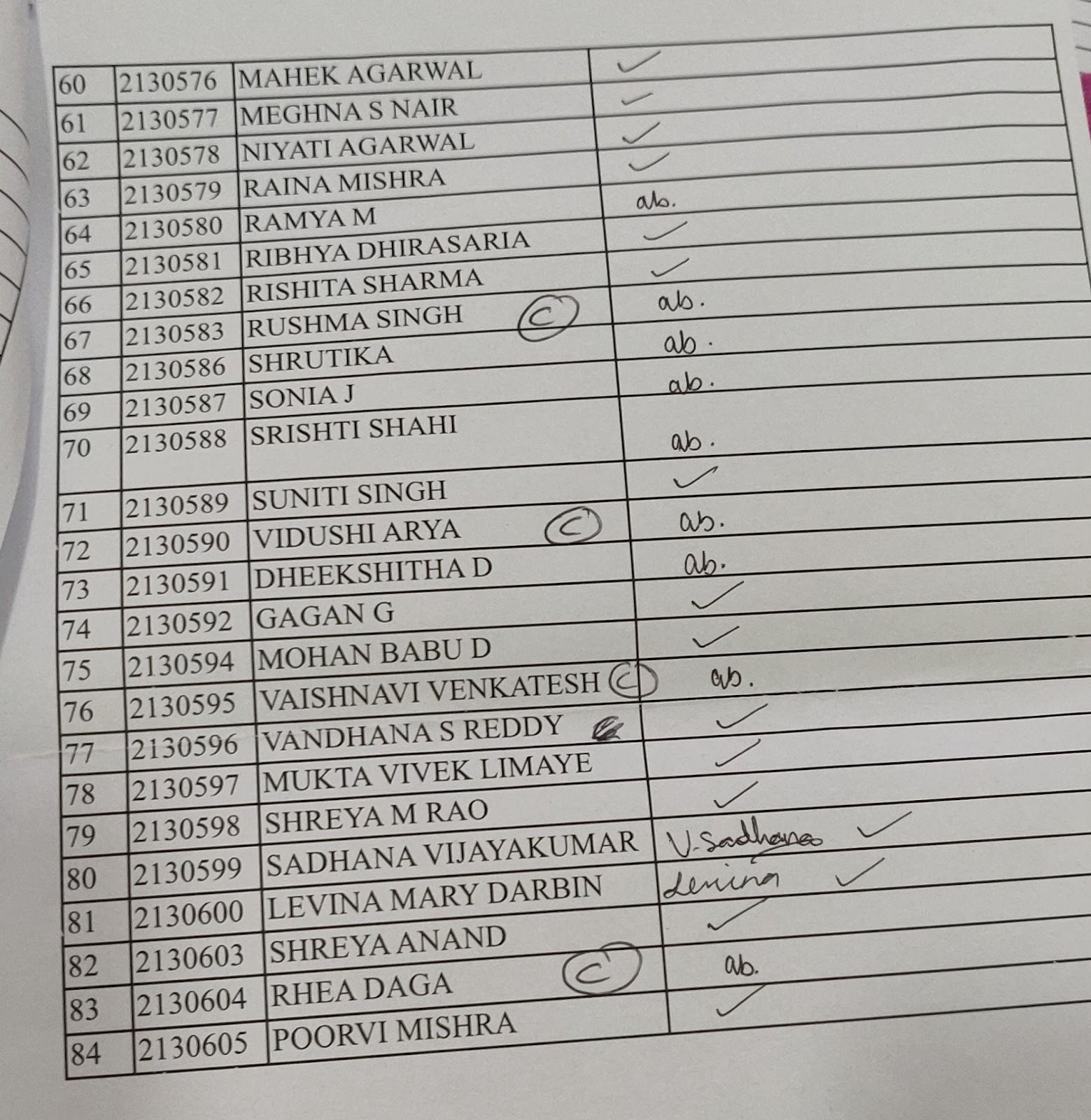
Given below are some photographs as well as the attendance sheet from the session.

Attendance List:

INAUGRATION OF THE FILM CLUB “LIGHT’S ON , UNDARK”


 Department of Sociology and Social Work

Date:16/09/2022
Venue: Campus view
Time:1.00 pm - 2.00 pm

The inauguration of Film Club "Light's On, Un-Dark" A initiative by the students of the department of social work batch 2022, with the purpose of making students of Christ University aware about several issues through films. It is inteadeed to create awarness and encourage conversations among students about the latent aspects of flms.

The club was inaugurated by Ms. Sahana Anappa, who is a alumni of the department and actress. She gave a speech about how movies play a major role in changing society. Which was initiated with a welcome adress, An address by the Head of the Department, Dr Victor Paul was followed after which the chief guest addressed the gathering. The event concluded with a vote of thanks.

The club will be conducting several events, competition for the students and there will be a movie screening on Saturday of every week.

Video Link :- https://www.instagram.com/reel/Ciq8w0Mgk2W/?igshid=YmMyMTA2M2Y=

Student Association Inauguration and Observation of Gandhi Jayanti 


Department of Sociology and Social Work

1st October, 2022 l Quadrangle, Christ PU College (Central Campus) l 11am to 12pm

The purpose of the event was to inaugurate this year’s Student’s Association and to also observe Gandhi Jayanti. 

Dignitaries Present:

  1. Chief Guest Cedrick D’Souza, a Christ University MSW graduate (batch of 2011-13). Cedrick was born in Goa and brought up in Delhi and is currently working in GK & Aerospace.
  2. HoD Dr Victor Paul and 
  3. The faculty members 

The event was scheduled for 11 AM and started at 11:12 AM, with Poorvi Mishra (3 PSECO) and Niyathi Agarwal (3 PSECO) as the MCs for the day. 

Inauguration and observation was started by a formal introduction by the Cultural Secretary, Sarah Jain (3 PSECO). 

At 11:16 AM, ceremonial watering of plants was done by the dignitaries and the office bearers. 

Right afterwards, HoD addressed the gathering with a special emphasis on the coming together of Sociology and Social Work. He spoke about the introduction of Gandhian Philosophy into both our curriculum and extra curricular activities. He then went on to mention how the Student’s Association is a platform to lead, to love, and to leave behind a legacy and how it rightfully enforces the vision and mission of Christ University.

He mentioned CLASP which stands for (Credibility, Legitimacy, Accountability, Service and Political) and also about NAAC audit. The purpose of this was to speak of their individual and combined importance to the institution and for the students as well. His speech highlighted curriculum, teaching-learning assessment process, governance system, student support system, best practices (peer education) and distinctiveness. 

At 11:28 AM, after HoD’s speech, the Chief Guest took over the stage. He began by expressing gratitude for being invited and then elucidated the challenges in the corporate world and asked students to do justice to the time. He further reminisced about his 30 days fieldwork experience in Kolar as a part of CSA. At last, he spoke about focusing on career building opportunities in the sector of choice. The speech ended at 11:33 AM.

At 11:34 AM, Oath-Taking ceremony took place for 15 of the office bearers officiated by the HoD which ended at 11:36 AM.

At 11:37 AM, the President of the Association Meenakshi Prashanth (3MA Sociology) addressed  all gathered with special mention of ‘Collective Vision and Opportunities in the Department’. 

At 11:40 AM, a musical tribute by 6 students was paid to Mahatma Gandhi which ended at 11:45 AM. 

At 11:46 AM, Account of community service was done by Yash Kohli (3MSW CCP) 

At 11:50 AM, A speech on principles of ‘Gandhi- Swaraj and Swadesh’ was delivered by Hira (1MSW HRDM) 

At 11:54 AM, Talk on Gandhian Philosophy Shardul (3PSECO)

At 11:56 AM, a vote of thanks was presented by the General Secretary Joffin Angel (3MSW HR). 

And lastly, the event ended by 11: 57 when the expected end was 12 PM. 

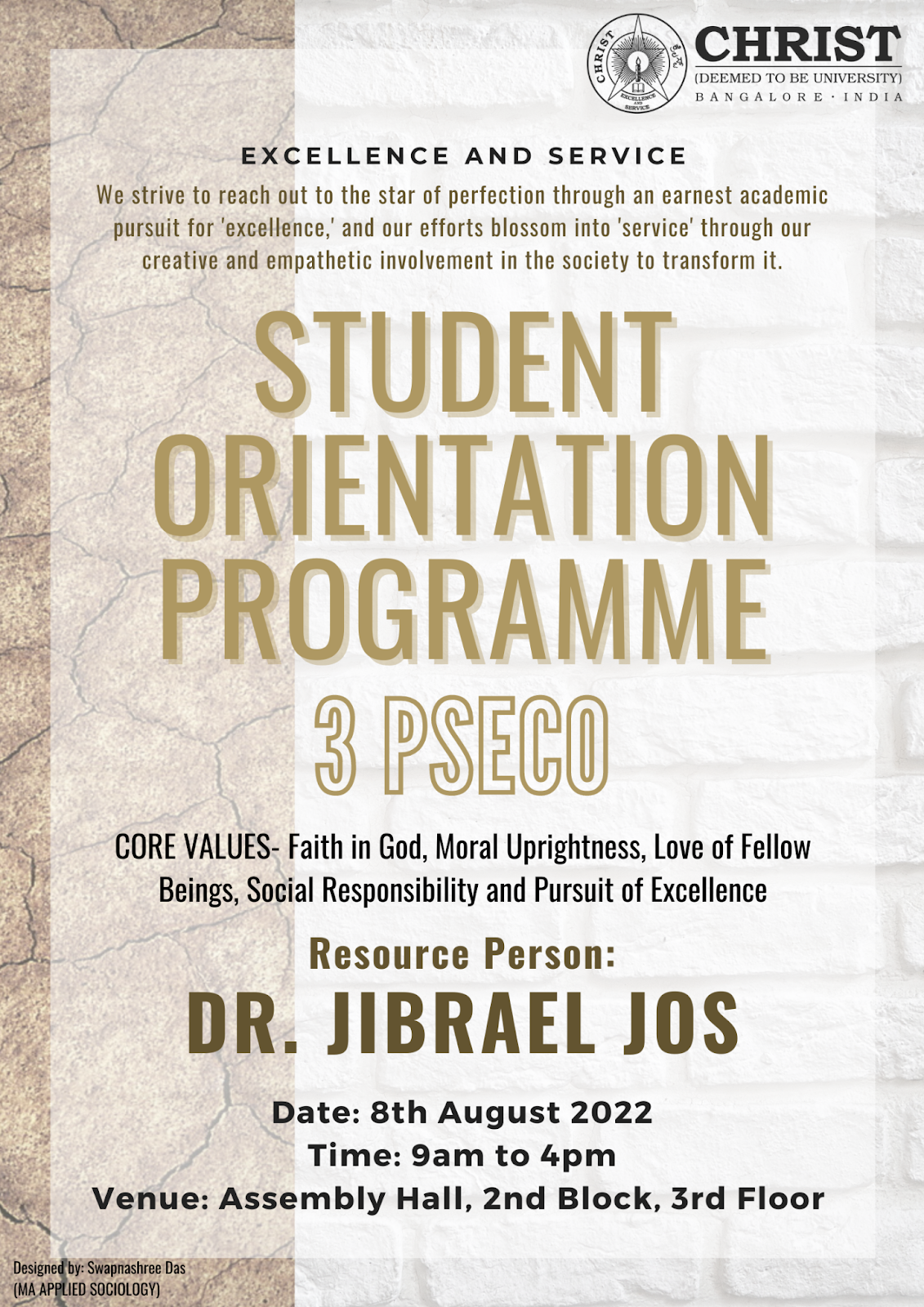
3PSEco Student Orientation Programme


Date : 8th August 2022

Time: 9-4pm

Venue: Assembly Hall/III Floor/II Block


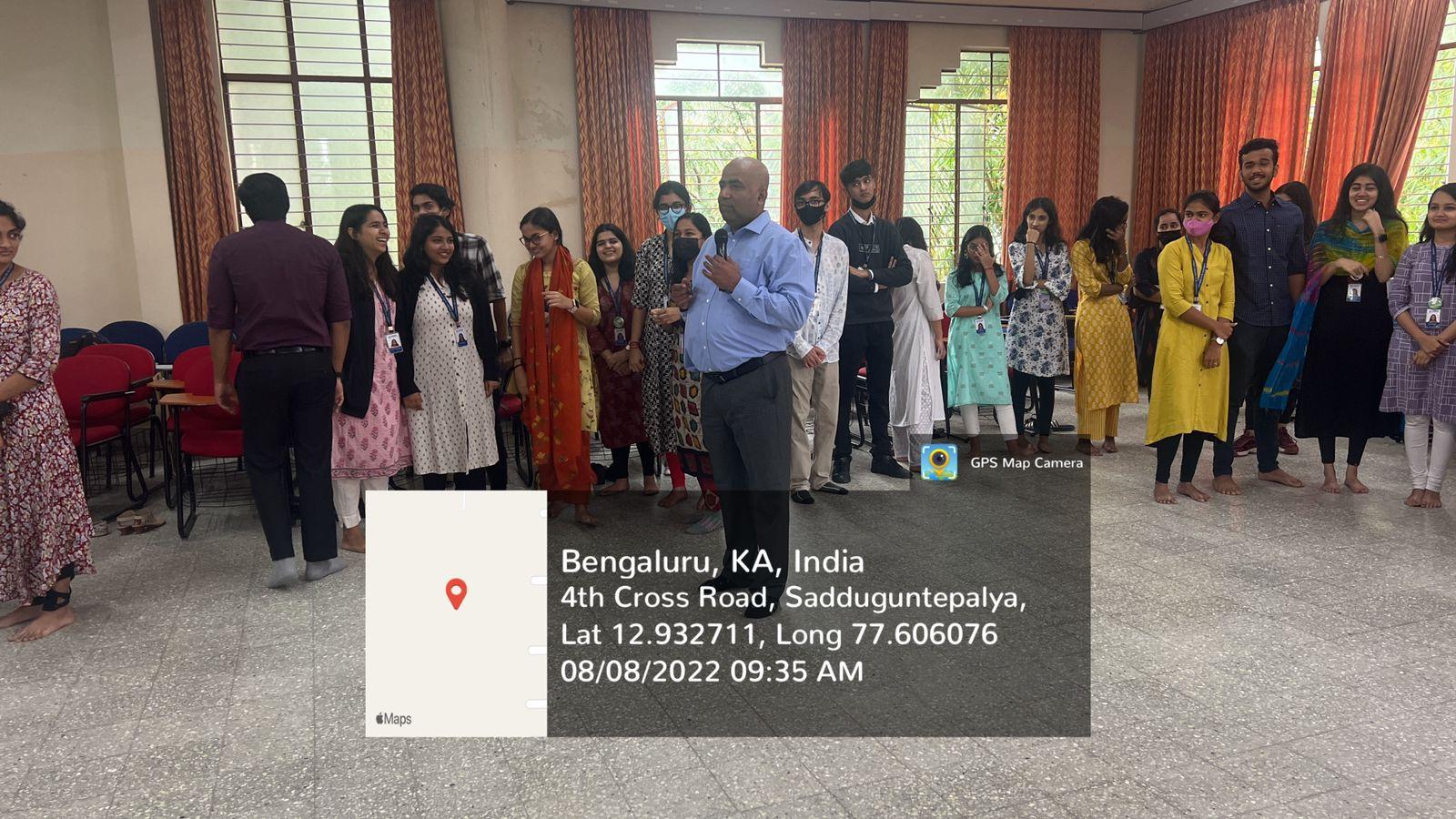
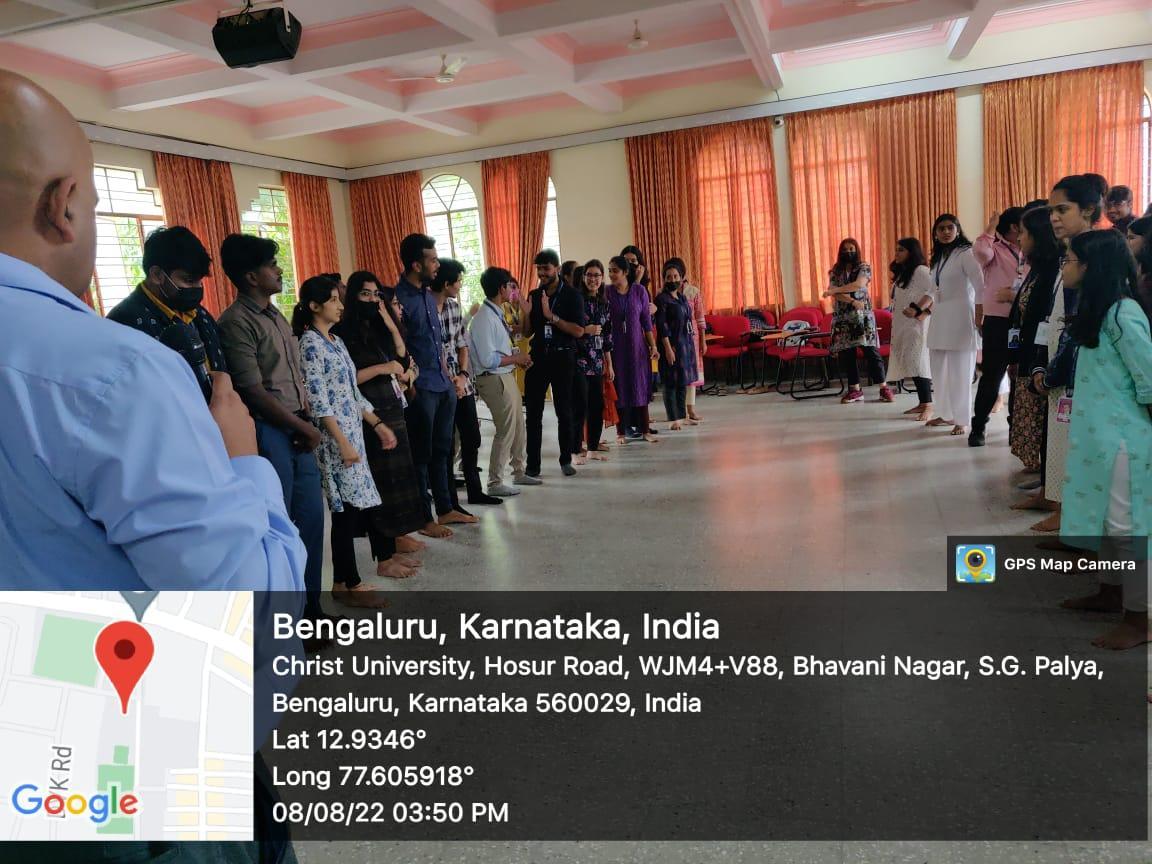
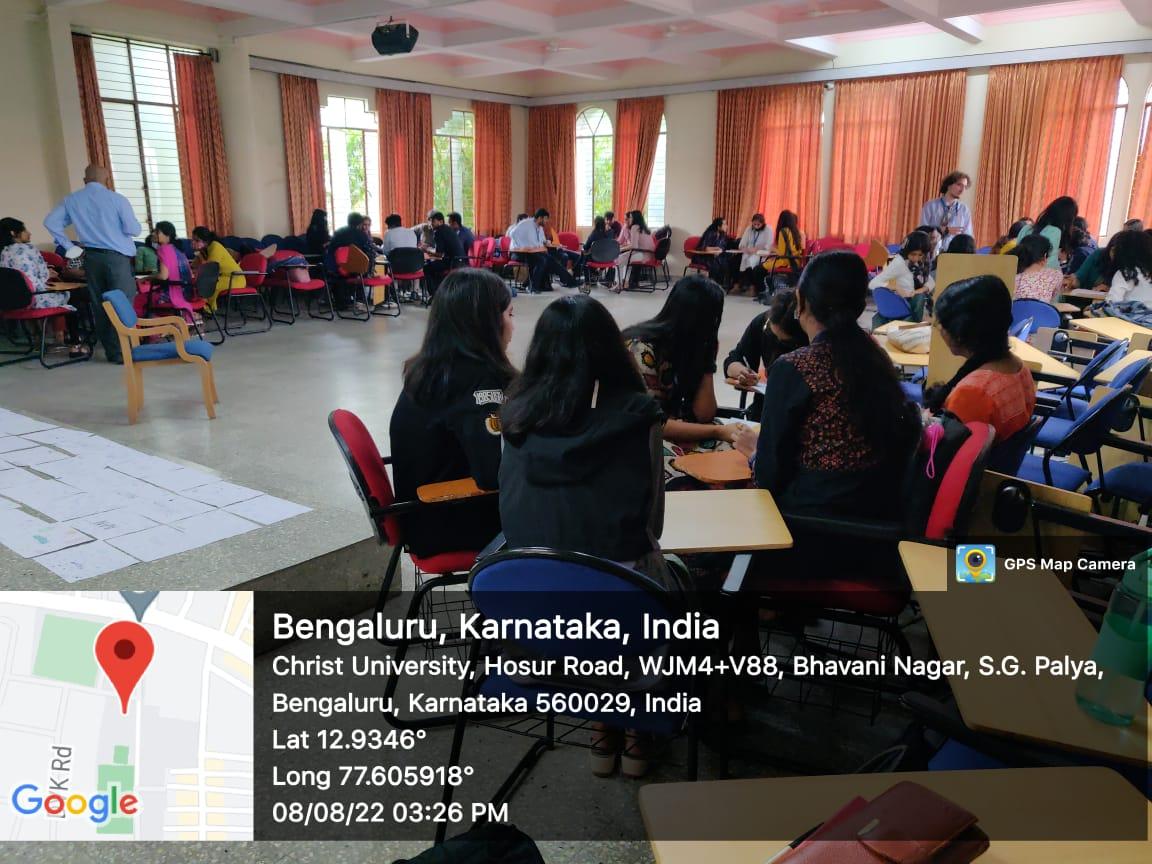
On Monday, 8th August 2022, 3PSEco had an orientation program scheduled from 9am to 4pm. The program started with a silent prayer and in presence of Dr Sudipta Garai and Dr Jibrael Jos, the resource person. The program intended to initiate a collective feeling among the students keeping in mind the mission, vision and the core values of the University. It was all done through activities, fun, games and group work.

The students were then divided into groups of 8 and were each given an object to enact. The groups that show most creativity in their action were rewarded points. After 3 rounds of that game, groups were shuffled and the new tasks were to answer rapid fire questions and enact a scene. Different roles taken up by the group members in the scene were guessed by the audience. 

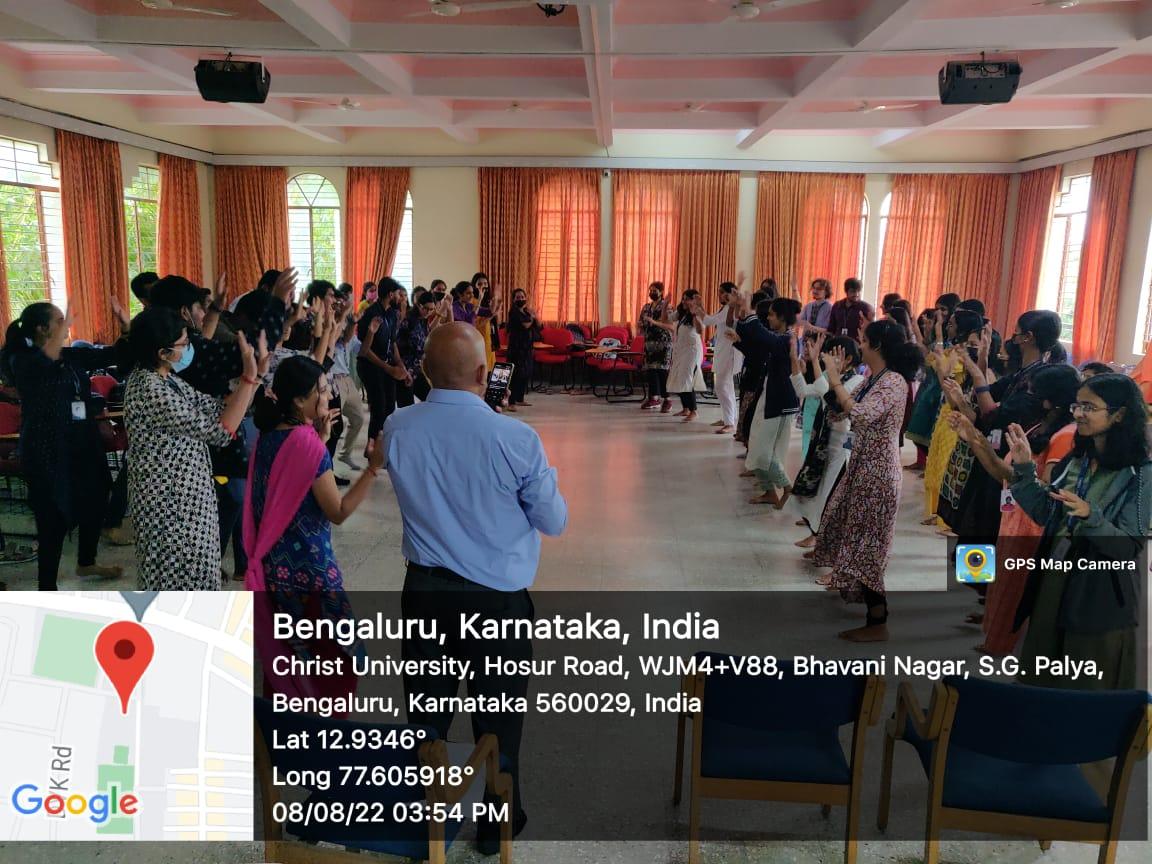
After a short break, the class was given a choice to choose their own groups of 3, 4 or 5 people. They were all given topics to speak about for 30 seconds each within the group. The next two tasks were where the class bonded and had the most fun. It was singing and dancing. For singing, they were divided into 2 groups and were given a choice to sing any 2 songs together. Once the dancing began, there were no more inhibitions or hesitation. There was a dance battle where each group followed the other group’s steps and grooved to the music. Following this was when sir sat the class down and spoke about how life has its ups and downs but it's always the individual's choice whether to see certain life events as bad luck and demotivate themselves or as good luck which would help them to work harder. 

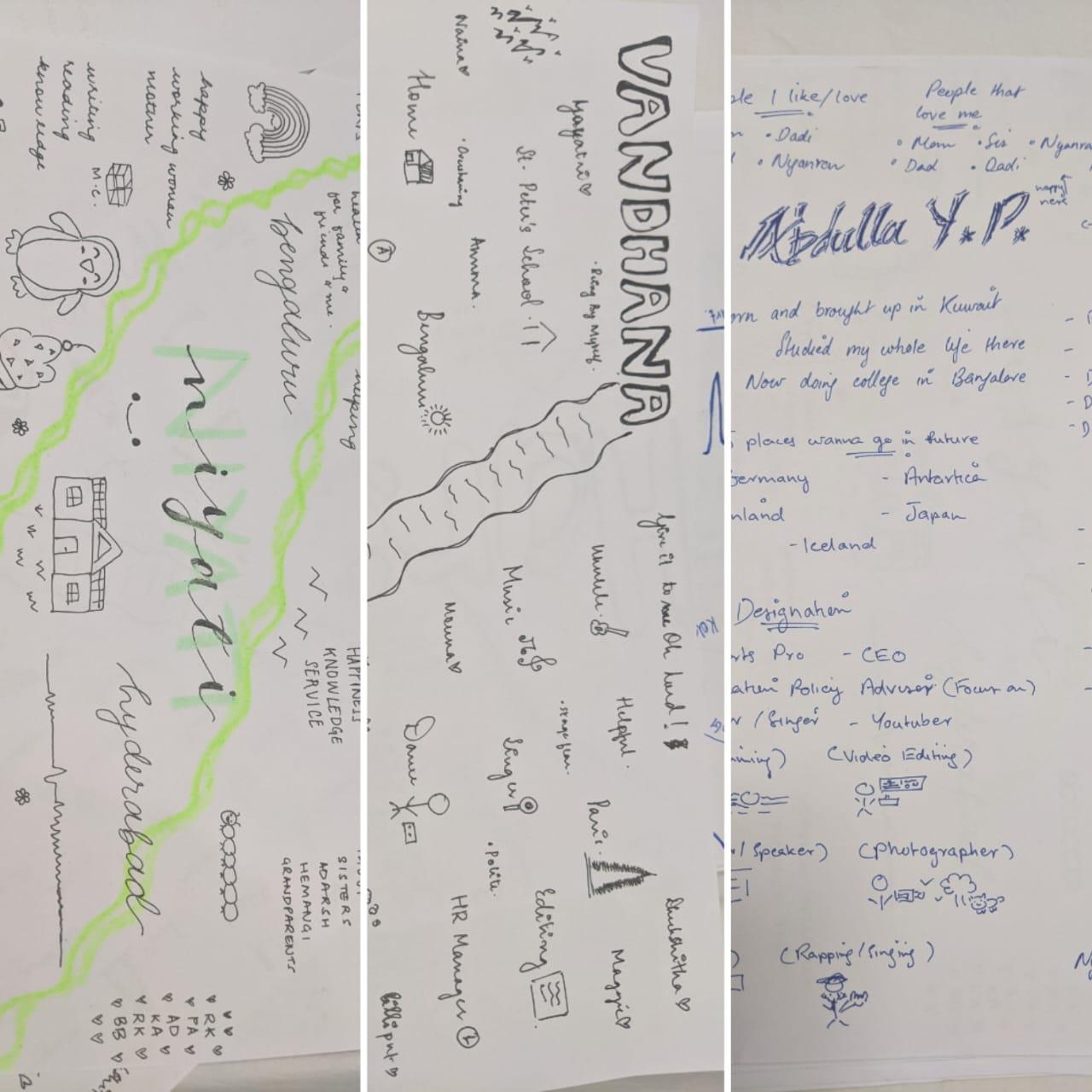
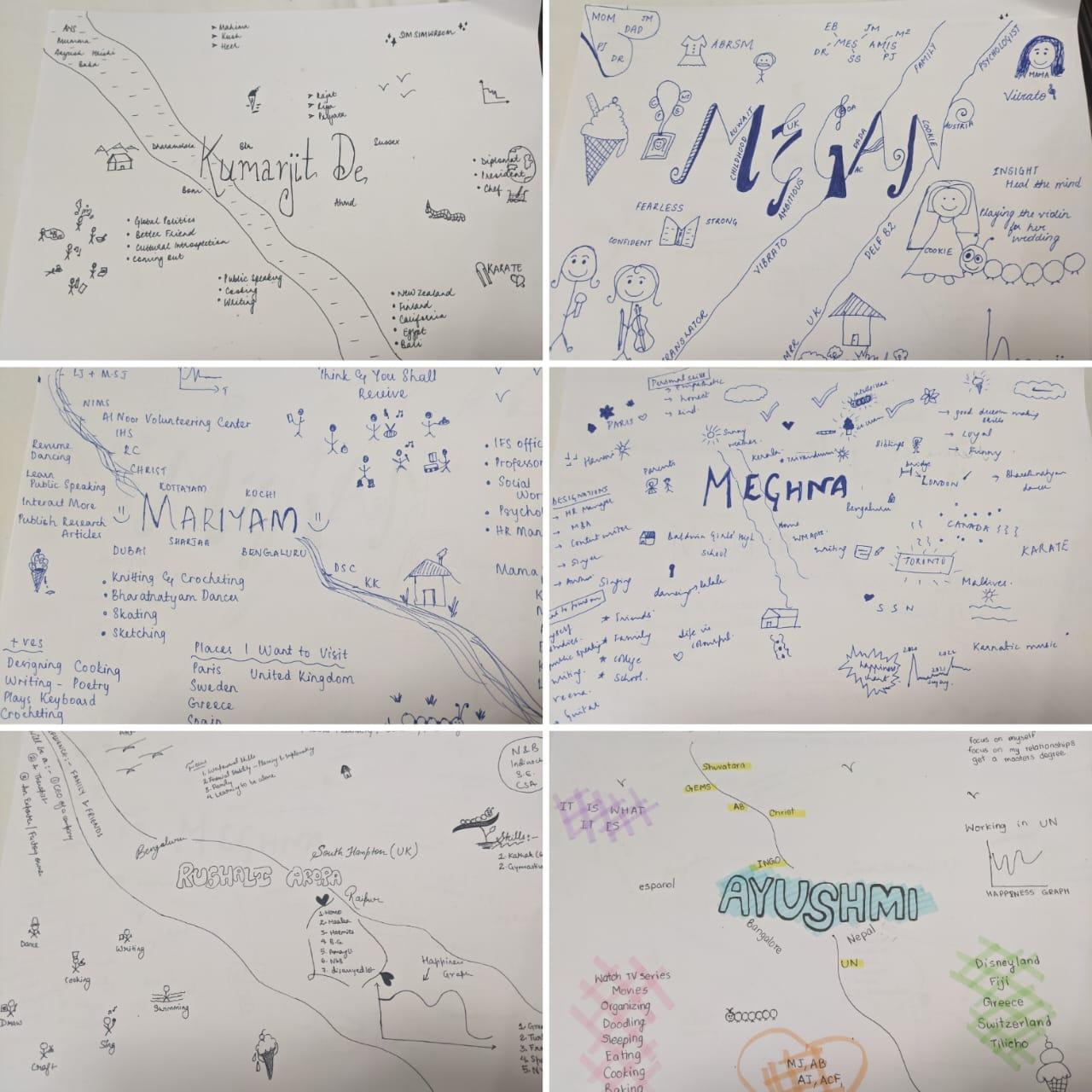
After the lunch break, all the students were given a blank paper on which they had to draw their river of life. They were asked to write words and short phrases about their goals, places they wish to visit, and so on. The task was to make the paper look artistic while they mapped their life on it. Once they completed the river of life task, they were asked to think of how they want the next 2 years in PSEco to look like. All the students collectively wrote some goals and wishes they would want to achieve as a class along with fun things to do to bond with each other. The fun, eventful day ended with all of them showcasing their songs and dance moves to Dr Sudipta Garai (3PSECo/Class teacher) and a few feedback.

The students bonded as a class, spoke to people they wouldn't regularly speak to, and the best part of it all, broke the ice as a class. Dr Jos connected well with the students and brought the collective feeling among the students which shall help them beyond their academic life. The program ended with a silent prayer.

Student Activity Picture (River of Life)

Students activity Pictures (River of Life)