Tuesday, 25 March 2014


Wednesday, 19 March 2014
Presentations on Indian Society by II PSEng, 2013-14
Indian Society is a vast varied society with no singularity
or homogenity to the entirety of the nation, the language, the myths, the
practices, the culture all have their own unique origins and histories that have
developed into modern day India as we know it. In an attempt to both educate
and enlighten both themselves and their classmates, each individual of the
class had chosen a topic coming broadly under the topics of Linguistics, Races,
Religion, Family, Caste and Occupation, under the direction of Dr. Sheila
Mattews.
The
presentations began with the Linguistics group who approached the topic by
initially with the division of India into the various regions that make up the
whole, and through this exemplified the diversity that can be found in India in
that very process with the number of languages to be found in the country. With
the presentations by the individuals they attempted to bring out the manner in
which these languages have taken shape in India, the process of invasion and
colonisation and how these affected some areas but not other, yet all sharing
common aspects in their speech, or their script and so on. This uniformity of diversity and
commonality across India clearly points towards the pluralistic nature of
Indian society.
Following the
Linguistics group was the Races group, handling the various racial backgrounds
of the people in India, from all over the country. They discussed the division
of the races in India on the basis of their various physical characteristics
and the manner in which they came to be in India, through the many centuries of
history that is in India's past, from the Dravidians, to the Mongoloids, to the
Indo-Aryans and the races that followed as well as a result of interaction
between these races. How these races were spread across India and their arrival
in India itself was discussed with reference to the many conquering forces that
have come to India, the Mughals, the Mongols, and many others.
Having
gathered what the heterogenuous mass of our population roughly looks like and
talks like the presentations moved on to the beliefs of the many, many division
and denominations of our country. With the various tides of changes that have
occured over the land of India so too have thoughts and ideas about the
individual's origin as well as the origin of the world. The group that had
taken up this topic included the religions of Judaism, Zoroastrianism,
Buddhism, Sikhism, Christianity and its
many denominations, Hinduism. Islam and the Tribal religions – like Sunmaism,
derivatives of the Bond religion of Tibet and others. With India being the
place of birth of some of these religions and its acceptance and adaption of
these other religions into its own practices and customs shows us the
pluralistic nature of India.
The group
following this were given the topic of Caste and Occupation and spoke of how it
was thought to be primarily a Hindu practice, but in reality how it cuts across
religions to form systems of social stratification, its presence and
prevailance in both Islamic, Christian and Buddhist practices.The idea of
reservation on the basis of Caste was discussed with reference to SCs and STs
as well as OBCs and Dalit Christians with the changes in thought about the concept
over time as well as the intial division of influencial forces in India, such
as Ambedkar and Mahatma Gandhi, about the issue.
The final
group's topic for presentation was Family and the discussion covered the types
of families that could be found across India, dividied on the basis of lineage,
heriditary, residence, marriage- both polygamous/monogamous and polyandry.
Looking at the family structure that could be found in the different religions
across India.
With this
concluded the presentations of PSEng on the various aspects of Indian Society-
through which one could see the pluralistic nature of India in its current
context as well as its development into such a situation.
-Michael Varghese
1214205
II PSEngRelease of 'Insights from the Field'

MA
Applied Sociology is a Masters program offered by
the Department of Sociology, Christ University. The Department has been one of
the pioneers in the area of Social Science in Bangalore. This program is
significant in its scope and reach, as it extends the discipline of Sociology
from beyond its theoretical foundations, to application in various fields such
as research, the Non Governmental sector, public sector undertakings, Human
Resources, Public Relations and the media.
In
keeping with the essence of the program, the Department has introduced
internships for students during the third semester. The Department recognizes
that learning from the classroom is not always as effective as learning through
experience. The internships have thus been conceptualized to impart experiential
learning. The students of the first
batch of the Masters program in Applied Sociology, thus, undertook internships
in organizations within the Corporate Sector, Non Government Organizations,
Educational Organizations and Research units during their summer break in 2013.
This
booklet consolidates some of their experiences, which have proven to be a
wonderful learning opportunity for the students of the first batch, and will
also be enlightening for the batches that will follow. The organizations that
they have interned with cover a wide range of organizations and thus have
helped bring in a wide variety of learning experiences into the classroom. This booklet was released on March 17, 2014.
Saturday, 8 March 2014
International Women's Day Celebration 2014
 |
The Department of Sociology came together with the Department of Social Work and the Center for Social Action to celebrate the 100th International Women's Day Celebration. Students from I EPS let a slogan and a signature campaign on the campus. Ayushi Mehta, Tanseem Fatima, Mridula Kore, Nayona Banerjee, Semren Singh, and Anagha Jaipal led the campaign across campus.
Students from the Department of Social Work performed a street play to encapsulate the need for this significant day.
Addressing the crowd, Prof. Mallika Krishnaswami, Dean, Humanities and Social Sciences, said it was a day to pay tribute to one of the most wonderful creations of God. Saying no matter what you call her - the fairer sex, the necessary evil, the angel or the devil - she is an indispensable part of human existence, she referred to the important roles women play in our lives, as daughter, sister, friend, mother or grandmother. Believing women to be a powerful tool in bringing about change, she stressed upon the need to empower women as ‘the hand that rocks the cradle can rule the world’. Positive that women can contribute significantly to society, she added that International Women’s Day is a day to express gratitude to the women in our lives and that at Christ University we believe in treating women with pride and dignity, with all due respect to her, in line with the UN theme “Equality for Women is Progress for All”.
This celebration on Christ University Campus also saw hundreds of students joining together to form a human chain and get together to take a pledge.
This pledge was designed by Ms Brinda from the final year PSEco. She led the group as they took the following pledge:
We the free brethren of our
motherland solemnly pledge to standby the woman of
our society in all their endeavors.
We will ensure that archaic notions of
a homely wife, a silent sister and an
inferior colleague are cast away and strive to celebrate their independence and individuality in a free society.
We strongly condemn acts of violence and crimes meted out to the women
of our country and pledge to never remain silent in the face of such an
atrocity.
We understand that a truly free and liberated society can be
built on the foundation of equality and it is our utmost duty to
sensitize our fellow citizens in this regard.
It is not the dreams and
aspirations of women that need to be curtailed but the gender bias rooted
in society.
Friday, 7 March 2014
Workshop on Logical Framework Analysis
The workshop on Logical Framework Analysis was organized by the Department of Sociology on March 5, 2014. The
resource person for the day was Dr. Godfred Victor Singh (Director, Center for
Social Action, Christ University). It was held in Christ University,
Bangalore. This two hour workshop was the second of two workshops. the first being conducted on November 13, 2013. The
participants were the students of II MA
Applied Sociology.
As this workshop was a
continuation of the previous one, Dr. Godfred Victor Singh began with a recap. He first spoke about how Logical Framework Analysis is useful in the
developmental context and the methods for developing indicators that
corresponds to the Log Frame descriptive statements. He further spoke about the project management
cycle.
The resource person
primarily spoke about the things that can be monitored through Logical
Framework Analysis some of which are inputs, activities, outputs, impacts,
process, assumption and key cross cutting issues/principles. He gave us a very detailed description about
the factors that promote a realistic Logical Framework Analysis or Logical Framework
Matrix some of which include Base line survey, Resource availability, Problem
Tree analysis, SWOC/T analysis and periodic evaluation.
Base line survey
includes collection of qualitative information, collection of quantitative
data, data analysis process, interpretation of data and project proposal.
Resource Availability includes committed personnel, quality materials and
guaranteed funds. Risk analysis
includes, external risks and internal risks, analysis of factors which may
influence the implementation of the project and hence the achievement of
objectives, alternative strategies maybe needed and risk management. Problem
tree Analysis is a deeper analysis of a problem that exists. It analyzes the
root cause of the existing problem. It explores the
cultural/attitudinal/behavioral and economical and political factors that gives
rise to the problem. SWOT/C Analysis is a tool for auditing, identifying for
example an environment, agency, company and organization.
The workshop was a very
informative one and helped each student to get a very clear understanding about
Logical Framework Analysis. The Framework is very helpful for those who seek to
pursue project/program management as their career.
We would like to thank
Dr. Godfred Victor Singh for such an insightful workshop and all his valuable inputs.
Alumni Meet 2014
The Department of Sociology organized its
alumni reunion on January 26, 2014. It was attended by students who finished
their undergraduate and post graduate courses from the University. The meeting
began by 3 pm in Room C105, Central Block. Dr. Pritha Dasgupta, Head,
Department of Sociology welcomed the gathering. It was followed by the sharing
of experience by the alumni members. Mr
Anup Lal, President, Alumni Association for the Department of Sociolgoy in his
presidential address spoke on the need for networking between the institution
and the alumni. University alumni association president Mr. Jugnu Oberoi also
visited the Sociology chapter and addressed the members. It was a good platform
for the students pursuing their post graduation courses to learn about the
career prospects and also to build networks. The session got over by 5 pm with
a high tea.
 |
| The Presidential Address by the Sociology Chapter President Mr Anup Lal |
 |
| Address by the President, Christ University Alumni Association, Mr Jugnu Oberoi |
Sunday, 19 January 2014
Talk by Dr Antoon Vandevelde

Professor Antoon Vandevelde is visiting Christ University, Bangalore. He studied economics and philosophy at the University of Leuven and has been teaching at Leuven University. His research is mainly situated in the field of economic and biomedical ethics and political philosophy. He has taught across three continents with rich experiences in Europe, Africa and Asia.
He is an extremely erudite scholar who has published books on Is Inheritance Legitimate?, (with G. Erreygers, Springer, 1997), on Gifts and Interests (Peeters, 2000), on Autonomy and Paternalism (with Th. Nys and Y. Denier, Peeters, 2007) and on Justice, Luck and Responsibility in Health Care (with Y. Denier and C. Gastmans, Springer, 2013). Prof Vandevelde has also published articles on the theory of justice, including global and intergenerational justice, the ethics of migration policy, trust, altruism and happiness.
In an extremely engaging lecture for the Faculty of Sociology and Social Work on January 20, 2014, Prof Vandevelde spoke on Global Justice and Duties of Humanitarianism. He spoke about the Rawlsian Theory of Justice as he examined the concepts of humanitarianism and justice through the work of numerous scholars and philosophers like Nussbaum, Sen and Phillippe Van Parijs.
 |
| Prof Antoon Vandevelde at Christ University, Bangalore, January 20, 2014 |
India Gateway Program with the University of Oregon
University of Oregon
India Gateway Program
The Department of Sociology, Christ University had the privilege of hosting the students and faculty from the University of Oregon, USA between January 6 and 11, 2014. Nine students accompanied by Prof Kenneth Lieberman were with the Department of Sociology as part of the India Gateway Program.

Ice Breakers organized by Soumya and Tanarupa from I MA Applied Sociology

Ice breakers

Quizzing Professor Kenneth Liberman

Strategic Huddle

Group Games

An introduction to Bollywood Dancing by Shrodha and Shruthi, II MA Applied Sociology

An animated discussion over coffee
This program began with students seminars organized by the undergraduate students of Sociology, followed by seminars by the faculty members from the Departments of Sociology, History, Political Science and Law. The focus of these seminars was Indian popular culture and issues related to gender. The student seminars were inspired by a set of essays by Patricia Uberoi and were intended to introduce the students to India and her popular culture.
Given below are the details of the papers presented:
- Jaikishan and Shreya, students from I and II EPS presented a paper on 'Beautifull Wife, Danger Life': Engaging with Popular Culture. Their paper provided an overview of the broad themes that were to be examined over the following sessions.
- Kasturi, Shristi, and Siddharth, II EPS, presented a paper on Feminine Identity and National Ethos in Calendar Art. This paper looked at art, Calendar art and how these representations have been linked with notions of both feminine identity and the construction of nationality.
- Bhadra, Brinda and Mithun, students from I EPS and III PSEco, presented on Imagining the Family: An Ethnography of Viewing Hum Aapke Hain Kaun. This paper examined the notion of family in India as well as elements of ideal and real culture. The film, Hum Aapke Hain Kaun, was used as a vehicle to examine and explain these notions.
- Ann and Anshula from I EPS presented the final student paper on The Diaspora Comes Home: Disciplining Desire in DDLJ. This paper examined the notions of migration, identity, and home, through the iconic film Dilwale Dulhaniya Le Jayenge
- Prof Vageshwari, Department of History, spoke on Women and Popular Culture with special reference to women's movements in Karnataka.
- Prof Sindhujaa Iyengar from the Department of Political Science conducted an interactive session on Political Participation and Women's Empowerment
- Prof Somu, from the School of Law, Christ University presented a paper on Law and Women's Rights in India. He focused on the importance of the Constitution and the Laws that have been enacted in India both to promote and safeguard the rights of women and other minorities.
- Prof Suparna Kar addressed questions relating to son preference and the resultant skew in the sex ratio in India through India's Missing Millions
- Prof Pritha Dasgupta focused on The Discipline of Women's Studies in India: Perspectives and Challenges. She looked at the major areas of focus.

Paper presentations by students

A rapt audience

Interactive sessions

Presentations
These papers and the numerous interactive sessions with the students of MA Applied Sociology provided an invaluable opportunity to look at India and her society and culture.

Sociology students from Christ University, India, and the University of Oregon, USA
Thursday, 9 January 2014
Visit by Lehigh University
Visit by the students from Lehigh University, Pennsylvania, USA
Lehigh
University is a private, research university located in Bethlehem,
Pennsylvania. They run a Global Citizenship Program that draws students from all three of
Lehigh’s undergraduate colleges—arts and sciences, engineering and applied
science, business and economics—and prepares them to live and work in an
increasingly interconnected world.
As part of this Program, 21 students and 3 trip leaders visited the Christ University, Bangalore campus on Monday, January 6, 2014. Volunteers from 1 EPS helped organize their morning on the campus and spent time with the visiting team.

Traditional Welcome

Students greeting the visitors with the traditional diyas and aarti
Shruti Mahadevan, a third year student from PSEco, treated the audience to a wonderful Bharatnatyam piece on the baby Krishna. This piece was part of the invocation to start off the program on an auspicious note.


Our students were then given a brief introduction to Lehigh University and its Global Citizenship program. This helped to set the tone for the program and provide a context for the interaction between the two groups of students and faculty.
The students from I EPS participated in an interactive session to look at society, culture and education in India and in USA. These students spoke about the differences and similarities across both cultures. They examined an average day in the life of a student in both the Universities.
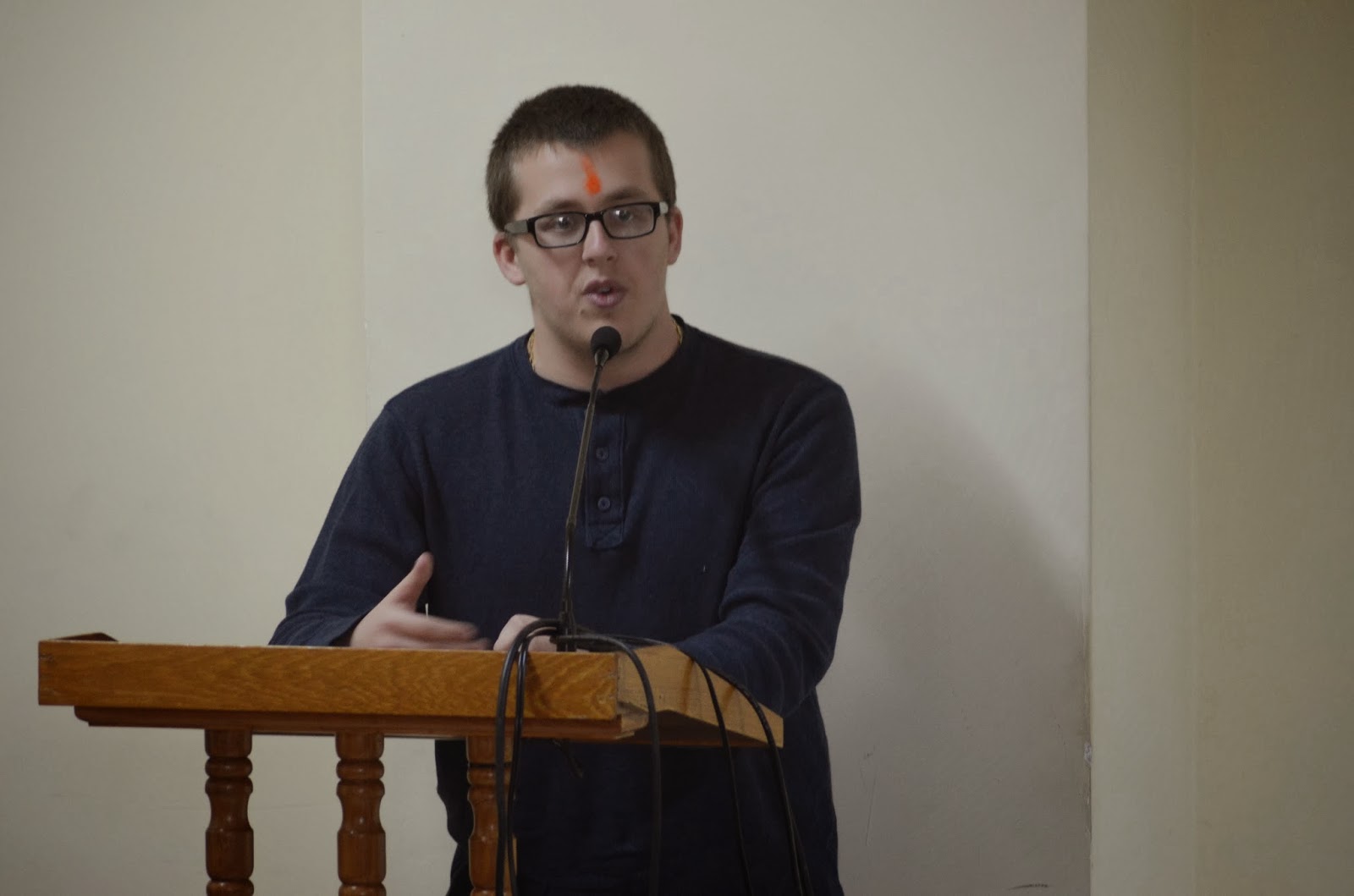
Introduction to the Global Citizenship program

MCs taking over

Interactive session


The visit culminated with a group photo and a vote of thanks. This visit and the interaction that it has entailed has helped to establish friendships that cut across cultural and geographic boundaries.

Campus tour

Lunch in the cafeteria with other Christites


The team leaders from Lehigh and Faculty from the Department of Sociology, Christ University

The entire student group

The send off
Thursday, 12 December 2013
Workshop on LFA

The department
of Sociology at Christ University had organized a workshop on December 10, 2013, on Logical Framework Analysis (LFA). Students of second year MA Applied Sociology
and MSW attended the workshop between 1:00 pm and 4:00 pm. Faculty members from the Departments of Sociology and Social Work were also present for the workshop.
The workshop was
initiated and conducted by Dr. Godfred Victor Singh, the director of CSA, Christ University. The workshop was divided into two sessions. The first
session was a detailed explanation on projects and the second session was on
LFA.
The first session
covered the characteristics of a project, a project life cycle and he also
explained how to make a project successful. The differentiation between project
and program was also made. The section was very useful in understanding the
reality of projects, through sharing real time experience. The objective of the
section was to give a brief account on project which was achieved successfully.
The second session
was on Logical Framework Analysis (LFA).
LFA, a research based tool was dealt in with detail in this session. It
has become a major tool for planning a project and it leads to achieve goal
oriented projects. The other topic which he covered was history of LFA, purpose
and characteristics of LFA. The basis of LFA was explained in-depth and nine
steps in LFA were also discussed at the end. The section ended with an assigned
task to the participants, to give them a practical experience of LFA.
The workshop was
very fruitful for all the students. Since the LFA is part of student’s
curriculum, it was an opportunity for students to understand LFA better. The
workshop was interactive and it gave us an in depth knowledge about
Logical Framework Analysis. There will be a follow up session in February 2014.
Deepa Sebastian
Subscribe to:
Posts (Atom)