Wednesday, 17 February 2016

Workshop by the Indian Social Institute

The Indian Social Institute organized a half day workshop for the students of MA Applied Sociology on January 30, 2016. This workshop was organized by the Training and Research Unit. This Unit of the Indian Social Institute focuses its attention on the empowerment of the marginalized groups, especially the Dalits, Tribals, Women, Children, and Minority Communities through capacity-building to secure their human rights through training, networking and advocacy.

This workshop was conducted for the students to engage with with the possible issues and interventions of Bonded labor and Distress Migration and it created the opportunities for the students to intern with the Unit and take their academic knowledge to the field.
    

Development Induced Displacement and Resettlement: A Guest Lecture

Image result for hemalatha kDr Healatha K, an expert on the area of development induced displacement delivered a lecture for the students of MA Applied Sociology on January 28, 2016. This highly informative and engaging talk enabled the students to gain immensely from her hands on experience on the area of Development Induced Displacement and Resettlement in the state of Karnataka primarily as a result of the building of large dams. This lecture bridged the gap that is often perceived between academic research and the classroom.

Seminar on Social Psychology

The students of MA Applied Sociology organized a seminar on Social Psychology which was held on November 24, 2015. The central theme of the session was social psychology and its significance in the study of sociology. 
The entire session was commendable in terms of how well it was organized and it could have have been improved upon with a more extensive engagement. Nibedita's presentation on media and society was one to catch the eyes of the audience, as it was not just a simple reading of script rather an audio visual experience full of videos and gifs, and she further showed crystal understanding of the subject matter. 
The highlight of the session for the audience was the next presentation on ethnomethodology.  Liya and Apeksha explained the concept through breaching experiments. Their part was mostly audio visual with a plethora of theoretical backing, making the presentation a wonderful experience. Brother Luke’s presentation seemed the most planned and the best executed. It had clearly cut out sections and his way of presenting showed confidence and commitment. He added his personal touch with a joke to begin with which was a pleasant change. 
Rusha ended the session with a presentation on ‘Peer pressure and drug abuse’, the presentation showed confidence and an all-round comprehension of the concept, tying the whole thing quite pleasantly.

Young Sociologist Competition 2015-16

NATIONAL YOUNG SOCIOLOGIST COMPETITION 2015-16

“To deny people their human rights is to challenge their very humanity.”
-          Nelson Mandela

Based on the theme of Human Rights, the National Young Sociologist Competition 2015-16 was organized by the Department of Sociology, Christ University, Bangalore. It was held on December 10, 2015 which is celebrated as Human Rights Day all over the world to honour the adoption of the Universal Declaration of Human Rights by the UN General Assembly in 1948. This was a national level competition where undergraduate students of Sociology across India were invited to send an abstract of their research paper. Out of all the abstracts that were sent, 10 were selected for the final paper presentation.  
The event started with a warm welcome speech by Dr. Sudhansubala Sahu, Young Sociologist Competition Coordinator and an introduction of the judges – Dr. Kshitij Urs, Dr. K. G. Uma and Dr. Sobin George. This was followed by an introductory speech by Dr. John Joseph Kennedy-Dean,   Humanities and Social Sciences, that stressed on the importance of the protection of human rights in today’s world.                                                            
Dr. Kshitij highlighted the importance of critical thinking through his speech. As participants in democracy, we shouldn’t take anything the way it is given to us. Asking questions is absolutely necessary. He ended his speech by stating the idiom: birds which are born in cages feel that flying is an illness, meaning the State keeps us in boxes and shapes the way we think. We have to learn to come out of these boxes and think differently.  
  Professor Suparna Kar proposed the vote of thanks and with this the inaugural session came to an end.  
This was followed by paper presentations by the participants. Each participant was given 10 minutes for presentation and 5 minutes for discussion. They were expected to identify different human rights as specified by the universal declaration; carry out an original research to understand how human rights are violated in the local context and then identify agencies or organizations who are working towards their protection. Under the broad theme of Human Rights, various sub-themes were included:
·        Right to Life Liberty and Security
·        Right to Freedom of Opinion and Expression
·        Right to Own Property
·        Right to Work and Right to Equal Pay for Equal Work
·        Right to Education
Several interesting papers were presented – Child Labour in Hazardous Industries, Human Rights Violation among the Tribal Women of Attapadi, (Not) Hiring Hijras: A qualitative study of the right to work being violated, Sustainable Education, Right to Life, Liberty and Security in Live-In Relationships, Right to Work and Equal Pay for Equal Work, etc.
Among these, the first position was secured by Atreya Arun of Christ University. His paper titled Pretrial Detentions in India: An executive and judicial failure in the upholding of human rights looked at the plight of pretrial or undertrial detainees who are held for excessively long time periods. This denies them basic human rights and although there are certain laws that have been enacted, they are not implemented and maintained due to inefficiencies in the judiciary and executive. Using the case of Dantewada district jail in Chhattisgarh, the paper tells us that the situation can be improved by adhering to the basic laws of the Indian Constitution and rethinking the legal process to make it more egalitarian.
 Gopika C. R. of B.C.B. College, Kottayam won the second prize for her paper titled A Sociological Analysis of Awareness of Human Rights Violation among Transgenders in Kerala. The findings of the paper revealed that 96% of the transgender community was aware of their rights. They faced a violation of the Right to Life, alienation from social life and no access to employment opportunities. Public awareness, proper implementation of laws, publication of books and reports about the transgender community at the regional level could bring some improvement in the current situation.
The third position was secured by Varsha Iyer of Jyothi Nivas College, Bangalore for her paper titled (Not) Hiring Hijras: A Qualitative Study of the Right to Work Being Violated. It was a qualitative study that analyzed socio-cultural identity and employment opportunities for the Hijra community.
The prize distribution was done by the judges – Dr. K. G. Uma and Dr. Sobin George and the vote of thanks was offered which brought the even to an end. The audience benefitted from the large wealth of knowledge presented to them, making the event a grand success. 

Wednesday, 7 October 2015

Rural Exposure visit

The Rural exposure visit for MA Applied Sociology students took place on 26th and 27th of June. We were a batch of more than 40 students along with teachers. We visited villages in the Hoskote Taluk which belongs to the Bangalore Rural district. Our visit was planned and organized meticulously by Centre for Social Action – Christ University.
We were provided stay in the CSA dormitories. The village visit was an eye opener in many sorts. We started off with an enlightening interaction with one of the pioneers of this social change Mrs.Shakuntala from Appasandra. We had six translators to assist while this interactive session was going on. It was a riveting experience. We heard about the transformational journey the villages had undergone with the help of CSA. They explained how the whole project took off in 2003.


A very humble beginning, filled with many a troubles and challenges. CSA first began with the Nutrition of Children. CSA had a preliminary report with pointed towards the massive malnutrition trends in this region. Gradually with procurement of the nutritious food, the weight of the kids increased substantially and was there for everyone to see. This in a way reduced the slight inhibitions the villagers had towards the “Christ” tag. Soon, CSA was involved in assisting education for these kids. They were convincing their parents and getting them into schools, reducing dropouts, spreading awareness of a quality education and reaps of reward awaiting them in future.
Mrs.Shakuntala also spoke about the Self-Help groups, which has been the backbone of the village development from last one decade. There are more than 15 SHGs which meet up regularly. It enables crowd saving and this money would then be diverted to savings bank account. Later when a need arises , the loan from this amount is granted to a member. There are also cluster groups which provide money only for the income generating activities. It started off with an initial seed amount of 25 lakh rupees. And today the village can boast of a turnover of 18 crores. Most of the households are financially stable and settling into safe courtyards.


We also had the opportunity to visit the Government School in Appasandra village. The experience was an eye opener for all the privileges we enjoy. Cause the situation cried for more assistance and help. The school taught from 1st to 5th std. But it had only two classes. This meant many classes had to be combined and with only two teachers, most often this combination made all classes look same. The headmaster told us about the lack of government support, how just 92 paise was allotted to each kid for a month. And also how irregular and irresponsible it was when the paying heed to the concerns and cries of the school. With the whole country chanting about “Swachh Bharat”, many of these schools do not have proper washroom facilities. In Appasandra, there are no water facilities. A kid has to draw water from a distance and travel to use washroom. We spoke to the kids and taught them few of what we knew. We also used flashcards to have an interactive session. The enthusiasm and exuberance the kids’ exhibit is tremendous and keeps our faith intact in the potential. We also had house and farm visits which enabled us get firsthand experience about the lifestyle and operations of SHGs.
On the last day, we had a community program where we painted the walls of their school with educational themes. We also had a reflection session, where our mutual experiences were shared and suggestions were made. To top it all, all groups sang a local folk song to appreciate and nurture the local tradition. Overall, it was an eye opener and a fruitful visit, which will help us take our future as sociologists in the right path. 


Prajwal, MA Applied Sociology

Rural Exposure MA Applied Sociology

On the 26th of June, 2015, the first year and second year MA Applied Sociology students were taken by the Sociology Department for a village visit to Hoskote. Hoskote is a taluk in Bangalore Rural District. Headquartered at the Hoskote town, it consists of 5 Hoblis - Anugondanahalli, Jadigenahalli, Kasaba, Nandagudi and Sulibele. Agriculture, Apiculture and horticulture are primary occupations of people here, although the industrialization in the recent times in Hoskote and places around has thrown up new opportunities for the people. Hoskote is the largest taluk in Karnataka having 333 villages.

On arriving the same day, we had stayed at the Pragathi Cluster Level Association, funded by The Churches’ Council for Child and Youth Care, Hoskote as a village can now be seen as a semi-developed town. Since this was my second visit to the village, it was still a refreshing experience and I was accustomed to the ways and practices of the village and its people. Given an overview of the developments by Shakuntala mam, the students got an insight into the past, present and future of Hoskote.
After being divided into separate groups, my group had gone to the local school. We had spoken to the school headmaster who was an extremely hospitable gentleman. We learnt that he had been the principal for twenty years out of his own choice. Two classes were held simultaneously in the school, which was a bit difficult to understand. However, the students enjoyed their classes. There were a higher number of girls in the class as compared to boys. Every student was extremely keen on learning and according to the headmaster were “fast learners”. Later on we taught the students about health and nutrition and what vegetables and fruits were important for the proper functioning of the body.

Later on we were introduced to the local tutor by Vinay Sir. He had taken us to the cultivation area, where they grew raggi that they consumed for their own requirements and did not sell it. Mangoes, chillies and mulberry leaves were also grown. By the evening we were taken to the tutorial centre where we had a discussion with the tutor. The number of students who come has dropped in the years. According to me, a proper tutorial centre along with proper lighting and more experienced teachers are required to motivate the children and mainly the parents to send their children to these centres.


We were also taken to visit an SHG group. These women stayed together and according to them, they would take loans for personal needs such as weddings or for festivals and in two-three months would pay them back. It was great to see how these women were getting their act together and actually going out of their way to do things for their village.

The next day the artists of our department gave back to the community by painting the walls of the school with images of the solar system and so on. It was truly a beautiful gesture.

Later on in the reflexive session, we all had certain recommendations. A few were that street lights needed to be put along with proper drinking water and other facilities for the school so as to make the children’s lives better. Another suggestion was that SHG groups should not only use the loans that they get for personal purposes but should make proper use of it so as to benefit the community as a whole such as construction of better roads and buildings, proper drainage systems, etc. Every individual should also learn to be self-reliant and not always depend on outsiders for help. The outside world should be introduced to them and this is possible with proper transportation that needs to be easily available to them. A hospital should also be within reach so that they can access it easily whenever necessary.

Overall it was a great and fun learning experience. The people of Hoskote are very hospitable and treated us with respect and kindness. They were never shy to answer any of the questions that we put forth, maybe because they are used to students visiting them. Hoskote is a promising village and if looked after properly can develop further.

Neomi DCruz, MA Applied Sociology


Monday, 28 September 2015

Seminar on Social Change in India

On 21st September 2015, paper presentation was organized by the students of I MA Applied Sociology under the guidance of Dr. Sheila Mathew, professor, Department of Sociology. The class was divided into three groups. Each group was assigned topics namely, ‘Commercialization of Agriculture in India’, ‘Industrialization’ and ‘Globalization’. And, 19 papers were presented in total in over a week’s time.
The first group presented their papers on commercialization of agriculture in India. The first set of presenters from the group defined the concept of commercialization and gave the historical background to commercialization of agriculture in India.  

The next set of presenters covered the topics such as commercialization of agriculture in contemporary times, the changes in agrarian class structure, the agrarian crisis and the agrarian unrest due to commercialization of agriculture in India.
The second group presented their papers on industrialization. The papers presented were on the history of industrialization in the west, the socio-economic changes that occurred due to industrialization, the history and growth of industrialization in India till the contemporary times, the differential view held by sociologists on the industrial class structure in the west and in India.

The third set of presenters presented on globalization. The key topics addressed by the group include the definition and history of liberalization, privatization and globalization in India, the various dimensions of globalization, the impact of globalization on Indian agriculture and the positive and negative impact of globalization on Indian society.


In conclusion, it was observed that commercialization, industrialization and globalization facilitated social change. But, the benefits were reaped only by an elite section of the society, while the vulnerable sections remained out of the realm of these drivers of social change.

Friday, 25 September 2015

Exploring our rural roots

As we entered the bus, one by one, all of us were equally excited for the overnight visit that would expose us to the rural environment of Karnataka. This excursion, which was undertaken by the final year undergraduate students of Sociology between 31st July to 1st August, was directed with the help of the Centre for Social Action. The main objective of the trip was to create awareness among the students about the rural life of India by sensitizing them to rural communities. One of the main tasks assigned to us was to study the village system and its important components.After a journey of around 2 hours, we reached the base camp in Halasinakayipura village, Hoskote, where we received a warm welcome from Mrs.Shakuntala, the head of the village cluster. She rendered a brief summary of the developmental activities that were initiated in the village by CSA. We were made aware of how CSA had worked in the village for the first 7 years after which all the responsibilities were given to the villagers for better functioning. She also oriented us with the challenges faced by them before the advent of CSA to the village, which include – lack of awareness about the nutrition to be provided to children and pregnant women, problems in the areas of education, financial inclusion and women’s position in society.
We were met by Mr.Ranjit Kumar Singh after a delicious lunch. We had an enthusiastic ice-breaker session with him, after which he gave us instructions about the activities to be done. All of us were divided into 2 groups and had to visit two different villages with our respective leaders.
              Team Ragi Mudde visited the village of Chikanallala, where on visiting the school [Nammoora Sarkaari Hiriya Prathamika Shaale] they interacted with the headmaster. The students found out about the day-to-day functioning of the school and the problems faced by them, one among which was the lack of benefits received from the government. Further, the students visited two households, where they had friendly encounters with the inhabitants. They learnt about the functioning of self help groups and how the men of the houses enthusiastically supported their wives in all of their endeavours. One of the interesting experiences of the students was weaving silk with a charkha that was improvised by the wheel of a cycle. This was looked at as a source of additional income.
Activities were carried out in Halasinakayipura by Team Suhaas’s Angels. They visited the school in the village, agricultural fields and two houses after which they observed a self help group meeting. All this gave them a firsthand experience of the daily circumstances of rural society. The students learnt songs in Kannada from the schoolchildren. They saw fresh crops being grown and were also offered a few vegetarian delicacies like tomatoes and ridge gourds. On their way back to the base camp, they also had the opportunity to witness a beautiful peacock in the forest.  
As the day came to an end, the two groups returned to the base camp, tired and exhausted. Everyone had a scrumptious dinner and retired for the night.
The following morning proved to be a peaceful delight with the smell of fresh earth and the sound of birds singing. Consequently, most of us went out for a morning stroll, exploring the interiors of the village. After a tasty breakfast, we prepared ourselves for Shramdhaan, or the gift of service, which was to be provided in the form of painting the school walls of the Halasinakayipura School. An artistic quarter of us were involved in painting the water cycle and depicting the stages of a woman’s life through our colours and brushes. The rest of us applied coats of primer on the other walls. Completing this task took a time period of 3 hours after which we had a session of reflection with Mr.Ranjit Singh.
                
All of us shared our experiences during the session and discussed the learning outcome. We reflected and internalized our roles as agents of change in order to transform the adverse situations in rural society. We conversed about the importance of development projects and the session ended with us giving a few suggestions as to how this rural exposure programme for students could be improved. We had a wholesome lunch and set out on our way back.
In its entirety, it was a beautiful experience that widened our perspectives and gave us multiple dimensions of looking at the world.

 OINDRILA MUKHERJEE
5PSEng

1313263 

Sunday, 20 September 2015

Panel Discussion: “Growth and issues of the Indian middle class.”

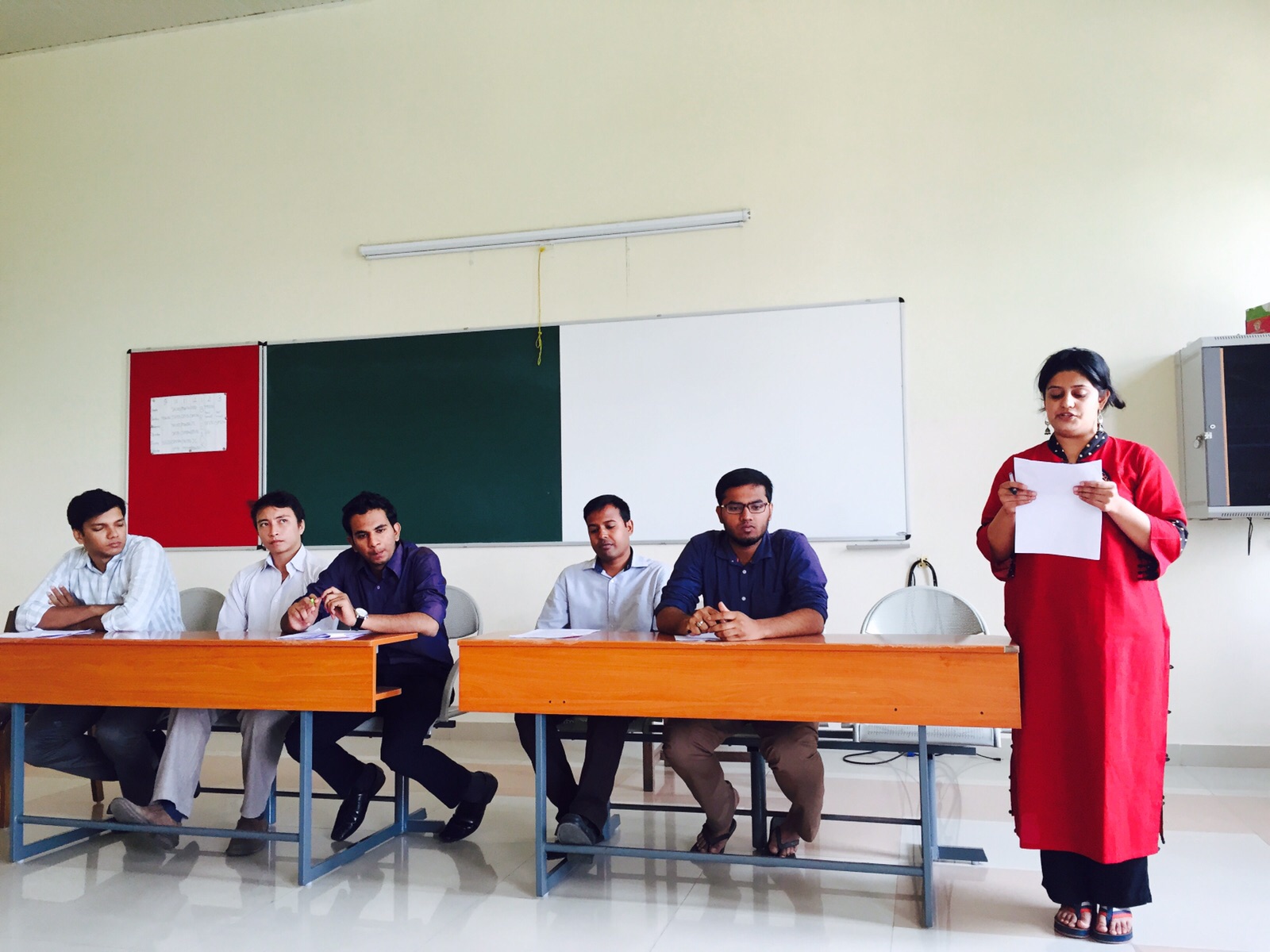
On 20th July 2015, the students of the Dynamics of Indian society paper from I MA Applied Sociology held a panel discussion on “The growth and issues of the Indian middle class.” The panel discussion was organized under the supervision of Dr. Sheila Mathew, Professor, department of sociology, which was moderated by Ashween Lama, Mitchelle D'Souza, and Roshni Mondal. The class was divided into three groups. The panelists from the first group initiated the panel by defining middle class and gradually moved to discussing the rise of the middle class from the British period to the post LPG period of contemporary India. Along with discussing the rise of the middle class, they also pointed out the disassociation of caste in India, the influence of Nehruvian and Gandhian ideology on the middle class in particular and the Indian Society in general.
The second set of panelists continued the panel with intensive discussions about the various problems faced by the middle class. They highlighted the various psychological, political, social and economic issues faced by the middle class. The panelists also emphasized on issues related to education and lack of skills among the middle class.
The third group of panelists discussed the impact of the middle class on the society and their various contributions to the society. They spoke about the effects of the middle class on the economy, politics, and the social organization.  The panelists pointed out that in a patriarchal society like India, the amount of gender disparities in the IT sector is less compared to the other sectors such as banking and finance. This gender blindness of the IT sector led to the comprehension that IT is a good job for women. The panelists also highlighted the political behavior of the middle class and the changing social lives of the middle class.
In conclusion, it was observed that all the panelists pointed out the importance of the middle class as the driver of economic, political and social change of the society.


Workshop on ‘CSR in India’

The Department of Sociology organized a workshop on Corporate Social Responsibility in India on Wednesday, 16 September 2015. It was attended by teachers and students of various departments including Applied Sociology, Social Work and Development Studies with a total of 90 participants. Resource person for the day was Ms. Abha Saxena from Social Equity Services. The context of the workshop was the implementation of mandatory CSR in India. The first session was on the provisions of CSR implementation based on Companies Act. She discussed the structure and provisions of the policy cum strategy document on CSR. Thrust was given on the understanding of what is CSR and what is not.

It was followed by a presentation by the II MA Applied Sociology students on their findings on CSR implementation of various companies in India. They had visited few organizations and reviewed the annual reports of some other companies. They discussed how the CSR implementation styles differ from companies to companies, the focus areas for CSR activities and different ways of taking CSR in a project mode with the help of Non Governmental Organisations.

The next session was on the current status of CSR implementation based on the data collected through various channels like NGO Box report, Mercer Survey etc for 2014-15. The cheque book philanthropy style of   companies were analysed very critically. This was followed by a discussion on the scope, opportunities as well as challenges of CSR implementation in India. It was a fruitful workshop in participatory manner with active dialogue between participants and the resource person.