Monday, 9 March 2020

Interactive Session with Indi-Village

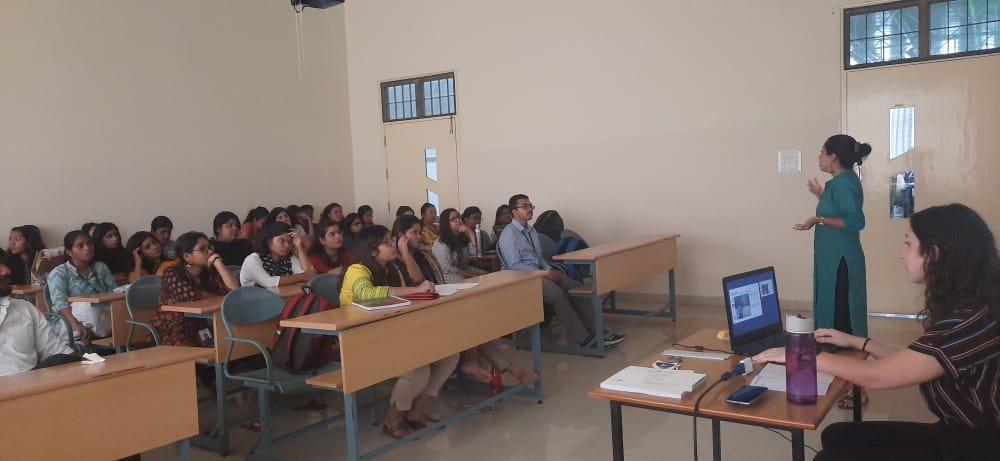
The first and second-year MA students of Applied Sociology interacted with a few representatives from Indivillage on the 25th of February, 2019. The session was organized by the Department of Sociology and Social Work. 
As global crises and assertions are being made for a collective need, to work on the Sustainable Development Goals (SDGs), this organization has been working towards attaining some of the SDGs in rural Indian landscapes. Some of the goals that IndiVillage has been working towards include Quality Education, Gender Equality, Decent Work and Economic Growth. The organization primarily works with impact outsourcing to bring about better opportunities and for growth in rural India, through Information Technology (IT) and Information Technology Enabled Services (ITES).

The session was fruitful for students interested in the development sector, and the first-year students to the network who would soon be interning. Furthermore, through interactions, the discussants also provided insights into the challenges and necessity for students of humanities and budding social scientists to work for the social impact sector. 

M N Srinivas Memorial Lecture

As the birth and death anniversary of M N Srinivas falls in the month of November, the Department
D:\sudipta.garai\Downloads\IMG-20191122-WA0005.jpgof Sociology and Social Work organized an MN Srinivas memorial lecture on the 22nd November 2019, from 12 to 1pm on the topic “Politics of Knowledge: The case of ‘indigenous’ medicine in India”. The event began with an introduction to MN Srinivas’ outstanding contribution to the sociology of India. Our guest lecturer, Prof. Leena Abraham, Associate Dean, School of Research Methodology and chairperson for Centre for Studies in Sociology of Education, TISS Mumbai, gave a brief account of the politics of ‘indigenous’ medicine in India. Her lecture started by explaining the concept of hegemony within the knowledge, politics of knowledge and the power struggles within indigenous knowledge systems. The lecture threw light on the various manifestations of these politics in indigenous knowledge systems in India such as Globalisation, colonization, and feminization of Ayurveda in the past few decades. The lecture by Prof. Leena Abraham was very insightful and helpful to understand in-depth, both the fields of knowledge production and sociology of medicine. The lecture followed by a short interactive session in which students and faculty members asked questions and clarifications. Apart from the Master's students of Sociology, many undergraduate students from other departments took part in the lecture. The president of the Sociology and Social Work Students Association thanked Prof. Leena Abraham for her insightful lecture and presented her with a memento.

South Asia in Transition

“South Asia in Transition” is an initiative taken by the Department of Sociology and Social Work in order to open a new arena of discussions and deliberations in comprehending the transitional changes of South Asia in the global order. 
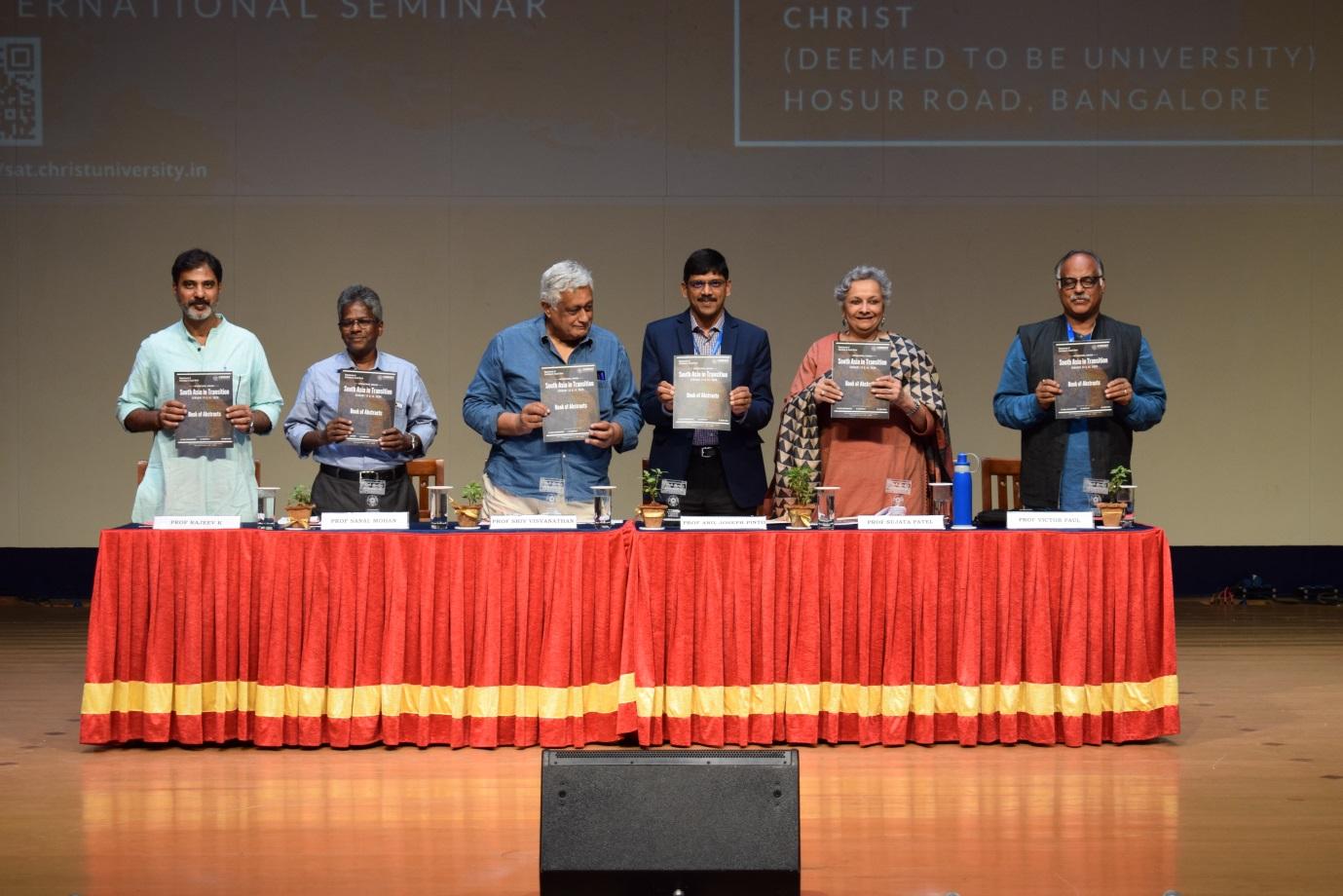
D:\sudipta.garai\Downloads\DSC_0143.JPGThe International seminar took its structural framework from the think tank of eminent faculties like Dr Rajeev Kumaramkandath, Dr Sudipta Garai and Dr Deva Prasad F. The idea was further supported by the head of the Department Dr Victor Paul, Vice-chancellor Dr Fr Abraham V M and Dr Tony Sam George Dean of Social Sciences.
The International seminar took place on 13th and 14th of February 2020, where a plethora of intellectual ideas collaborated making scholars and students across the globe ponder about various aspects of South Asia. 
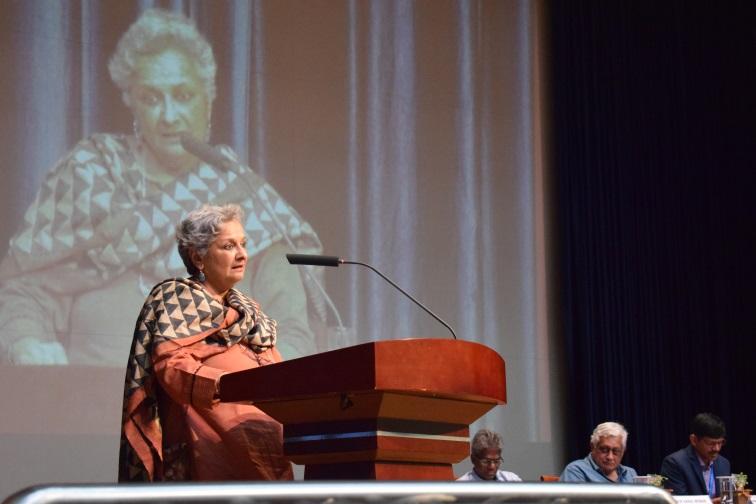
On day 1, the conference began with a vibrant inauguration in the presence of brilliant minds such as Prof Sujata Patel who delivered a keynote address, Prof Shiv Vishwanath who articulated on Reinventing South Asia: On Nature, knowledge and Democracy and Prof Sanal Mohan who traced back Alternative Histories in South Asia. Further, there was a presentation on Canadian sizzlers to NRI cities: The culture of migration in Punjab followed by a panel discussion which was headed by Dr. Shiv Vishwanath on research papers related to SAARC and Andaman prisoners. This was followed by paper presentations by the participants at various venues. 
On day 2, there were elaborate sessions conducted in various venues, wherein, approximately 55 research papers were presented by various scholars across the globe on themes such as Education, empowerment and livelihood, Legal and political discourses, History and tradition, Global Networks and Cultural Hybridity, Gender and sexuality, Culture and Society, Media and technology.
D:\sudipta.garai\Downloads\DSC_0128.JPG

The seminar came to a conclusion with a valedictory session chaired by Dr. Fr. Joseph CC pro-vice-chancellor and Valedictory address delivered by Dr. Vathsala Aithal (University of Applied Sciences, Germany).
The end of the seminar has opened the beginning of new thoughts in the minds of students, faculties, and scholars which might further shape up into great ideas ahead.


Interactive Session - Dr. Shiv Vishvanathan

The Department of Sociology and Social Work organized an interactive session with Dr. Shiv Visvanathan on 15th February 2020 for the undergraduate and postgraduate students of Sociology. Dr. Visvanathan, is currently a Professor at Jindal Global Law School, Sonipat, and Director, Centre for the Study of Knowledge Systems, O.P Jindal Global University. He is an Indian public intellectual and social scientist best known for his contributions to Science and Technology Studies, and for the concept of cognitive justice a term he coined. 

The discussion gave interesting insights into Sociology as a dissenting science and reimagining dissent in contemporary India. Dissent today is one of the most critical acts of democracy. It is considered as the custodian of difference, giving voice to minorities and people on the margins. One has to stop thinking of the idea of the opposition in negative terms. Democracy without dialogue and opposition is incomplete. Dr. Visvanathan emphasized the crucial role that sociology plays in capturing these dissenting voices. 

 From its inception, Sociology has been a dissenting science. Dissent should be understood within the broader framework of the theory of democracy and the theory of knowledge. In contemporary India, Dissent is treated as unacceptable, obsolete and even anti-national. Thus Dr. Visvanathan says that it has become more important than ever before for sociologists to engage with the idea of dissent both as a concept and as an activity. 

The lecture was followed by a question-answer session. Students raised questions concerning various contemporary issues. There were discussions on practicing sociology in India, research and the methodology of the social sciences. The lecture was very informative as it successfully laid the foundation for further research and discussion on reimagining dissent in contemporary India. 

GUEST LECTURE- DR. SHILPA SREENATH


Dr. Shilpa Sreenath is a practicing counseling psychologist, with more than 10 years of experience. She graduated from CHRIST (Deemed to be University) in 2007 after completing

three years of BA in PSEco and a Masters in Clinical psychology. She later completed her further education in the UK and got her doctorate in psychology from Glasgow Caledonian University in 2014. On Wednesday 12 February 2020, she engaged in an interactive session with the 4th-semester students of PSEco.  
During the session, she shared her experiences in dealing with patients in both India and the UK. Her experience in working with people coping with cultural adjustment and inclusion issues, those who are internet and social media-dependent; and those who are experiencing lifestyle and urban stress were very insightful. Her psychological interventions and therapeutic framework are based on the guidelines provided by the British Psychological Society and Health & Care Professions Council, U.K.
Dr. Shilpa also spoke about the areas of her expertise including depression and low mood; anxiety-related issues such as phobias, generalized anxiety disorder, social anxiety, trauma/PTSD, panic, and health anxiety; stress and anger issues; low self-esteem; bereavement; relationship issues; substance misuse; self-harm; and life transitions.

Dr. Shilpa Sreenath also on the importance of higher education and how it helped her. Students raised many interesting questions during this session about different subfields in Psychology and their scope, selection of subjects for masters, doing masters abroad, tests to be written, any differences in patients in India and abroad and how the place of education influences the career of a psychologist. It was an enriching experience for the students.

`The Social and Political of People’s Movement” - Dr Anshuman Behera

The Department of Sociology and Social Work organized a guest lecture by Dr. Anshuman
Behera on the topic ``The Social and Political of People’s Movement” on 7th February 2020. Dr. Behera is an Associate Professor at the School of Conflict and Security Studies, National Institute of Advanced Studies, Bangalore. His research areas include conflict resolution, internal conflicts in India, Nepal, and Bangladesh, terrorism in South Asia, and religious radicalization.

The lecture gave interesting insights into some of the important aspects of people’s movements
in contemporary India. Beginning from the problematization of the idea, Dr. Behra explained the
changing paradigms and the politics of people’s movements. The current political scenario is
marked by extreme levels of partisan hostility and polarization. The politics of attribution thus
becomes an important topic for discussion.

The culture of name-calling is dividing society into more and more hostile groups. Dr. Behra
discussed how the politics of attribution has shaped the face of contemporary people's movement. For long, the power dynamics and the political agenda behind people’s movements were ignored by the scholarly world. For example; The tribal and peasant uprisings were often discussed as subaltern movements and were never discussed under the larger context of people’s movements. It is clear that a hegemonic power relationship exists in the way people’s movements are
conceptualized and studied. Thus Dr. Behra calls for a reconceptualization of people’s
movements to unravel the existing structures of social domination.

The lecture was followed by a question-answer session. Students raised questions concerning the
anti-CAA protest, tribal uprisings, Maoist insurgency, national security, and so on. The lecture
was very informative as it successfully laid the foundation for further research and discussion on
the topic discussed earlier.  The session was inspiring, informative, and wonderfully delivered.

Thursday, 20 February 2020

INTERACTION WITH ALUMNUS FROM THE ARMED FORCES

On 25th January, the Department of Sociology and Social Work organized an interactive session with the alumni serving in the armed forces for students from the Humanities and Social Sciences as well as the Sciences. Mr. Mohanachandran Panicker (Group Captain, Administration/Air Traffic Controller) - an alumnus of the 1969-73 CBZ batch, Mr. Dinesh Pattabhi (EO at Indian Army) - an alumnus of PCM - and Major Suraj (Air Defence) - and alumnus of PME – were the esteemed guests of the session. 
During the session, they mentioned many anecdotes from their experience in college as well as in the armed forces. This was followed by a Q&A session. Students inquired about the Combined Defense Services (CDS) exam and various other competitive exams. Mr.

Pattabhi and Major Suraj
emphasized the importance of early preparation and responded to various queries related to the same. They also answered questions about life in the armed forces and shared their personal experiences. The session ended with a vote of thanks by Sonika Kumar of 4MSOC. The session was inspiring, informative, and wonderfully delivered. 

DATA PROTECTION AND CONFIDENTIALITY

An interactive session on data protection and confidentiality were held at the Department of Sociology and Social Work of CHRIST(Deemed to be University) in Bangalore with M.A. I & II-year students. It was an informative lecture conducted by Professor Rolf Jox on Data Protection and Confidentiality – The Example of Germany. 
He addressed the following German laws regarding the concerned matter:
~ Article 2 i.e., General Data Protection Regulation (GDPR) Material Scope. 
~ Article 4 which defines personal data as any information relating to an identified or identifiable natural person (data subject) and processing as “any operation or set of operations which is performed on personal data”. 
He further mentioned that data will be protected through all protecting laws, respective general rules and provisions of the GDPR, national rules of data protection and provision of penal and civil law. He spoke about how personal data shall be processed lawfully, fairly and in a transparent manner in relation to the data subject; collected for specified, explicit and legitimate purposes and not further processed in a manner that is incompatible with those purposes; adequate, relevant and limited to what is necessary in relation to the processes for which they are processed; processed in a manner that ensures appropriate security of the personal data. Article 6 which talks about the lawfulness of processing states that processing shall be lawful only if and to the extent that one of the following applies: the data subject has given consent to the processing of his/her personal data for one or more specific purposes and there is secure handling of data protection/ confidentiality.

Lastly, he spoke about anonymization. He believes that anonymization should be made possible for permitting the client’s consent too (Article, 8 GDPR). The issue of consent was also focussed upon in understanding data confidentiality. The Q&A session was also meaningful. As a whole, the lecture was very enlightening as knowledge regarding different laws concerning the issue in Germany was gained and also discussed to some extent in the Indian context.

FAMILY LAW SYSTEMS IN EUROPE

A guest lecture on “Family Law Systems in Europe” was organized by the Department of Sociology and Social Work to provide the students with an opportunity to understand the Legal Dilemmas from the perspective of Germany. The lecture was conducted by Prof. Dr. Rolf Jox, Katholische Hochschule Nordrhein (West Fallen Catholic University of Applied Science) on 27th January 2020 for the students of first-year BA PSEco (Psychology, Sociology, Economics). 

The session began with a welcome address given by Dr. Victor Paul, Head, Department of Sociology and Social Work. The lecture by Prof. Dr. Jox began with an introduction about family law systems in Europe, followed by an interactive session with the students about the Five Dilemmas and also about the legal situation and problems in Germany. It also comprised of discussions on a few case studies regarding parenthood, custody, contact, and adoption. The session ended with presenting Prof. Dr. Jox with a memento and heartfelt gratitude for his time spent in educating the students on Family law systems in Europe.

Sunday, 17 November 2019

Bengaluru Sociology Student Seminar (BSSS) - 2020


CHRIST (Deemed to be University) was born out of the educational vision of St Kuriakose Elias Chavara, an educationalist and social reformer of the nineteenth century in South India. He founded the first Catholic indigenous congregation, Carmelites of Mary Immaculate (CMI), in 1831 which administers CHRIST (Deemed to be University).
Established in 1969 as Christ College, it undertook path-breaking initiatives in Indian higher education with the introduction of innovative and modern curricula, insistence on academic discipline, imparting of holistic education and adoption of global higher education practices with the support of creative and dedicated staff.
The University Grants Commission (UGC) of India conferred Autonomy to Christ College in 2004 and identified it as an Institution with Potential for Excellence in 2006. In 2008, under Section 3 of the UGC Act, 1956, the Ministry of Human Resource Development of the Government of India declared the institution a Deemed to be University, in the name and style of Christ University. One of the first institutions in India to be accredited in 1998 by the NAAC, and subsequently in 2004 and 2016, CHRIST (Deemed to be University) has the top grade ‘A’ on the 4-point scale.
The multi-disciplinary University which focuses on teaching, research and service offer Bachelors to Doctoral programs in humanities, social sciences, science, commerce, management, engineering, education, and law to over 21000 students. The campus is a living example for the harmonious multiculturalism with students from all the states of India and around 60 different countries. CHRIST (Deemed to be University) publishes six peer-reviewed research journals and has published more than 300 books in Kannada and English. A promoter of sports, music and literary activities, it is a nurturing ground for creative excellence.

Societies in Transition: Modern and Post-Modern Conditions
The Bengaluru Sociology Students Seminar (BSSS) is an annual regional conference organized by the Sociology Students Association of CHRIST (Deemed to be University). They have identified Societies in Transition: Modern and Post-Modern Conditions as the topic for deliberations this year. This seminar is a platform for students pursuing sociology with any one educational institution within Bangalore to participate and present papers. This seminar is expected to initiate critical discussion, resulting in a dynamic exchange of ideas amongst the participants.
We invite papers attempting
1. to record fundamental processes involved in social transition;
2. to identify the root causes of social transition in the Indian context;
 3. to examine the past, present, and future (predictive) conditions of these societies in transition;
4. to understand the effects of social transition on social relationships;
5. to develop new methods to understand the social transition.
The following suggestive subthemes are identified. These are a few pointers which can be used as a foundation for formulating papers. We look forward to receiving novel works which are argumentative and debate provoking. Papers addressing issues and concerns outside the list below will also be considered if they fall within the broader theme of the seminar.
·         Indigenous Cultures and Modernity
·         Redefining Caste and Class Structures
·         Emerging New Political and Economic Structures
·         New Social Movements and Social Transitions
·         Role of Youth Today
·         Changes in Gender Roles
·         Changes in Social Institutions
·         Role of Technology, Media and Communication in Social Transitions
·         Role of Education in Social Transitions

Interested students are requested to send 150 words abstract to the below-given email address by November 30, 2019.
Important information:
·         Date of Seminar: February 12, 2020
·         Venue of Seminar: CHRIST Main Campus, Hosur Road, Bengaluru.
·         Date for receiving abstracts: November 30, 2019
·         Date for receiving the final paper: January 15, 2020
·         Abstracts and Final papers (APA style) should be sent to the given email ids.
Ø  Presentations can be made both in Kannada and English
Ø  Registration fee for participants is Rs.200 and for presenters Rs.250.
Ø  All the registered participants will be provided Tea, Lunch and Certificate of Participation (Presenters will also get a folder and a certificate of presentation)

Kindly make use of the online registration form in the invitation mail. Payment can be made on the seminar day at the venue. However, confirming your participation in advance is compulsory.

For more details, please contact:                                                          
Ruby Koshy
Secretary, Sociology Association